
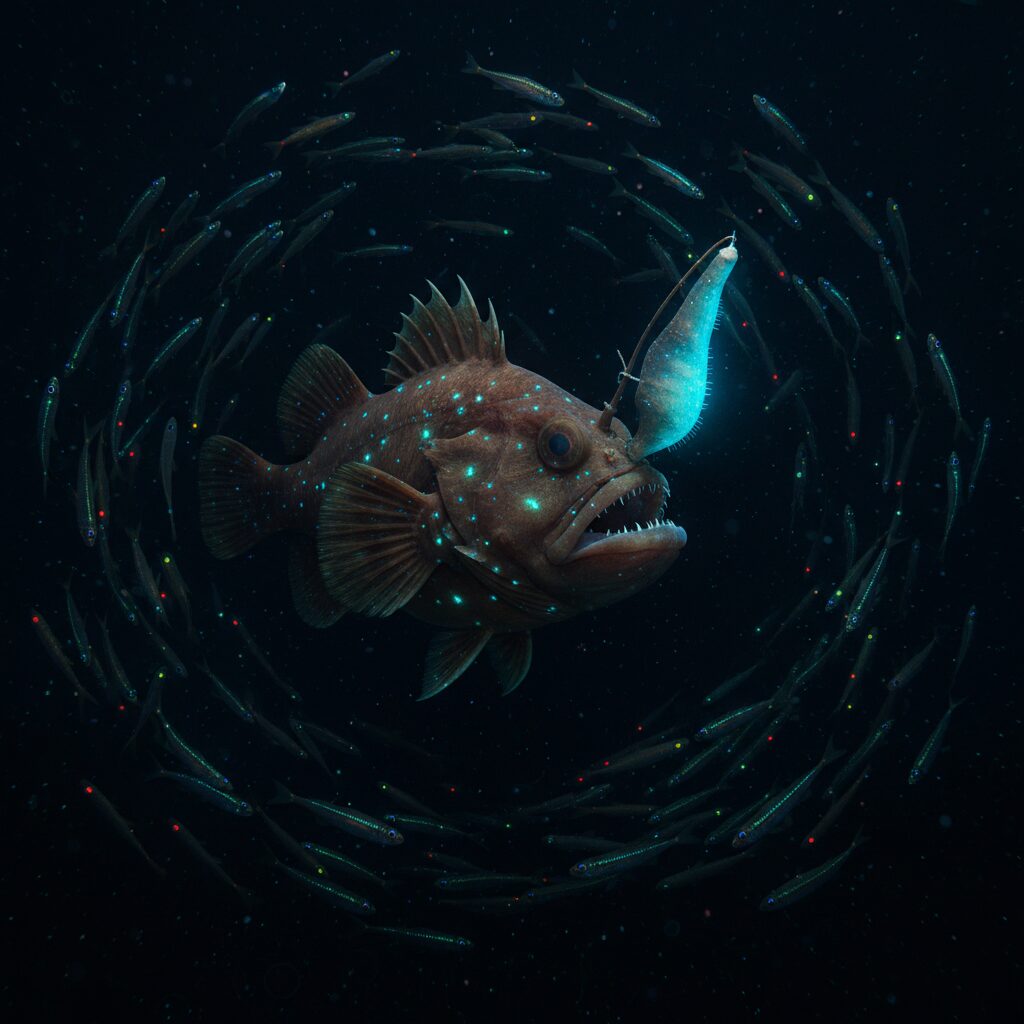
Let’s dive together into the dark depths of the ocean, where sunlight no longer dares to venture. There, in the heart of the abyss, lives a small but exceptional fisherman, the famous lanternfish. With its natural light worthy of an underwater neon show, this marine animal fascinates as much as it intrigues. How does it manage to illuminate itself in this cold and hostile chasm? What strategy does it develop to attract its prey in the almost perpetual darkness? Clearly, this fish is the superstar of abyssal adaptations in terms of bioluminescence and camouflage. The lanternfish, centered on the genus Centroxylene spinulosa, is not content with simply being a deep-sea dweller: it is a true evolutionary marvel, combining biological engineering and survival tactics that would make any strategist green with envy. In 2026, as marine technology provides us with increasingly precise images of the abyssal zones, this animal continues to teach us about life where everything seems impossible. Prepare to meet a creature that literally glows in the night of the deep sea. How does the lanternfish light its way through the deep ocean?Without sunlight, the abyss is a real challenge for animal vision. The lanternfish has therefore developed a rather exceptional lighting system: unlike a simple flashlight, its light source is a chemical super-production thanks to a… bacterial collaboration! Yes, this little fisherman maintains a symbiotic relationship with bioluminescent bacteria nestled in a growth on its head called an illicium. This luminous fishing rod moves and mimics the movements of small prey to attract hungry mammals, fish, and crustaceans. But the magic doesn’t stop there. This bioluminescence It is subtle, adjustable, and its shades of bluish or greenish light can flash or switch off at will. Yes, the lanternfish has mastered the on/off switch better than most of us. This feat serves not only to hypnotize gastropods and small fish, but also to confuse predators it wishes to avoid. Furthermore, this luminous halo allows its fellow lanternfish to orient themselves, a sign that this underwater spectacle is also a form of communication. In short, the lanternfish is the conductor of a luminous ballet, capable of attracting prey like a magnet, while camouflaging itself in the abyssal twilight. For scientists and nature enthusiasts, it is a perfect example of adaptation to life in the deep ocean, where every watt of light is a vital resource. Discover the lanternfish, a fascinating creature of the deep sea that uses its natural light to lure prey into the mysterious depths of the ocean.
Why does the lanternfish have a giant mouth with trap-like teeth? What the lanternfish has in its mouth isn’t just for show; it’s nature’s high-tech marvel! With an oversized head almost as big as its body, it boasts a jaw capable of opening wide enough to swallow prey up to twice its size. Like a deadly trap, its teeth are thin and curved inward toward the mouth. This means that once the victim enters, there’s no way out—a true dental lock.This modus operandi is the perfect illustration of
adaptations
Special abilities are required for hunting in the deep sea. In an environment where food is available intermittently (thanks to marine snow, those particles that fall from the top of the water column), each meal must be a near-perfect catch. The capacity to swallow large prey helps the fish build up significant energy reserves. The watery texture of its flesh and the lightness of its bones (covered with a thin layer of calcium carbonate) make its body very flexible and resistant to the pressure of the abyss. This soft, elastic body is a physiological feat that allows it to withstand harsh conditions—in addition to efficiently digesting large meals in a stomach capable of stretching like a marine accordion. In short, this impressive mouth is an excellent example ofmechanical and
biological adaptation optimized to survive the extreme demands of a deep-sea predator that knows the slightest misstep in feeding can be fatal. In which areas of the abyss do lanternfish hide? Lanternfish are not found on the menu of aquatic tourists. This species primarily inhabits the abyssal zone, an oceanic territory located several hundred or even thousands of meters below the surface, where sunlight is simply impossible to find. The temperature there often ranges from 4 to 10°C, and the hydrostatic pressure is so high it would cause any diver’s carafe to explode.
The lanternfish moves through these hostile depths, adopting two lifestyles depending on the individual: benthic, meaning it rests on the sandy or rocky seabed where it camouflages itself to lay its traps, or pelagic, in adventurer mode, moving freely in the water column. This dual capability demonstrates how well this species has adapted its way of life to the harsh conditions of the abyss. This small, ingenious fish roams the Pacific Ocean, from the coasts of Baja California to the Polynesian archipelago of the Marquesas Islands, and even into the Gulf of California. It has also been caught off the coast of New Guinea and in the Indian Ocean near Mozambique, proving that its underwater lights illuminate far more than just a few corners of the globe. Research on this type of fish remains complicated due to the difficulty of exploring these extreme areas—human divers, even with equipment, are always somewhat out of their depth. Most of the information on the lanternfish therefore comes from occasional catches and remotely operated underwater vehicles. This explains why the lanternfish is still a mysterious king of the deep in 2026. https://www.youtube.com/watch?v=vGZndYypgG4 How does the lanternfish reproduce in the unknown depths? Ah, reproduction, that astonishing chapter of deep-sea life: for a fish evolving in such isolated waters, finding the perfect mate is almost like a treasure hunt. The highly pronounced sexual dimorphism of the lanternfish is a true science fiction scenario. Males are microscopic compared to females, sometimes ten times smaller, and above all, they have a crucial job: locating a female based on chemical and visual signals.Once the famous “meeting” has taken place, the male transforms into a veritable sexual parasite. He bites the female, fuses with her at the tissue level, and gradually loses his autonomy, becoming totally dependent on the female’s bloodstream. Yes, you read that right, he literally becomes an extension of his partner, delegating almost all of his survival to her—an extreme export of “roommate” in the deep sea.This incredible adaptation addresses the spatial dilemma and the scarcity of mates in the deep ocean. By fusing, the female has a lifelong supply of sperm readily available, ready to ensure future egg production. Meanwhile, fertilization itself generally occurs externally, with the eggs and sperm released into the water. This entire process is an incredible display of reproductive adaptation in a world of immense distances.
Ces articles devraient vous plaire

explore the fascinating phenomenon of bioluminescent waves on the beaches
Imagine this natural spectacle where the sea transforms into a living painting, illuminated with a vibrant blue each time the waves caress the shore. The beaches, usually welcoming with their peaceful appearance, metamorphose at night…
https://www.youtube.com/watch?v=Ix5kZ-U4Jvs
Amazing list: What makes the lanternfish extraordinary in the abyss 🌊✨
⚡ Synchronized bioluminescence for hunting, communication, and protection. 🔦 Illicium transformed into an ultra-precise luminous fishing rod to attract prey. 🦈
Curved teeth
curved inwards, a veritable revolving door for its meals. 🧬 Extreme sexual dimorphism with parasitic males fused to females.
Ces articles devraient vous plaire

Learn how the mimosa plant reacts to touch by closing instantly.
When we talk about plants that move, we often think of snails searching for a fresh leaf or creeping vines. But imagine touching a plant and it closing up as if to send you a…
🌡️ Live in cool temperatures around 4°Cand withstand crushing pressures.
🥶 Feeds on “marine snow,”
organic particles that fall from the surface.
Ces articles devraient vous plaire

Did you know that some butterflies can survive extreme temperatures?
Did you think butterflies were just colorful, fluttering ornaments for sunny days, incapable of braving the slightest chill? Think again! Some of these delicate lepidoptera are showing real grit when faced with plummeting temperatures. Between…
🔍 Characteristic
💡 Function 🌊 Adaptation to the deep sea Bioluminescence
Lighting and light lure
Symbiosis with bioluminescent bacteria, adjustable intensityWide mouth and curved teethEfficient prey capturePrevents escape thanks to internal teeth Sexual dimorphism
Ces articles devraient vous plaire

Discover the phenomenon of synchronized firefly migration in Southeast Asia
Among the shimmering mysteries that nature offers us, the synchronized migration of fireflies in Southeast Asia stands out as a spectacle that is both poetic and scientific. Every year, as night falls on the rivers…
Ensures reproduction in a dispersed environment
- Red-black skin with spines Camouflage and protection Blends into the abyssal darkness
- Flexible and lightweight body Resistance to pressure and digestion Promotes survival in extreme environments
- What is bioluminescence in lanternfish? It is the ability to produce light through a chemical reaction thanks to a unique symbiosis with bioluminescent bacteria residing in a special growth called an illicium. How does the lanternfish attract its prey?
- It uses its luminous “hook,” which mimics the movements of marine organisms to lure small fish and crustaceans into its mouth. Why do the males become sexual parasites? In an environment where encounters are rare, the male fuses with the female to ensure a continuous supply of sperm.
- Is this fish dangerous to humans? No, living at extreme depths, this fish is completely harmless and inaccessible for direct human interaction. Can lanternfish be kept in aquariums?
- Be careful not to confuse them: the aquarium lanternfish is a completely different tropical freshwater species, lacking deep-sea bioluminescence.