
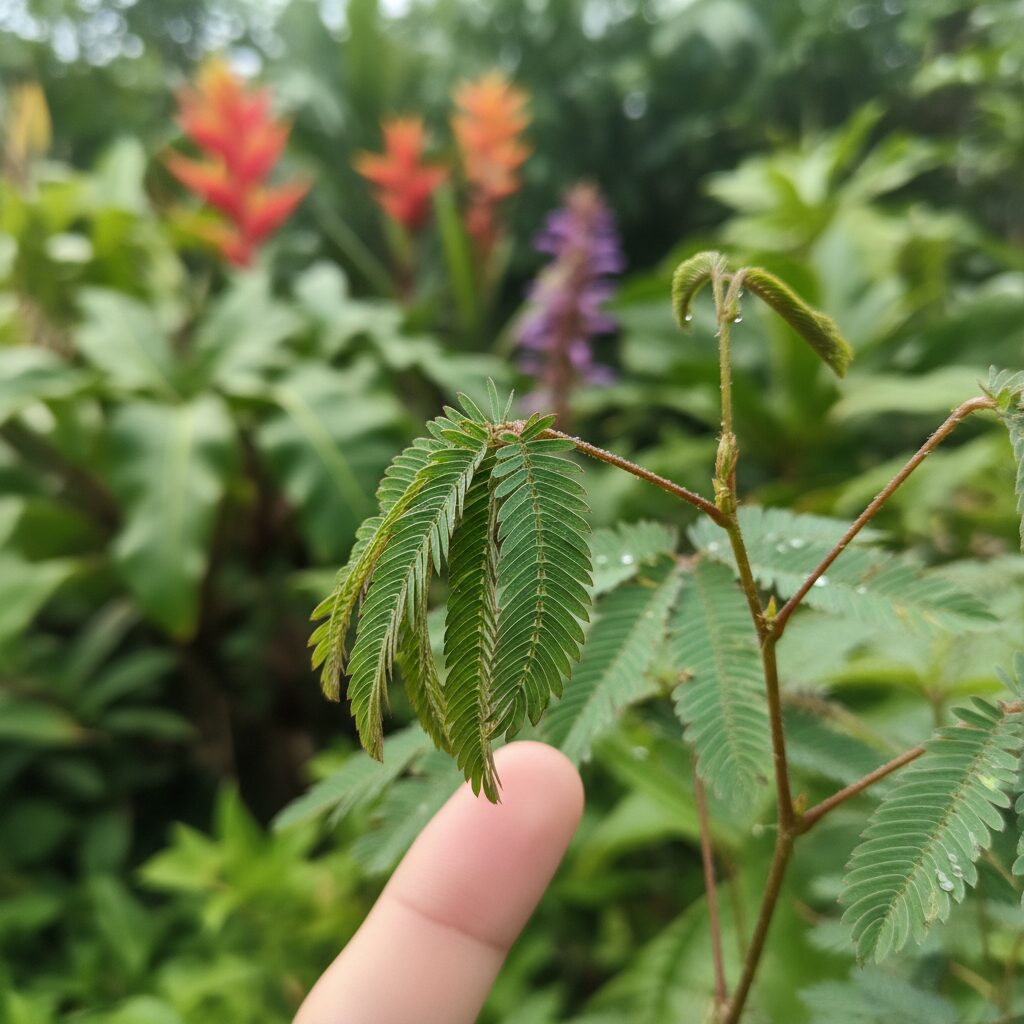
When we talk about plants that move, we often think of snails searching for a fresh leaf or creeping vines. But imagine touching a plant and it closing up as if to send you a clear message: “Hey, don’t touch that!” That’s the magic of the mimosa plant, more specifically Mimosa pudica, also known as the sensitive plant. This little marvel from South America has made responsiveness to touch its botanical superpower. It’s impossible not to notice it when it snaps its leaves shut like a cardboard box in front of you, in a fraction of a second. It’s not just a simple trick, but a genuine defense mechanism. Why? How? Spoiler alert: it’s not black magic, but plant biology. So hold on tight, because this sensitive plant story is going to shake up your view of plants. If you thought plants were phlegmatic, you’re about to change your mind. The mimosa pudica defies logic by instantly closing its leaves at the slightest touch, a phenomenon known as thigmonasty to those familiar with scientific jargon. And it doesn’t stop there: this sensitive plant doesn’t just react to touch, it also adapts to the whims of wind and temperature. A true botanical ninja! This reaction may seem trivial, but it contains a serious evolutionary strategy. So, ready to understand why the mimosa plant is the star of sensitive plants that love to play hide-and-seek with their enemies?
How does the mimosa pudica plant perceive touch and close its leaves instantly?
Imagine the mimosa plant as a team of tiny sensors, hypersensitive to the slightest touch. Each leaf of this sensitive plant is composed of leaflets, these miniature leaves that come together to form the complete leaf. At the base of these leaflets and the leaves themselves, there are small pockets filled with water.
When you touch a leaf, an almost instantaneous electrical signal travels through the plant, triggering a fascinating mechanism: the water contained in these pockets is released to other parts of the plant. This movement of water causes a temporary contraction of the motor cells (yes, plants have muscles too, but in a plant version), and bam, the leaves fold up in no time. As if they were doing a collective facepalm to say, “Oops, we’ve been touched!” This phenomenon is a perfect example of thigmonasty, a scientific term that describes movements resulting from a tactile stimulus.
This reaction occurs in a matter of seconds (often 3 to 4 seconds), an impressive timeframe considering that most plants move at a snail’s pace. This system also works for slightly more subtle stimuli, such as a breeze or heat, indicating that the sensitive plant is a true queen of sensitive plants!
But be warned, this is not a simple automatic reflex. This electrical signal shared by the plant uses a flow of ions, notably potassium and chloride, which modifies the turgor pressure in the cells. And the dehydration of these motor cells changes the rigidity of the leaves. The sensitive plant is therefore a truly sophisticated biochemical machine that incorporates genuine internal communication to react to the world around it.
The role of electrical impulses in the movement of sensitive plants
Electrical signals aren’t unique to humans and animals. The mimosa pudica demonstrates that plants, too, possess an effective means of internal communication. When the plant is touched, the electrical impulse travels rapidly through its tissues, triggering water evaporation in specific cells. Like a rudimentary nervous system, this intraplant communication transforms a simple touch into a swift and visible movement.
Ces articles devraient vous plaire

Did you know that some butterflies can survive extreme temperatures?
Did you think butterflies were just colorful, fluttering ornaments for sunny days, incapable of braving the slightest chill? Think again! Some of these delicate lepidoptera are showing real grit when faced with plummeting temperatures. Between…
This sophisticated system is somewhat reminiscent of the speed with which our own nervous system sends signals, except that the plant uses ions rather than neurons. It’s a unique process that fascinates biologists because it adds a whole new dimension to plant biology.
Discover how the mimosa plant reacts to touch by instantly closing its leaves. Learn about the fascinating mechanisms behind this rapid and surprising reaction.
Why does the mimosa plant use instant closure as a defense mechanism? Make no mistake, the instant closure of the mimosa pudica is not a whim of a plant celebrity but a true art of survival. This sensitive plant has developed this defense mechanism to escape herbivores and insects that would see its leaves as an appetizing treat. By folding its leaves, it becomes much less attractive, resembling a simple, grumpy stem or a harmless object.
Researchers have observed that grazing animals, disappointed by the sudden disappearance of their feast, are likely to look elsewhere. The mimosa, therefore, relies on surprise and the “I’m not edible” effect to keep its precious foliage intact. As a bonus, closing its leaves reduces the exposed surface area, which can also help limit water loss and lessen damage caused by heavy rain or strong winds. Clever, isn’t it, this sensitive plant!
Here again, this rapid reaction forms a temporary physical barrier, giving the plant an extra chance to protect itself against external threats. This process is part of the incredible adaptive strategies developed by the plant kingdom to survive the vagaries of the wild.
To illustrate this, imagine a mimosa in the middle of a meadow, which comes to life as soon as an insect’s foot lands on it. If the insect isn’t wary, the plant’s sudden reaction can either frustrate it or alert it, thus saving the plant from an impromptu nibbling session.
Ces articles devraient vous plaire
Discover why geckos can walk on ceilings without falling
Whether at home or deep in the tropical jungle, the gecko is a true little acrobat, defying gravity with astonishing skill. This lizard, capable of walking on walls, climbing smooth surfaces, and even strolling upside…
Because nothing is perfect, the sensitive plant doesn’t always close its leaves in response to every stimulus. The intensity and repetition of contact play a role. If the touch is too light or too quick, the plant may not react. Furthermore, when the mimosa is stressed or weakened, its response becomes less dramatic.
Moreover, closing the leaves is energy-intensive. Even for a plant, making the “snap” of closure requires some effort and resources. The mimosa therefore chooses when to expend this energy to be ready for a real threat, and sometimes lets a discreet tickle go unnoticed.
https://www.youtube.com/watch?v=Fl-3lpYXnYg What are the ideal conditions for growing sensitive plant mimosa at home?
Do you dream of having your own Mimosa pudica plant at home to play at being a budding botanist and impress the family? Be aware that this sensitive plant has its quirks, especially when it comes to climate. Native to the warm regions of Central America, it thrives when given a cozy haven with a stable temperature.
- It prefers an environment where the temperature fluctuates between 18°C and 24°C, never dropping below 15°C, as this is its cold tolerance threshold. As soon as the thermometer dips, it sends its leaves into “winter closure” mode, and there’s no changing its mind.
- Also, the plant likes a humid atmosphere and bright light without direct sunlight. Too much sun risks burning it, which would ruin its beautiful display of instant closure. As for watering, it’s quite thirsty: keep the soil slightly moist but not waterlogged, otherwise, you’ll end up with a recipe for root rot. In short, a well-lit spot in the garden, but not in direct sunlight, a pot with good drainage, regular watering, and there you have it! You’ll have a thriving Mimosa pudica ready to dazzle you with its touch.
- Practical tips for optimal care of your sensitive plant:
Ces articles devraient vous plaire

Explore the secrets of the spectacled snake, a creature of the Indonesian jungle
While the Indonesian jungle is already an incredible playground for any budding adventurer, it boasts an unexpected reptilian star: the spectacled snake. This mysterious creature, often seen displaying its famous ornamental “headband,” does more than…
🌿 Use a well-draining, aerated potting mix to avoid overwatering.
💡 Place the plant in indirect light, away from direct, scorching sun.
💧 Water regularly, keeping the soil slightly moist.
| 🔥 Maintain a temperature between 18 and 24°C (64 and 75°F). | 🌀 Mist the leaves with water to simulate tropical humidity. | |
|---|---|---|
| ❌ Avoid pesticides; the plant is very sensitive to chemicals. | ||
| What are the biological and medicinal secrets of Mimosa pudica? | Already fascinating for its behavior, the mimosa pudica plant also holds a treasure trove in its chemical composition. This plant contains several bioactive compounds such as tannins, flavonoids, alkaloids, and the famous mimosine, a toxic component but also the subject of much medical research. | |
| In traditional medicine, particularly in Africa, mimosa pudica is used for its sedative, diuretic, and anticonvulsant properties. Yes, this plant, which folds its leaves when you tease it, could very well calm epileptic seizures or help manage anxiety! | Modern studies show that these chemical compounds interact with the human biological system, offering promising therapeutic potential. But caution is advised, as mimosine is toxic in high doses. Don’t assume that this plant is a risk-free panacea. | |
| In short, mimosa pudica is both a star among plants sensitive to touch and an interesting candidate for herbal pharmacology. This dual nature is attracting the interest of botanists and medical researchers alike. Table of biological compounds and their effects in the Mimosa pudica plant | 🌿 Compound | 🔍 Biological effect |
Tannins
Astringent, antibacterial, and protective properties
Used in traditional medicine
Alkaloids
Sedative and neuroprotective effects
May influence the nervous system
Flavonoids
Powerful antioxidants and anti-inflammatories
Ces articles devraient vous plaire

Discover the phenomenon of synchronized firefly migration in Southeast Asia
Among the shimmering mysteries that nature offers us, the synchronized migration of fireflies in Southeast Asia stands out as a spectacle that is both poetic and scientific. Every year, as night falls on the rivers…