
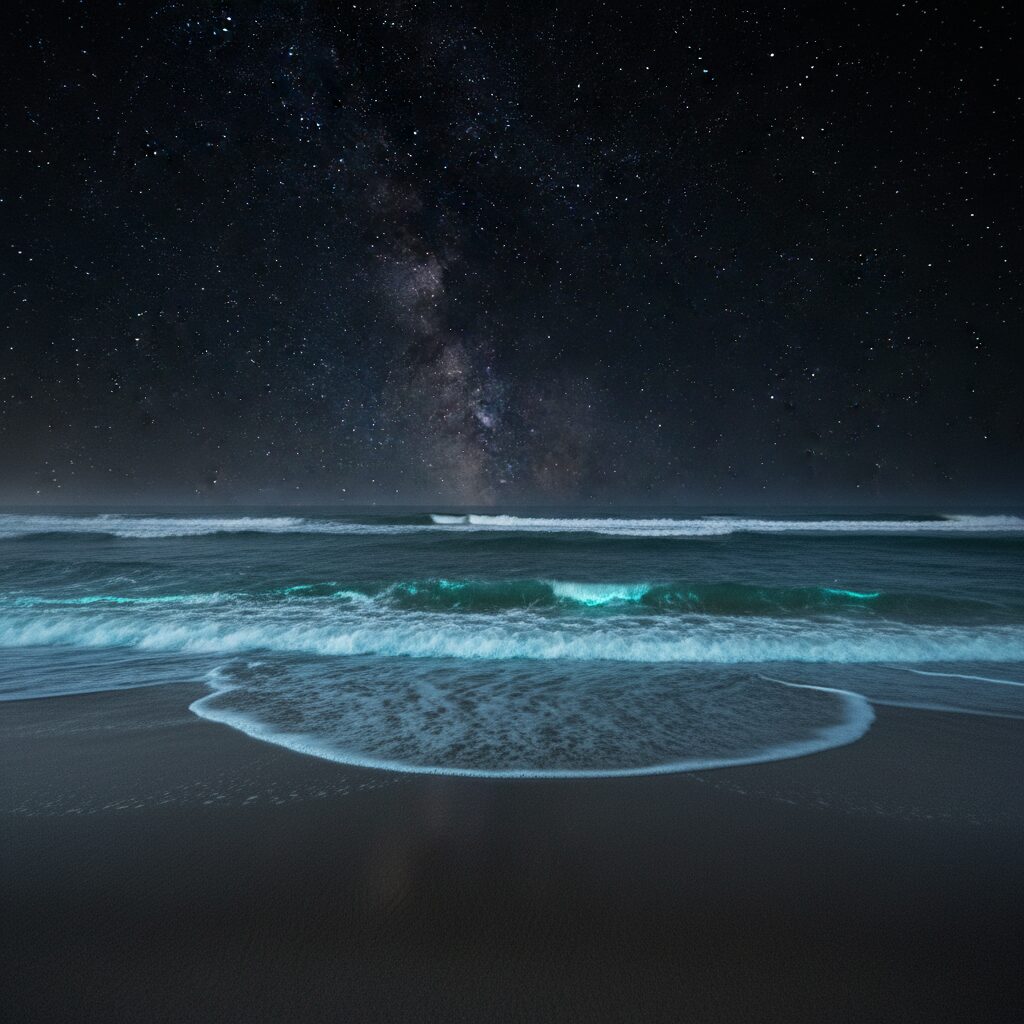
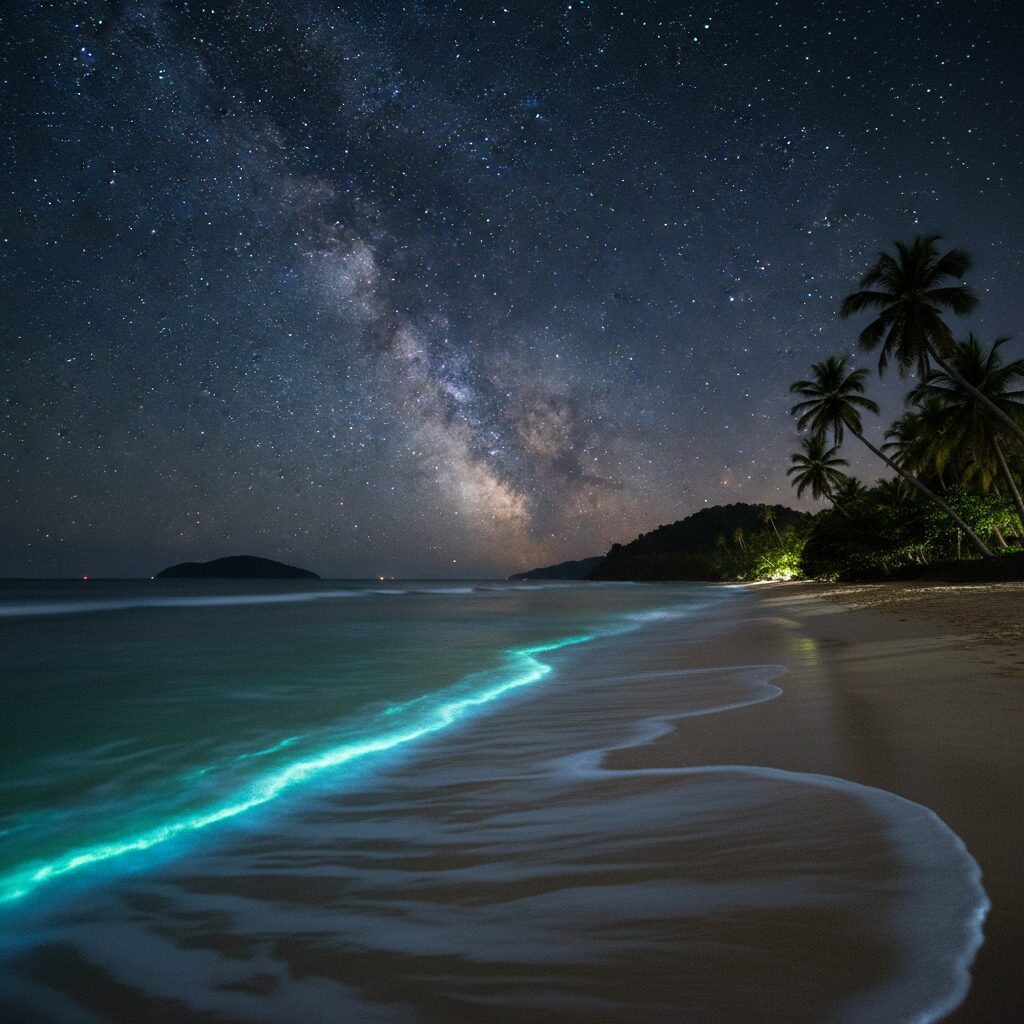
Imagine this natural spectacle where the sea transforms into a living painting, illuminated with a vibrant blue each time the waves caress the shore. The beaches, usually welcoming with their peaceful appearance, metamorphose at night into a magical theater thanks to the fascinating phenomenon of bioluminescent waves. This gentle luminous magic is not a trick or an urban art installation, but a natural phenomenon of marine organisms as tiny as they are exceptional. Attention all curious minds and dreamers seeking nocturnal wonder: marine bioluminescence is an invitation to observe the ocean differently, to immerse oneself in a marine ecosystem where light reigns supreme, even in total darkness. Many beaches around the world bear witness to this luminous dance, but it is especially when the night is dark, the moon absent or hidden, that the sea adorns itself with its most beautiful effects. Bioluminescent waves thus have the power to enchant our nighttime strolls, transforming a few meters of shoreline into a breathtaking visual spectacle. This natural phenomenon invites us to wonder about these bioluminescent marine organisms which, although tiny, play a key role in the marine ecosystem. Why do some marine organisms begin to glow like little lanterns under the stars? Bioluminescence is much more than a pretty show; it is a vital mechanism, an evolutionary response with its mysteries and surprising scientific explanations.
Why do these bioluminescent waves actually glow in the dark?
First, it’s important to understand that we’re not talking about a lamp that plugs into an outlet, but about light-producing marine organisms capable of a captivating little biochemical revolution called bioluminescence. This chemical reaction releases energy in the form of visible light, often in shades of blue or green—blue being the star, of course. This magic happens thanks to a molecule called luciferin, which, when it comes into contact with the enzyme luciferase, produces this intense light when excited. The waves, as they move, create a luminous awakening in these microorganisms, causing the famous glow that the lucky beachgoer or nighttime adventurer can admire. A true natural fireworks display! 🌊💡 This fascinating biochemical process is mainly linked to certain types of phytoplankton and dinoflagellates, such as the species Noctiluca scintillans, often responsible for the bioluminescence observed on several beaches, particularly in the Bay of Biscay. But they aren’t the only stars of this luminous spectacle: certain bacteria and marine jellyfish also play leading roles. For example, amateur photographer Maxime Daviron couldn’t believe his eyes when, in the middle of the night of May 18-19, he observed this phosphorescent blue on the beaches of Vielle-Saint-Girons in the Landes region, while testing his skills at capturing nighttime thunderstorms. This display lasted for about two hours, offering a rare moment combining raging lightning and a shimmering sea. It’s impressive how nature can surprise us in the most unexpected places.
But then, why do bioluminescent waves often prefer darkness to show off? Because this light in the night serves as their secret weapon! Whether to defend their microcosm—imagine a sea of living light bulbs feeling guilty about being eaten—or to attract their companions, bioluminescence acts like an SOS in the middle of a swell. A kind of panic signal that would make even the smallest car warning light flicker. If you want to understand the mystery behind this luminous ballet without the slightest trace of visible animal life, this article tells you even more about this astonishing absence of animals around.
Discover the magic of bioluminescent waves, a spectacular natural phenomenon that illuminates beaches at night, offering a fascinating and unforgettable spectacle. Where and when can you experience the best nighttime show of bioluminescent beaches?Want to see this natural phenomenon that doesn’t reveal itself to just anyone? Don’t imagine you can just pull out your swimsuit and snorkel at any beach on a summer evening. Bioluminescent waves require a very specific combination: particular marine conditions, adequate nighttime lighting, and above all, abundant marine flora. Fortunately for enthusiasts, certain spots around the world clearly have a monopoly on this phosphorescent spectacle. For example, Toyama Bay in Japan transforms into a magical scene from March to June, where millions of firefly squid dance and illuminate the waters in rhythm with their reproduction. In Taiwan, the “Blue Tears” make the waters sparkle between April and September thanks to dinoflagellates, especially when the moon is less visible.
Ces articles devraient vous plaire
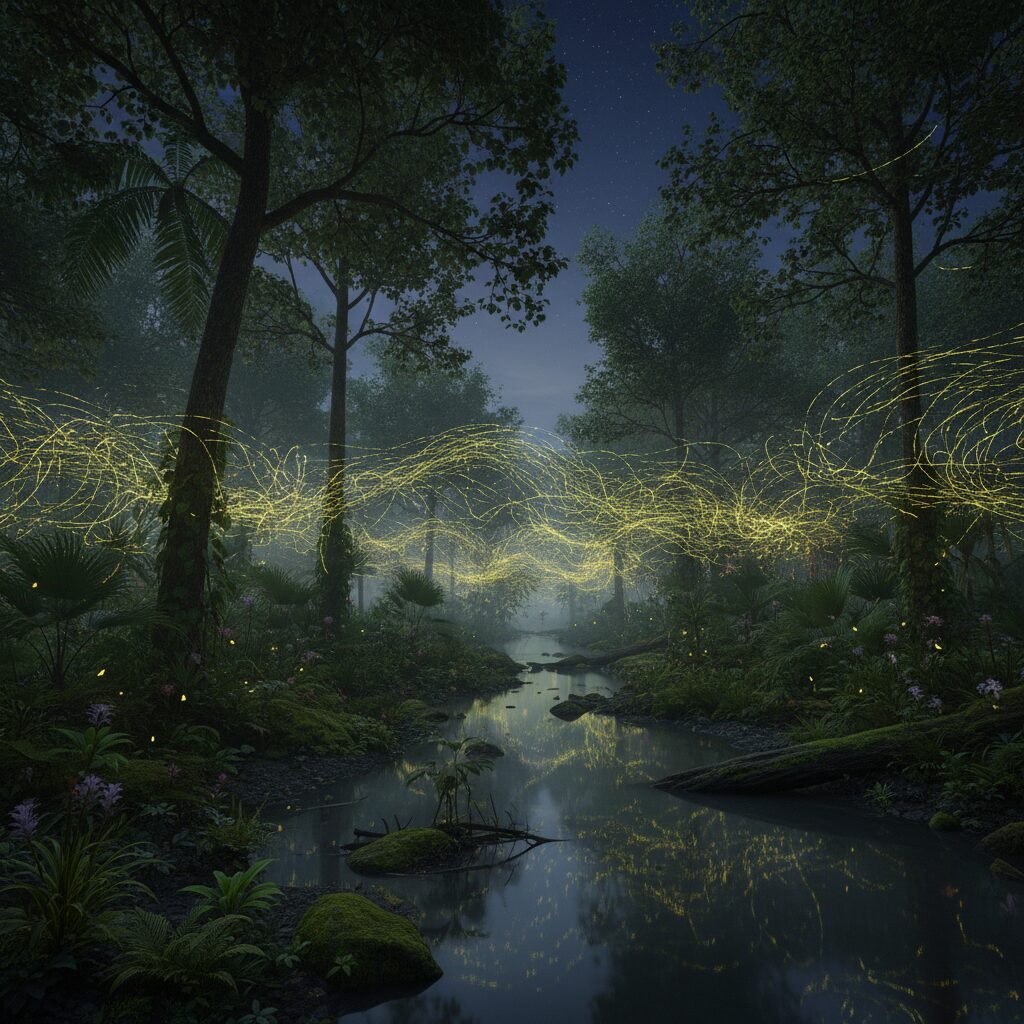
Discover the phenomenon of synchronized firefly migration in Southeast Asia
Among the shimmering mysteries that nature offers us, the synchronized migration of fireflies in Southeast Asia stands out as a spectacle that is both poetic and scientific. Every year, as night falls on the rivers…
✨ Toyama Bay (Japan)
– Best time: March to June
🌊 “Blue Tears” of Taiwan
– Special summer and moonless nights (April-September)
- 🌟 Vaadhoo Beach, Maldives – June to October, perfect for a bioluminescent swim 🚣♂️
- Maya Bay, Thailand – Magical nights from November to April, kayaking recommended 🌌 Mosquito Bay Lagoon, Puerto Rico
- – Bright all year round, peak December-April https://www.youtube.com/watch?v=V_BA3ma6EEw How do these marine organisms influence the nocturnal marine ecosystem? If bioluminescence fascinates your inner child-citizen-of-the-planet, it also plays a vital role in the marine ecosystem. These bioluminescent waves aren’t just there to look pretty at night or amaze tourists looking for an Instagram photo—although they do help to make Snapchat stories look dazzling. In fact, the marine organisms that produce this light play a crucial role in the marine food chain and the health of the oceans. Bioluminescent dinoflagellates, like Noctiluca scintillans, are a type of phytoplankton that provides food for a whole fleet of marine inhabitants, from micro-crustaceans to larger fish. By glowing in the night, they also trigger a reaction in predators and prey, making visible what might otherwise remain hidden beneath the dark waters.
- However, too much light, even natural light, can also be a sign of imbalance—the infamous phytoplankton bloom, which sometimes spirals out of control and ends up disrupting the ecosystem. This type of proliferation can create dead zones and oxygen deficiencies, threatening biodiversity. Monitoring these phenomena therefore remains a major ecological challenge, a true barometer of ocean health, with scientists carefully studying bioluminescent waves in search of early warning signs.
- A summary table of key interactions of bioluminescence in the marine ecosystem: 🔬 Organism 💡 Luminous role
Ces articles devraient vous plaire
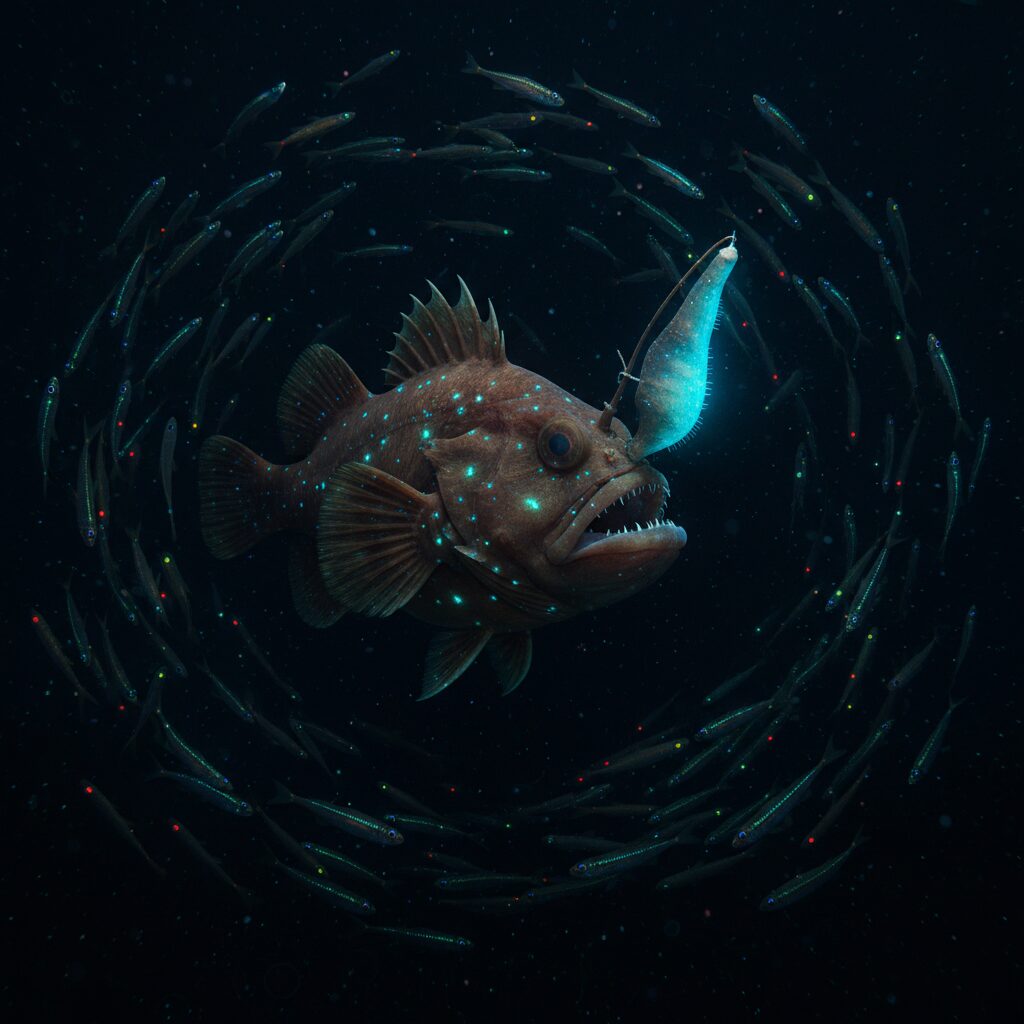
Meet the lanternfish, an animal of the deep sea that lights up to attract its prey.
Let’s dive together into the dark depths of the ocean, where sunlight no longer dares to venture. There, in the heart of the abyss, lives a small but exceptional fisherman, the famous lanternfish. With its…
⚠️ Associated risks
Noctiluca scintillans
Produces an intense blue light when disturbed
Food for zooplankton and nocturnal fish
| Blooms cause oxygen depletion, disrupting fauna | Fireworm squid | Illuminate for reproduction | Maintain the balance of marine populations |
|---|---|---|---|
| Vulnerability to predators when illuminated | Bioluminescent bacteria | Attract or repel predators | Participate in the biological cycle in the marine environment |
| Minor effect except in cases of local proliferation | https://www.youtube.com/watch?v=6WkOw9veG60 | What are the tips for observing bioluminescent waves without disrupting the balance? | Observing bioluminescence remains a privilege, but to enjoy it without turning the beach into a hellish disco, a few golden rules are essential. First, choose moonless nights, otherwise all this natural light is swallowed up by the moonlight, a kind of camel that refuses to share its light. Second, be mindful of the sensitivity of this marine ecosystem: forget sunscreens loaded with chemicals or insect repellents that pollute more than your summer playlist. And of course, leave cigarette butts and other traces of human activity behind on your phosphorescent path. |
| It is also advisable to use local guides or responsible operators who know the area and are committed to preserving this nocturnal wonder. Respecting the abstract conditions of the environment is paramount, especially since excessive disturbance could ruin the spectacle and the balance of these luminous microcosms. Finally, for tech enthusiasts, avoid over-illuminating with your smartphone: the intense white light extinguishes the bioluminescent effect, and it spoils the mood. | Because observing these bioluminescent waves without respect is like going to a concert and shouting louder than the music: it disturbs everyone. For those who want to learn more about phosphorescent phenomena on beaches, here is a very informative and useful link. | What mysteries still remain about marine bioluminescence? | While science has made significant progress in understanding bioluminescent waves, several questions still linger over these luminous waters. For example, why is this phenomenon so rare on many beaches, given that the microorganisms responsible are often present in small numbers? How do climate changes impact these populations, which are essential for maintaining the ocean’s balance? And what about the temporal and spatial variations that make bioluminescence as unpredictable as an underground festival spot? Areas of exploration remain open for marine biologists to investigate how light pollution, changes in ocean temperature, and human activities alter this fragile natural balance. For now, one thing is certain: encountering a beach illuminated by bioluminescent waves remains a magical moment, one of the small miracles that nature still offers us, even in a world often saturated by screens and noise. Discover how bioluminescence can illuminate your nighttime walks and much more by exploring our other articles on natural phenomena and the amazing marine luminescence. |
Ces articles devraient vous plaire
Learn how the mimosa plant reacts to touch by closing instantly.
When we talk about plants that move, we often think of snails searching for a fresh leaf or creeping vines. But imagine touching a plant and it closing up as if to send you a…
What exactly is marine bioluminescence?
It’s the ability of certain marine organisms, such as phytoplankton and dinoflagellates, to produce light through a natural chemical reaction, primarily in blue or green.
Why is bioluminescence most noticeable at night?
Because natural sunlight or moonlight masks the phosphorescent effect, bioluminescence is therefore more visible in the dark, especially on moonless or cloudy nights. Can you see bioluminescent waves in France? Yes, although this phenomenon is rare, it has been observed on some beaches in the Landes, Loire-Atlantique, and Vendée regions. An excellent reason to take out your nighttime flashlight! How can you respect the marine ecosystem when observing it? Avoid chemical sunscreens, do not litter, choose moonless nights, and follow the recommendations of local guides to avoid disturbing the bioluminescent organisms.
Ces articles devraient vous plaire
Discover why geckos can walk on ceilings without falling
Whether at home or deep in the tropical jungle, the gecko is a true little acrobat, defying gravity with astonishing skill. This lizard, capable of walking on walls, climbing smooth surfaces, and even strolling upside…
Do bioluminescent waves serve any purpose?
Yes, this light can serve as a defense against predators, for communication, or to attract mates for reproduction. It’s a fascinating natural evolutionary mechanism.