
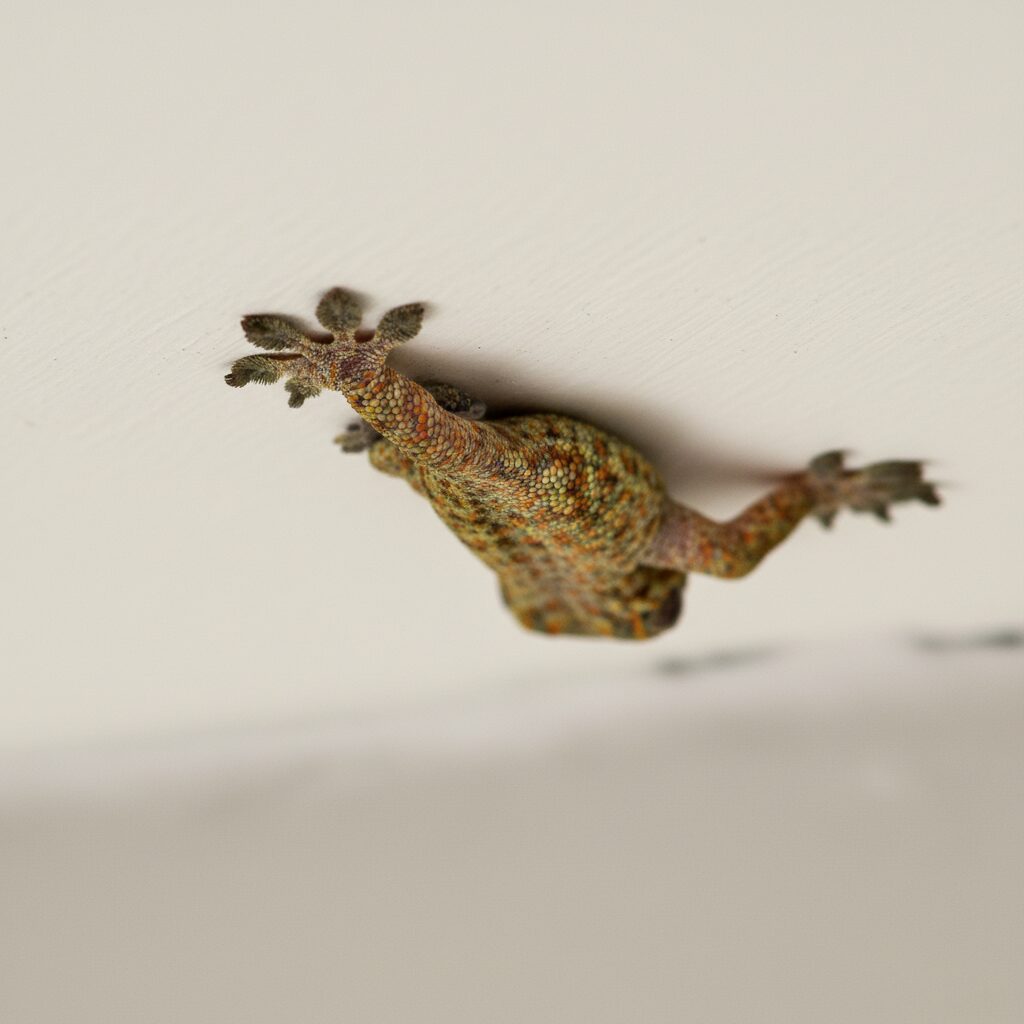
Whether at home or deep in the tropical jungle, the gecko is a true little acrobat, defying gravity with astonishing skill. This lizard, capable of walking on walls, climbing smooth surfaces, and even strolling upside down on ceilings, never ceases to fascinate. But how on earth does it manage to stay stuck without ending up a spectacular, albeit wobbly, glide to the ground? The answer lies neither in a magic secret nor in super-sticky chewing gum, but in fascinating microscopic engineering that combines physical forces, unique anatomy, and a touch of fat – yes, even the gecko needs a little extra help. Between the tiny hairs on its feet and atomic interactions, nature has created an unparalleled grip, which is already inspiring wild innovations in biomimicry, from “gecko gloves” to climbing robots. Get ready to discover the secret behind this natural feat, because hold on tight, it’s high-flying science!
How do geckos stay upright on smooth surfaces like ceilings without falling? Look at a gecko under a microscope—you don’t even need a giant superhero magnifying glass, an ordinary microscope will do—and you’ll discover an astonishing sight: millions of microscopic hairs on its feet. These tiny hairs, called setulae, aren’t just there for decoration. Each setula is like a super-thin thread that branches out even further to form comb-like structures called spatulas at their tips. Imagine the spatulas as a tiny army of adhesives at the microscopic level, gently sticking to the ceiling surface. But the craziest thing is that this adhesion doesn’t come from some weird glue-based sticky substance or reptilian magic. No. It’s Van der Waals force.which plays the main role. For those who have forgotten their physics lessons (don’t panic, we’re here to have fun and learn), these forces are ultra-weak electromagnetic interactions between the electrons in the molecules of the setae and those of the ceiling. Individually, these forces are ridiculously weak, but multiplied by millions, they form a grip powerful enough to support a lizard, its belly, its tail, and its expert climbing ego. This explains why geckos can calmly walk around even upside down without gravity playing tricks on them. Where it gets even more technical and badass is in the way the gecko masters its grip. It doesn’t stay stuck forever like a sticker under you when you change your mind, but it knows how to release the pressure with each step. How? By changing the angle of its setae. This small surgical-mechanical adjustment gently lifts its foot to move forward. Pure natural ingenuity that offers dreamlike adhesion and mobility, all without leaving a trace or wearing out prematurely. It puts even the best lab adhesives to shame, and probably your last poorly cut piece of tape. Setules and spatulas: where size matters more than strength. To give you an idea, each spatula is about 200 nanometers wide. Yes, nanometers. If you don’t know what that means, just think of it as 10,000 times smaller than a human hair. That gives you an idea of the precision and finesse of this system. Thanks to this incredible density, several hundred thousand, or even millions, of spatulas can make close contact with the surface of a wall or ceiling, significantly increasing adhesion.Beyond the simple “fringe,” there’s a very thin lipid layer—barely a nanometer thick—covering these footpads. You might be wondering why the gecko has a kind of microscopic fat on its feet? This lipid layer is essential for repelling water. Imagine trying to climb a wet ceiling: a real slippery challenge! Thanks to this thin layer of lipids, the gecko prevents moisture from seeping between its footpads and the surface. No more slips, no more falls, just incredible grip on any surface, even wet ones. Discover the fascinating secrets of the gecko and understand how it can walk on ceilings without falling thanks to its unique feet. How did some slightly crazy researchers unlock this secret using the synchrotron?
The mystery of the gecko’s sticky feet didn’t wait until 2025 to pique the curiosity of the scientific community. Researchers at the National Institute of Standards and Technology in the United States have pushed their investigation beyond the limits of classical microscopy, using a tool straight out of science fiction: the synchrotron. This unusual name refers to a particle accelerator capable of generating ultra-powerful X-rays, allowing visualization of molecular composition at such fine resolution that one could almost count the electrons. With this instrument, they observed a structure far more complex and interesting than what optical microscopes could reveal. The synchrotron enabled them to detect not only the perfect arrangement of the setae, but also that crucial layer of tiny lipids that plays a key role in adhesion to wet surfaces. These discoveries open up incredible technological avenues, where simply observing the gecko could revolutionize our understanding of biomimicry. Scientists are already imagining “gecko gloves” to grasp wet objects without dropping them, or robots capable of running along walls like this lizard, as agile as a ninja. Imagine shoes that prevent you from slipping in the rain, directly inspired by those tiny sticky hairs. The gecko has thus offered a lesson in natural ingenuity that aligns with the frantic race for miniaturization and functionality in modern science. And spoiler alert: studying geckos isn’t just an environmentalist fad, because these advances could soon impact your daily life, from sports to innovative industrial technologies.
https://www.youtube.com/watch?v=nLwu6D_om-8 The unexpected applications of the gecko’s natural grip Biomimicry isn’t just blindly copying nature; it’s about understanding it deeply to create truly cool inventions. Here are some concrete examples currently under development thanks to in-depth studies of gecko grip:🧤 Gecko gloves : for surgeons or mechanics, offering perfect grip on oily or wet surfaces.
🚀
Climbing robots
Ces articles devraient vous plaire
Learn how the mimosa plant reacts to touch by closing instantly.
When we talk about plants that move, we often think of snails searching for a fresh leaf or creeping vines. But imagine touching a plant and it closing up as if to send you a…
👟 Anti-slip boots: inspired by gecko feet, ideal for hiking in rain or snow.
📦 Revolutionary adhesive tapes
: infinitely reusable without losing their effectiveness, and leaving no sticky residue. These innovations are challenging preconceived notions about grip and adhesion, making equipment more durable and functional without the use of harsh chemical glues.Why is the gecko considered a model of endurance when it comes to grip?
The amazing thing is that even after thousands of climbs, descents, slides, and other acrobatics on your white walls, the gecko’s feet show virtually no signs of wear. How is that possible? The explanation lies in the very structure of the hairs that make up its setae. A previous study revealed that the keratin fibers, the main proteins that form these hairs, are oriented in the direction of flexion. This evolutionary choice drastically limits abrasion from friction on hard surfaces, while preserving its grip. The gecko therefore has a foot that is both robust and lightweight, capable of withstanding intensive use without needing to recharge its natural adhesive. Basically, feet that wouldn’t wear out even if this little lizard became the new star of urban parkour. Enough to make most high-tech gadgets pale in comparison, gadgets that break down after just a few hours of use.
grip fidelity
and longevity of the natural materialis a true revolution, which has also led to the commercialization of several adhesive tapes that leave no residue. The gecko actually teaches us a double lesson: how to adhere firmly while knowing when to detach, and how to last without losing effectiveness.
- The microscopic secrets of gecko feet finally revealed Diving into the almost invisible world of gecko feet is a bit like discovering a micro-city full of molecular engineering. Thanks to advances in imaging technologies such as synchrotron and electron microscopy, the detail of the millions of hairs present now offers an unprecedented understanding ofhow these ingenious animals cling so effectively to the ground, wet surfaces, and even bedroom ceilings.
- Adding to the technical features is something akin to skincare or preparation: a thin lipid layer that acts much like a high-tech moisturizer. This layer plays a protective and functional role by repelling moisture and reducing friction. This perfect combination makes their grip more versatile, effective even in wet conditions, whereas you’d already be struggling on a simple wet floor. And as if that weren’t enough, the geckos’ spatulae can subtly change their angle of attack to release or activate their grip in rhythm with their gait, allowing for an ultra-responsive landing on the ceiling, like a circus act. It’s a super high-tech adhesion system, the result of a spectacular evolution, as impressive as watching an Olympic athlete dominate their sport. 🌟 Key Element
- 🔍 Description 🐾 RoleHairs (Setulae)
- Microscopic, very fine keratin fibers Increase the contact surfaceSpatulae
Comb-shaped tips of the setulae Create Van der Waals forces with the surface Lipid Layer
Ces articles devraient vous plaire

Explore the secrets of the spectacled snake, a creature of the Indonesian jungle
While the Indonesian jungle is already an incredible playground for any budding adventurer, it boasts an unexpected reptilian star: the spectacled snake. This mysterious creature, often seen displaying its famous ornamental “headband,” does more than…
Thin film of nanometric fat
Repels water and allows adhesion to wet surfaces
Fiber Orientation
Alignment of keratin fibers along the setulae Wear resistance and flexibility To delve even deeper into this fascinating world of natural adhesion, don’t hesitate to discover how another, much more flightless lizard conquers the skies without wings – nature is a true cabinet of curiosities that inspires at every moment.
Ces articles devraient vous plaire
Did you know that some butterflies can survive extreme temperatures?
Did you think butterflies were just colorful, fluttering ornaments for sunny days, incapable of braving the slightest chill? Think again! Some of these delicate lepidoptera are showing real grit when faced with plummeting temperatures. Between…
https://www.youtube.com/watch?v=OZI_711SQiY How can geckos walk on wet surfaces without slipping? The spatulae of geckos are covered with a thin lipid layer that repels water, allowing them to maintain effective grip even on wet surfaces.
Why don’t geckos leave any traces of their adhesion on ceilings? Their adhesion is due to Van der Waals forces, which, unlike traditional chemical glues, leave no sticky residue. Can we draw inspiration from geckos for technological applications?
Yes, biomimicry projects are underway to create gloves, robots, and shoes inspired by the gecko’s natural adhesive system. How does a gecko detach its feet without completely falling off? By changing the angle of its setae (seatules), the gecko gradually detaches its feet to move forward without losing its grip.
| Why don’t the hairs on a gecko’s feet wear out despite friction? | The keratin fibers that make up the hairs are aligned in such a way as to limit wear from friction on hard surfaces. | |
|---|---|---|
Ces articles devraient vous plaire

Discover the phenomenon of synchronized firefly migration in Southeast Asia
Among the shimmering mysteries that nature offers us, the synchronized migration of fireflies in Southeast Asia stands out as a spectacle that is both poetic and scientific. Every year, as night falls on the rivers…