
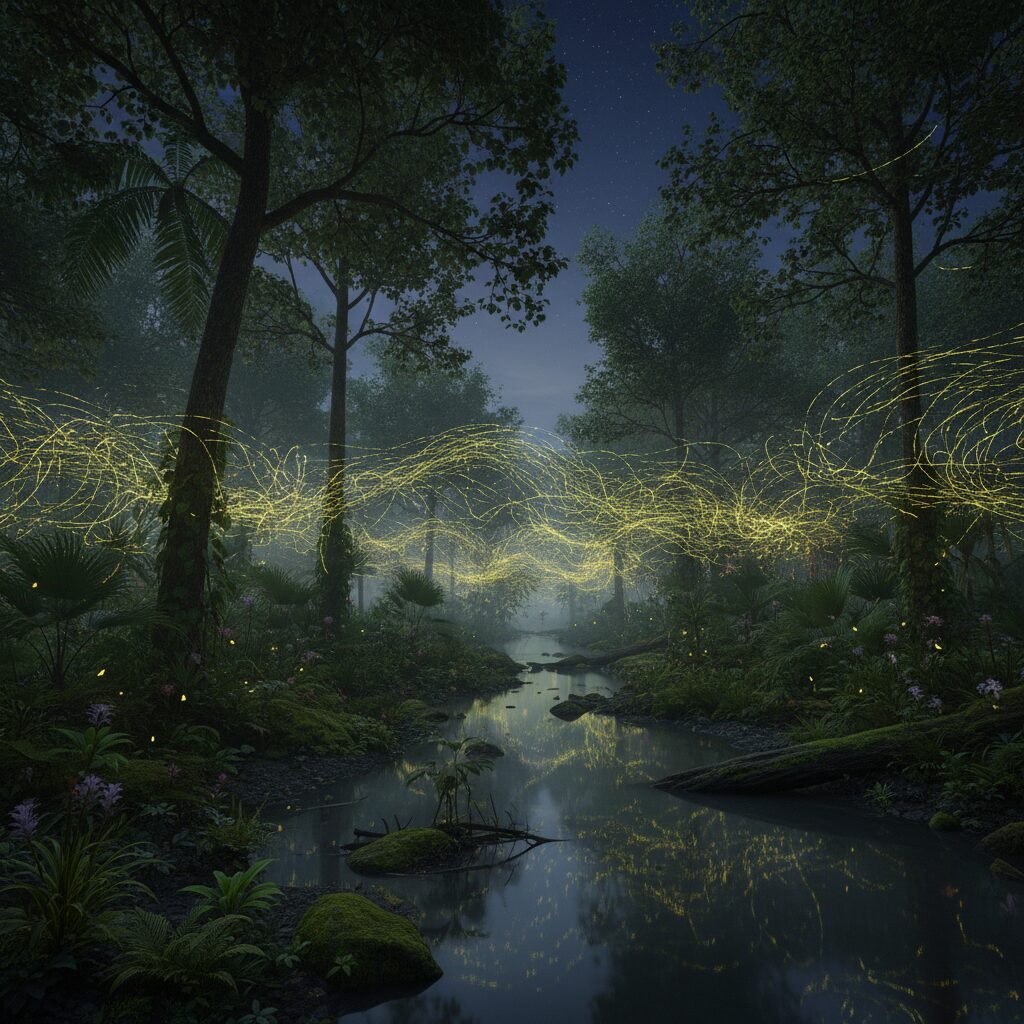
Among the shimmering mysteries that nature offers us, the synchronized migration of fireflies in Southeast Asia stands out as a spectacle that is both poetic and scientific. Every year, as night falls on the rivers and rainforests, thousands of fireflies light up in a single, unified display, creating a luminous ballet that astonishes as it intrigues. This natural phenomenon is not merely magic or folklore: it is the result of complex coordination among these insects, a true testament to biodiversity and communication in the animal kingdom. This extraordinary synchronicity prompts researchers to investigate the biological and ecological mechanisms that orchestrate these insect migrations, while also raising a fundamental question about the impact of environmental changes, particularly the disruption of natural light caused by human activity.
But how can we explain this perfect synchronization? What does it reveal about the survival strategies and social behaviors of fireflies? And above all, what happens when human-made light disrupts this nocturnal festival? By delving into the intricacies of their ecology, their migratory cycles, and the mysteries of their bioluminescence, we discover that these tiny lights of the evening conceal treasures of ingenuity, capable of breaking the dark silence of the night to transmit a luminous message of rare intensity. Prepare to journey to the heart of one of the most fascinating—and stylish—phenomena in the insect world, a journey that blends science, luminous poetry, and ecological concerns.
Why is the synchronized migration of fireflies so captivating in Southeast Asia?
The synchronized migration of fireflies is more than just a simple journey of chirping insects; it’s a veritable luminous flash mob spreading along the waterways of Southeast Asia. This natural phenomenon differs from the classic migrations of birds or butterflies in its extreme temporal precision and perfectly coordinated light signals. But why on earth do these fireflies decide to escape in a sparkling flock?
Firstly, the synchronization of their blinking is a clever tool to maximize the visibility of their sexual signal, avoiding individual light waste and attracting the opposite sex with panache. Imagine being in a large nightclub where everyone blinks solo: the message doesn’t get through as well as if it were a collective choreography, right? These migrations often coincide with a critical period in the fireflies’ reproductive cycle. By aligning themselves with the same light beat, males and females optimize their chances of encountering each other, which is quite handy when traveling at night over dark tropical marshes.
Furthermore, this synchronized migration acts as a formidable defensive strategy: why be spotted alone when you can flash en masse and distract or confuse predators? This luminous display confounds predators, who struggle to target a single firefly in the mass. It’s like standing in the middle of a fireworks display; everyone sees your light, but no one catches you. In addition to being mesmerizing, these migrations strengthen social bonds within groups of fireflies, also playing a role in intra-species communication, beyond just reproduction.

Ces articles devraient vous plaire
Discover why geckos can walk on ceilings without falling
Whether at home or deep in the tropical jungle, the gecko is a true little acrobat, defying gravity with astonishing skill. This lizard, capable of walking on walls, climbing smooth surfaces, and even strolling upside…
Explore the fascinating phenomenon of synchronized firefly migration in Southeast Asia, a unique natural light show that amazes nature lovers.
How does bioluminescence enable this coordinated insect migration? Getting to the heart of bioluminescence is like opening a power tube to understand the biochemical genius hidden behind firefly light. Unlike our energy-guzzling light bulbs, fireflies produce a cool light through a chemical reaction that transforms luciferin into visible light, thanks to a cool enzyme called luciferase, and under the guidance of a photogenic organ usually located at the tip of their abdomen.
This process takes place in a highly controlled environment within each firefly, using ATP (the biological energy currency) to discreetly produce their flashes. Most fascinatingly, these tiny insects masterfully adjust the frequency of their flashes in response to their neighbors and various environmental stimuli. The phenomenon of synchronized migration relies on this remarkable ability: each firefly calibrates its flash based on the light signals emitted by its neighbors. Imagine a group of musicians without a conductor, playing in perfect synchronicity without ever having rehearsed together: that’s the magic of fireflies. This instantaneous adjustment of lights creates spectacular light patterns, sometimes with hundreds, even thousands, of individuals flashing in harmony, giving the forest a magical appearance worthy of an old fairy tale. In the field, researchers have observed that fireflies don’t simply turn on their lights simultaneously, but rather adapt their timing to maximize the visibility of their signal, precisely because they avoid blending into a chaotic visual noise. It’s a delicate balance, combining neurobiology and visual communication: each firefly possesses ultra-sensitive photoreceptors that detect the lights of its companions, and a nervous system that synchronizes the release of oxygen in its photogenic cells to adjust its intensity and tempo.
This synchronization is so effective that it is being studied to apply its principles in fields as diverse as computer networks and robotics, where the need for decentralized coordination is crucial. Essentially, these little tropical fireflies are bioluminescent nerds inspiring the technology of the future!
Ces articles devraient vous plaire
Did you know that some butterflies can survive extreme temperatures?
Did you think butterflies were just colorful, fluttering ornaments for sunny days, incapable of braving the slightest chill? Think again! Some of these delicate lepidoptera are showing real grit when faced with plummeting temperatures. Between…
https://www.youtube.com/watch?v=SRkAkKtFJTg
What role does local ecology play in the synchronized migration of fireflies? Ecology is not simply a spectator in the fireflies’ nocturnal show, but rather orchestrates the success of these luminous migratory cycles behind the scenes. In Southeast Asia, the complexity of the region’s ecosystems, blending dense rainforests, wetlands, and tranquil rivers, creates the ideal context for these synchronized migrations to emerge and persist. The quality of natural lighting plays a decisive role. Unlike urbanized areas where light pollution distorts the nights and erases bioluminescent signals, natural habitats offer ideal darkness, maximizing the contrast between the fireflies’ light and the surrounding black. This contrast allows the light signals to be spotted from afar, which is crucial for communication during migration. Furthermore, riverbanks and wetlands provide not only a safe haven for these insects, but also an environment rich in food and moisture, essential conditions for firefly survival. Moisture optimizes the quality of their photogenic organs and signal transmission, while dense vegetation serves as landmarks and rendezvous points.
Ecologically, synchronized migration also contributes to the dynamics of local populations. By bringing together numerous individuals in the same place at the same time, the phenomenon promotes genetic diversity, reduces individual predation, and optimizes resource use. It is an age-old dance where each behavior is both adaptive and collectively beneficial.
Here is a list illustrating the key ecological factors that favor these luminous migrations:
🌿 Presence of wetlands and slow-moving rivers:
- essential for egg-laying and larval development.
- 🌑 Low natural or man-made light pollution: allows for optimal visibility of light signals.
- 🍃 Warm and humid climate:
- a necessary condition for the proper functioning of biochemical processes. 🌳
- Dense and varied vegetation: providing shelter and observation points for male and female fireflies.
Ces articles devraient vous plaire

Explore the secrets of the spectacled snake, a creature of the Indonesian jungle
While the Indonesian jungle is already an incredible playground for any budding adventurer, it boasts an unexpected reptilian star: the spectacled snake. This mysterious creature, often seen displaying its famous ornamental “headband,” does more than…
Abundance of insect prey:
ensuring a sufficient energy supply for fireflies to produce their light. https://www.youtube.com/watch?v=lUppn2ppOU4 What dangers threaten the synchronized migration of fireflies in their natural habitat?Unfortunately, this luminous spectacle that makes us dream in Southeast Asia is not immune to the perils of the 21st century. One of the most impressive natural phenomena is now threatened by human-induced factors that are disrupting the ecological balance: light pollution, massive deforestation, and climate change are severely disrupting the conditions necessary for synchronized migration, weakening local biodiversity. Artificial light at night, omnipresent in urban areas and even expanding rural areas, disrupts the bioluminescent communication of fireflies. Their blinking signal loses contrast, reducing their ability to attract each other, which directly impacts their reproduction. To put it simply, it’s a bit like trying to have a conversation at a rave with a faulty earpiece: the discussion quickly devolves into luminous gibberish. Deforestation and the conversion of land into agricultural or urban areas eliminate essential wetland habitats, degrading the fireflies’ natural refuges. Without these sanctuaries, populations face increasing difficulties in completing their synchronized migrations and life cycles, leading to their decline.
Finally, climate variations alter seasonal cycles and affect the availability of food resources. Warmer, drier periods, or conversely, repeated flooding, disrupt the intricate chemistry of photogenic organs, sometimes rendering them unable to produce the necessary light, or alter the behavior of prey.
🚨 Danger
| 🌍 Impact on fireflies | 🛠️ Proposed solutions | Light pollution |
|---|---|---|
| Reduced visibility of light signals and disruption of communication | Regulation of artificial lighting, creation of dark refuge areas | Deforestation |
| Habitat loss, population fragmentation | Reforestation, protection of wetlands | Climate change |
| Alteration of reproductive cycles, physiological stress | Scientific monitoring, adaptation of conservation programs | If these threats are not addressed, the synchronized migration of fireflies could become a memory as distant as the dinosaurs, even though it is the expression of incredible, fragile, and precious biodiversity. A matter of survival for these luminous ambassadors of our tropical nights. |
How does science study and preserve this unique phenomenon of fireflies? In 2026, research into the synchronized migrations of fireflies intensified and became more sophisticated. Scientists are using a combination of modern technologies to unravel every facet of this mesmerizing phenomenon. Among the most innovative approaches are monitoring by nighttime drones equipped with infrared cameras, genetic analyses to understand diversity and population flows, and computer modeling of synchronicity and the effects of climate change. Citizen science projects are also gaining momentum. For example, using mobile apps, hundreds of volunteers collect data on firefly presence, light intensity, and the start of synchronized migrations in different regions. This data feeds into national and international databases, helping to accurately map population trends in real time.
Ces articles devraient vous plaire
explore the fascinating phenomenon of bioluminescent waves on the beaches
Imagine this natural spectacle where the sea transforms into a living painting, illuminated with a vibrant blue each time the waves caress the shore. The beaches, usually welcoming with their peaceful appearance, metamorphose at night…
Habitat protection also benefits from local initiatives that combine ecology and community awareness. In Southeast Asia, several nature reserves have established “no-light” zones, where tourists and residents commit to turning off their artificial lights at night, allowing fireflies to shine undisturbed. These efforts also include educational campaigns that explain to local communities the importance of these insects to the local ecosystem, particularly as indicators of environmental health.
Here are the key methods used to understand and preserve the synchronized migration of fireflies:
🔬 Monitoring with nighttime drones and infrared cameras to film the spectacle without disturbing the fireflies.
🧬 Genetic analysis of populations to study their migratory patterns and diversity.
- 📊 Mathematical modeling of light signal synchronization.
- 📱 Citizen science mobile applications for large-scale monitoring.
- 🌳 Protection and restoration of natural habitats adapted to migratory cycles.
💡 Awareness campaigns to reduce nighttime light pollution.
https://www.youtube.com/watch?v=8NHbRl9_Dq0
Why do fireflies synchronize their flashing?
To maximize their visibility and effectively attract a mate during reproduction, while reducing the risk of predators.
What is the difference between fireflies and glowworms?
Fireflies emit synchronized flashes of light, while glowworms emit a more continuous light. Both belong to the same family, Lampyridae.
How does light pollution affect these migrations?