
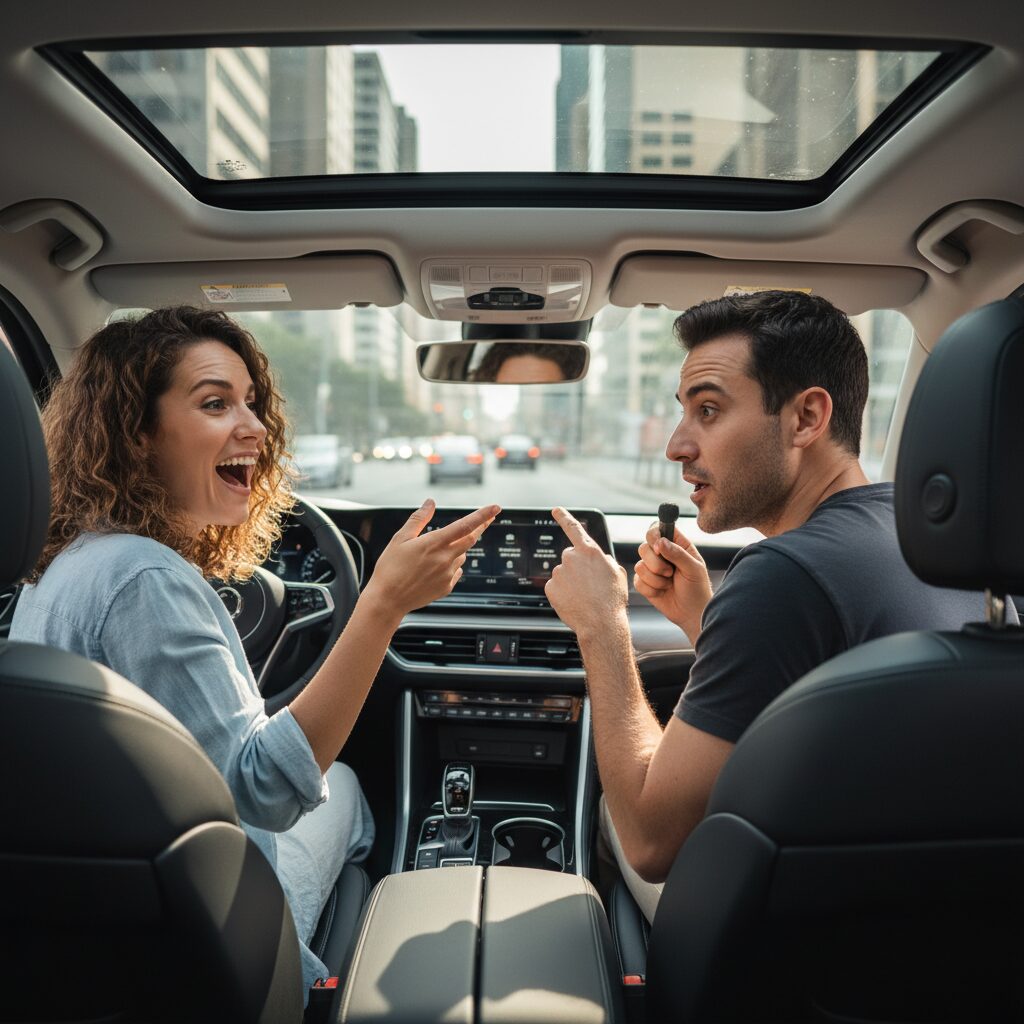
Have you ever overheard your own conversation in the car, as if you had an audience hanging on your every word through the windows? It’s a strange phenomenon: despite the fact that the only audience is your co-pilot—or worse, the complete emptiness of the passenger seat—we speak with an intensity and a performance worthy of a TED Talk. So, why this phenomenon? Is it simply to avoid awkward silence, or is the car an impromptu stage where we perform, for ourselves or for others? Between psychology, social behaviors, and a touch of self-persuasion, the car reveals more than just its engine.
Why does the car transform your conversation into a performance? The car, this confined space, acts a bit like a small theater on wheels. Communication inside a vehicle is influenced by several psychological and social factors. For one, the short distance between passengers forces intense interaction, where every word, every sound carries much more weight than elsewhere. We often speak as if we were auditioning for an imaginary audience. This is simply because the attention of the real audience (your co-pilot, your family, or your mute dog in the back seat) is almost total. Furthermore, the feeling of being cut off from the outside world—no immediate distractions, no noise other than the road—unconsciously compels us to fill the soundscape. Yes, it’s communication, “everyday karaoke” style.
But this verbal performance also serves another purpose:
it’s our brain directing its own little play. We want our message to be clear, even if there’s only one other person, or worse, just ourselves in two auditory copies. The car becomes a space for social rehearsal, where we refine our message. Moreover, this interaction also reflects our innate need to share and feel heard – even if the “audience” is just our own mental reflection.
The role of context and car-related expressions in this communication
The automotive world isn’t limited to simply driving: it’s full of French expressions that reflect our behaviors and our way of thinking about social interaction. Take, for example, “faire une queue de poisson” (to fishtail) or “partir sur les chapeaux de roues” (to leave at breakneck speed): our language draws heavily on the animal and mechanical worlds to color our exchanges, which also influences how we talk in the car.
It’s also impossible to ignore the strong symbolic dimension of the car in popular culture. Like in classic cinema (remember the unsettling exchange between Bourvil and De Funès in *Le Corniaud*?), it embodies more than just a means of transport: a slice of life, a social microcosm where status and emotions are fully expressed. A quick overview of roaring expressions 🚗😜 Expression
When to use it?
| Surprising Origin | To fishtail 🐟 | |
|---|---|---|
| When a car overtakes you dangerously before pulling back in | Inspired by the behavior of fish, which are quick and close when they overtake each other | To take off like a shot 🏁 |
| To start an activity or conversation very quickly | Reference to wheel trims in the 1950s | To put the pedal to the metal 🏎️ |
| To accelerate to arrive faster | Evokes the smell of natural burning rubber in old gasoline | To drive like a maniac 👣 |
| To drive very badly | Comes from “to be as dumb as a doorknob,” the foot being the opposite of the head | These expressions aren’t just funny phrases: they shape how we communicate and fuel the unique dynamic within vehicles. It’s as if the car, in its own way, imposes a rhythmic and figurative interaction. |
How does our brain create this illusion of an audience in the car? From a psychological perspective, talking in the car as if there were an audience follows a very specific pattern: it’s what cognitive scientists call self-presentation. The brain activates a form of internal social attention, anticipating judgment even in the absence of a real audience.Imagine yourself as the driver, but also as the screenwriter of your conversation. The sounds of the engine, the radio pauses, the passing scenery—everything contributes to a scenario where you and your interlocutor are the only actors, but deeply involved. It turns out that the car, an isolated space yet with physical companionship, reinforces this feeling of being observed by someone, even if it’s just you (who’s watching your gaze in the rearview mirror).
Ces articles devraient vous plaire

How do you rehearse an oral text so as not to forget half of it?
Rehearsing a spoken text is an art form, especially if you want to avoid a complete blank at the crucial moment. Whether it’s for a presentation, a speech, or even a wedding toast (because we…

How do we unintentionally imitate the posture of the person we are talking to?
You’ve probably already experienced that strange moment when, without realizing it, you find yourself crossing your arms just as the person you’re talking to has done the same. Don’t panic, you haven’t become a telepathic…
This internal interaction—often unconscious—acts as a stage to rehearse an idea, structure a story, or simply escape the awkward silence. Paradoxically, talking aloud in this rolling cocoon helps organize thoughts, regulate stress, and even strengthen social bonds.
List of reasons for this conversation aloud in the car 🚙🎤 🎭 Simulate an audience to structure your speech.
🧠 Better organize your thoughts in a confined space.
- 🤝 Strengthen the connection with your passenger(s), even if they’re silent.
- 😌 Reduce anxiety related to silence or monotonous journeys.
Ces articles devraient vous plaire

Why do we keep opening and closing the fridge for no reason?
You know that magical moment when you find yourself in front of the fridge, the door barely opened, then closed again, and bam, you repeat it ten times in a row? Not really to eat,…

Why do we wait until we cough to get out of a strange situation?
You know that awkward moment, right in the middle of a weird situation where no one quite knows what to say? And then, bam, someone coughs. This strange but oh-so-human reflex seems to open an…
🎬 Play a role, improvise a social scene.
A final look at social behavior and the car in everyday life This phenomenon of speaking “as if there were an audience” goes beyond the car: it’s part of a general human practice of social interaction, where we put on a bit of a show to be understood, heard, or validated. Inside the car, this social microcosm is amplified by the lack of escape routes, the relative intimacy, and the static posture. Essentially, the car is a rolling theater, a place whereexchanges naturally become more intense
and sometimes even a cerebral laboratory for self-communication. It’s therefore not so surprising that you find yourself speaking loudly, with intonations, as if in front of an imaginary audience , even when all you have to hear is the engine and the road. For those who enjoy curiosities, we also recommend checking out the
surprising pit stop sequences in Formula 1
or discovering some
unusual natural phenomena
that might just rival your next car journey. Does everyone talk like that in the car?
Not necessarily, but most drivers have this reflex at one time or another, especially when they are alone or with family or friends. It’s a fairly common and natural behavior.
Can talking loudly in the car distract you from your concentration?
Generally, no, especially if you’re used to it. However, a lively conversation with passengers can sometimes be distracting while driving, so be careful!
Why do we often speak more calmly at other times?
Because the environment influences how we communicate: in a car, with its confinement and particular acoustics, the voice tends to rise naturally.
Is this phenomenon related to isolation in the car?