
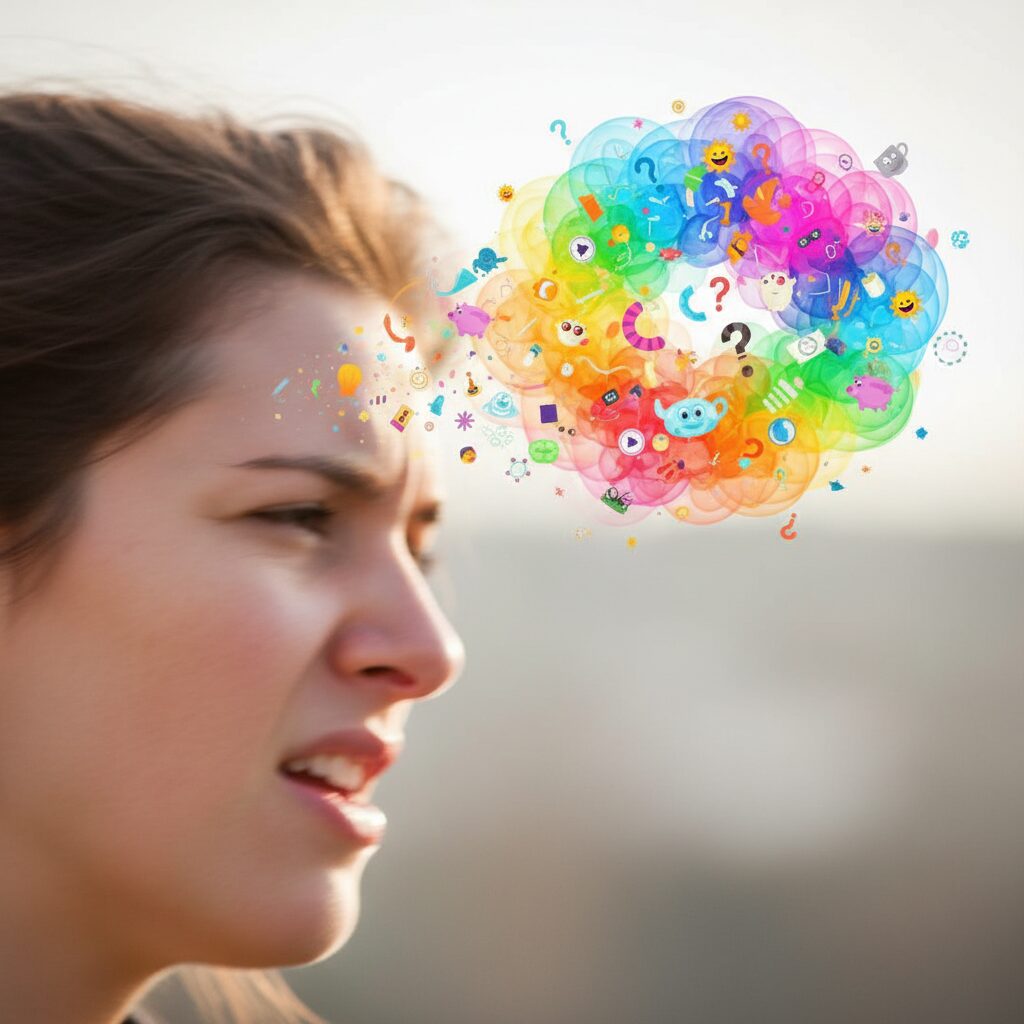
You’re there, in the middle of a Zoom meeting or planning your next meal (because we think better on a full stomach), when suddenly a crazy idea pops up like a mischievous cat on a keyboard. What do you instinctively do? You shake your head, right? This little gesture is much more than a nervous tic: it’s a genuine biopsychological reflex that helps to banish unwanted thoughts and signal mental rejection. But where does this somewhat strange habit come from, at the crossroads of neuroscience and human behavior? Why, instead of clicking “delete” in our brains, do we shake our heads as if to shoo away an annoying fly? In short, why this bodily reflex that is both universal and mysterious? This involuntary head movement actually serves a very specific cognitive function. It helps to materialize our psychological rejection of a far-fetched idea, like a visible signal to ourselves and others. It’s one of the unconscious gestures our brain has adopted to express an immediate “no,” even before we can string together a coherent sentence. A sign that our brain doesn’t just think, it also communicates through our body to better manage the complexity of thoughts. To delve into this strange reflex, we must go back to our earliest days, observe babies (who often demonstrate that they know far more than they show), and even take a look at our primate cousins, all sprinkled with a good dose of fun and fascinating science.
Why shaking our head is our instinctive way of dismissing a far-fetched idea
Before imagining that this gesture is simply a social tic, know that
shaking your head This behavior is deeply rooted in our cognitive development. From early infancy, infants refuse food not with words, but by turning their heads from left to right. Charles Darwin himself observed this and theorized about it as early as 1872: when babies pull their heads back, it is an early form of physical expression of mental refusal. As they grow, this form of communication remains; it evolves but, above all, persists despite the acquisition of language. The head becomes a visual switch to say “stop” to unwanted ideas or stimuli. This gesture is so universal that it is even found in all the sign languages studied, proof of its deep roots in our primary functioning.
The cognitive function behind this movement is simple: to put a physical barrier between oneself and the absurd idea that seeks to infiltrate our mind.
The unconscious gestures that express our psychological rejection This phenomenon goes beyond a simple verbal “no.” Head shaking acts like an invisible shield against intrusive ideas, those that try to impose themselves without asking our opinion. It’s a bit like when you try to chase away a brilliant idea from the perfect recipe, but your brain is more interested in playing hopscotch with outlandish thoughts. In neuroscience, this type of behavior is linked to emotional management: head shaking synchronizes our emotions with the prefrontal cortex, the area that thinks before acting, in order to effectively reject the flawed mental plan. Basically, our body takes care of the “stop” part so that the brain can focus on the “go” of interesting ideas. If only all our meetings were this effective. Why is this body language so universal yet sometimes reversed?
But be careful, shaking your head doesn’t have the same meaning everywhere. For example, in Bulgaria, this same movement means “yes.” A real puzzle for travelers. This kind of cultural exception demonstrates that, even if this intuitive gesture of rejection seems universal, it remains rooted in local traditions and social habits.
This cultural oddity could be explained by a phenomenon of transmission and evolution of body language, like those observed in languages. This is what leads some linguists to compare head shaking to a “universal language” of refusal, with a few nuances.
The neurobiological origins of head shaking as a tool for mental rejection According to specialists, this gesture is rooted in our biology and motor development. Infants, who don’t have words but have a crucial need to express their refusal, use this movement to communicate.
Ces articles devraient vous plaire

Why do we go around in circles before finally deciding to leave?
We’ve all experienced that magical moment when, ready to pack our bags, we find ourselves pacing around our living room, our office, or even standing in front of the door, like a caged animal hesitating…

How do we unintentionally imitate the posture of the person we are talking to?
You’ve probably already experienced that strange moment when, without realizing it, you find yourself crossing your arms just as the person you’re talking to has done the same. Don’t panic, you haven’t become a telepathic…
The cognitive function behind this is that the brain creates links between gesture and emotion, reinforcing the ability to dismiss a nonsensical idea. A strong link also exists with people known as “neuro-zebras,” who possess rapid, complex, and intuitive thinking. This group tends to produce remarkable, but sometimes outlandish, ideas, and sometimes struggles to express them clearly. They are often the ones who shake their heads to dismiss what they deem “invalid” even before formulating certain concepts, proof that this gesture is a natural prerequisite for mental filtering.
A non-exhaustive list of reasons for shaking one’s head:
🧠 Instinctive rejection
of an undesirable idea or stimulus
- 🔄 Emotional management through synchronization between the prefrontal cortex and the limbic system 👶 Primary form of expression in infants
- before verbal language 🌍 Universality in the body language of “no,” with a few cultural exceptions
- 🧩 Cognitive sorting to quickly eliminate a far-fetched idea before deeper processingComparative table of head-shaking meanings according to context
- 🌎 Culture / context 🗣️ Meaning of the gesture 🧬 Neurobiological/psychological root
- Western culture (Europe, Americas) Refusal, negation, mental rejection Instinctive expression born in infancy to say “no”
Ces articles devraient vous plaire

Why do we wait until we cough to get out of a strange situation?
You know that awkward moment, right in the middle of a weird situation where no one quite knows what to say? And then, bam, someone coughs. This strange but oh-so-human reflex seems to open an…

Why do we keep opening and closing the fridge for no reason?
You know that magical moment when you find yourself in front of the fridge, the door barely opened, then closed again, and bam, you repeat it ten times in a row? Not really to eat,…
Bulgaria
| Approval, “yes” | Cultural inversion of the body language | World sign languages |
|---|---|---|
| Universal head movement to mark negation | Common basis of gestures expressing refusal | Great apes (e.g., bonobos) |
| Expression similar to a parental “no” or refusal | Absence of verbal language but complex social communication | You can see that even if this gesture seems rooted in our deepest nature, it adapts to our cultures. Speaking of which, if the odd idea of shaking your head has ever crossed your mind, why not find other ways to express it? For inspiration, explore how |
| the unusual can become a source of brilliant ideas | or, why not, avoid seemingly good ideas by reading about the latest | amazing… but not always effective |
| high-tech trends. | Why do we instinctively shake our heads to say no? |
This gesture is a biological reflex that dates back to early childhood. Babies use the sideways twisting of their heads to express refusal even before they can speak, a habit that remains in adulthood as a universal physical expression of mental rejection. Does the head-shaking gesture mean the same thing everywhere? Not always. Although very widespread globally to signify refusal, in some countries like Bulgaria, this gesture means the opposite: it expresses approval. This shows that body language can be influenced by culture. Does this gesture have an impact on our brain?
Yes, it synchronizes the emotional and cognitive parts of the brain to facilitate the processing and immediate rejection of a far-fetched idea, acting as a visible and internal signal of refusal.
Do animals use this gesture to express refusal?
Some primates, like bonobos, seem to turn their heads to show disagreement or refusal, but this remains very different from human language and is part of a less complex form of social communication.
Is there a link between intuition and head shaking?
Indirectly, yes. Head shaking can help to dismiss a far-fetched idea and make way for a clearer, more grounded intuition. Certain cognitive profiles, such as right-brained individuals, use this mechanism to better manage the complexity of their thoughts.