
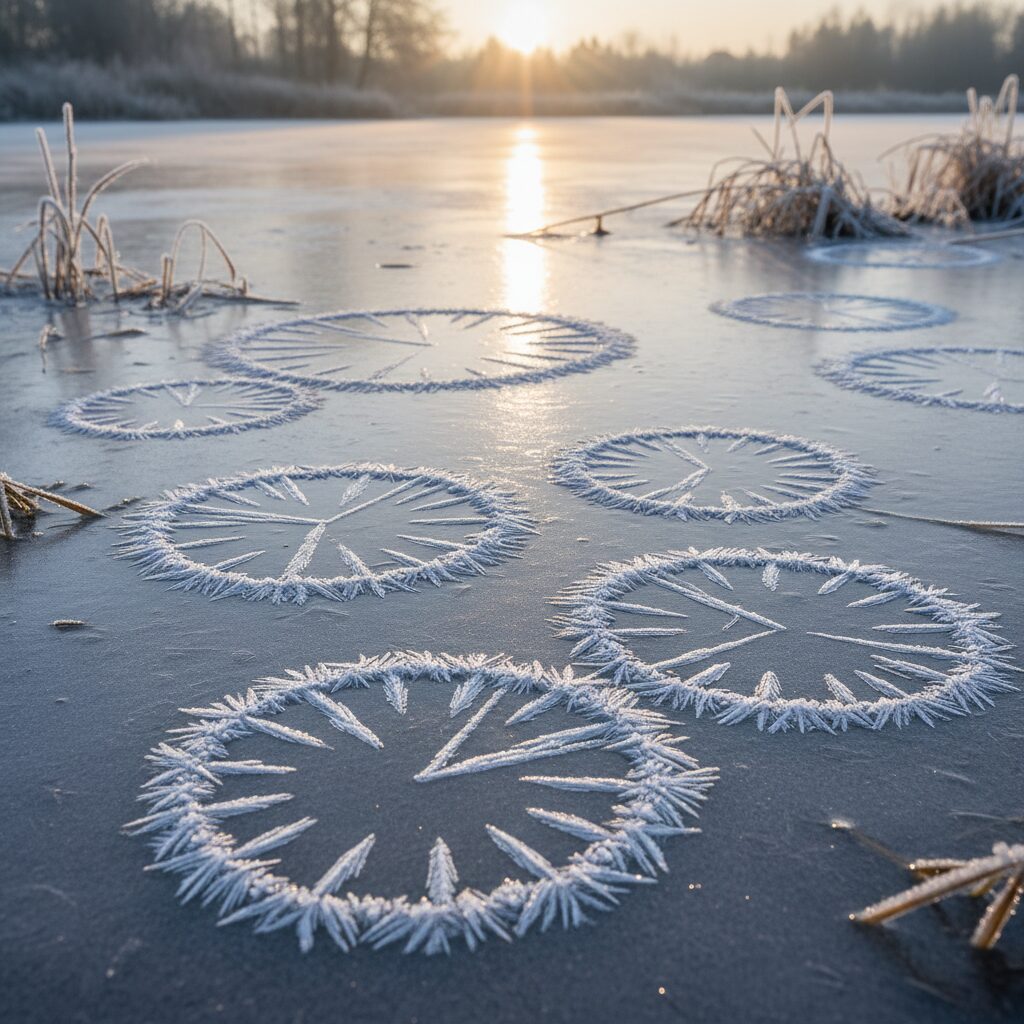
You’ve probably walked past a frozen pond one winter morning and noticed those curious patterns that resemble antique clocks, their hands frozen in a motionless dance. If these enchanting designs have already intrigued you as much as this strange natural phenomenon, you’ll see that behind this icy beauty lies a scientific mechanism as fascinating as it is complex. Why does the ice bend to this geometric art? How can a seemingly ordinary phenomenon like the formation of ice on a pond generate these crystalline structures that would make a Swiss watchmaker green with envy? This is a frosty enigma worthy of a Sherlock Holmes in fur boots!
In this crystalline world, several parameters come into play: temperature, humidity, water composition, interactions with the surrounding air, and subtle movements within the frozen pond. It’s not simply a matter of water freezing quickly, but a skillfully orchestrated ballet that creates these clockwork patterns, reminiscent of snowflakes, where water molecules solidify into distinctive hexagonal structures. Discover how the dynamics of ice and natural phenomena combine to sculpt a clock within frozen ponds.
How freezing processes sculpt clockwork patterns on the ice of frozen ponds
When the water in a pond begins to freeze, it doesn’t instantly transform into a smooth, uniform sheet. The freezing process is actually a delicate balance between the thermal energy lost by the water and the gradual formation of the first ice crystals. These crystals establish their territory by expanding and merging according to the laws of physicochemical principles. Here, the water molecules, as they transition from a liquid to a solid state, adopt a rigorously ordered structure based on a hexagonal lattice, which is also found in the formation of snowflakes.
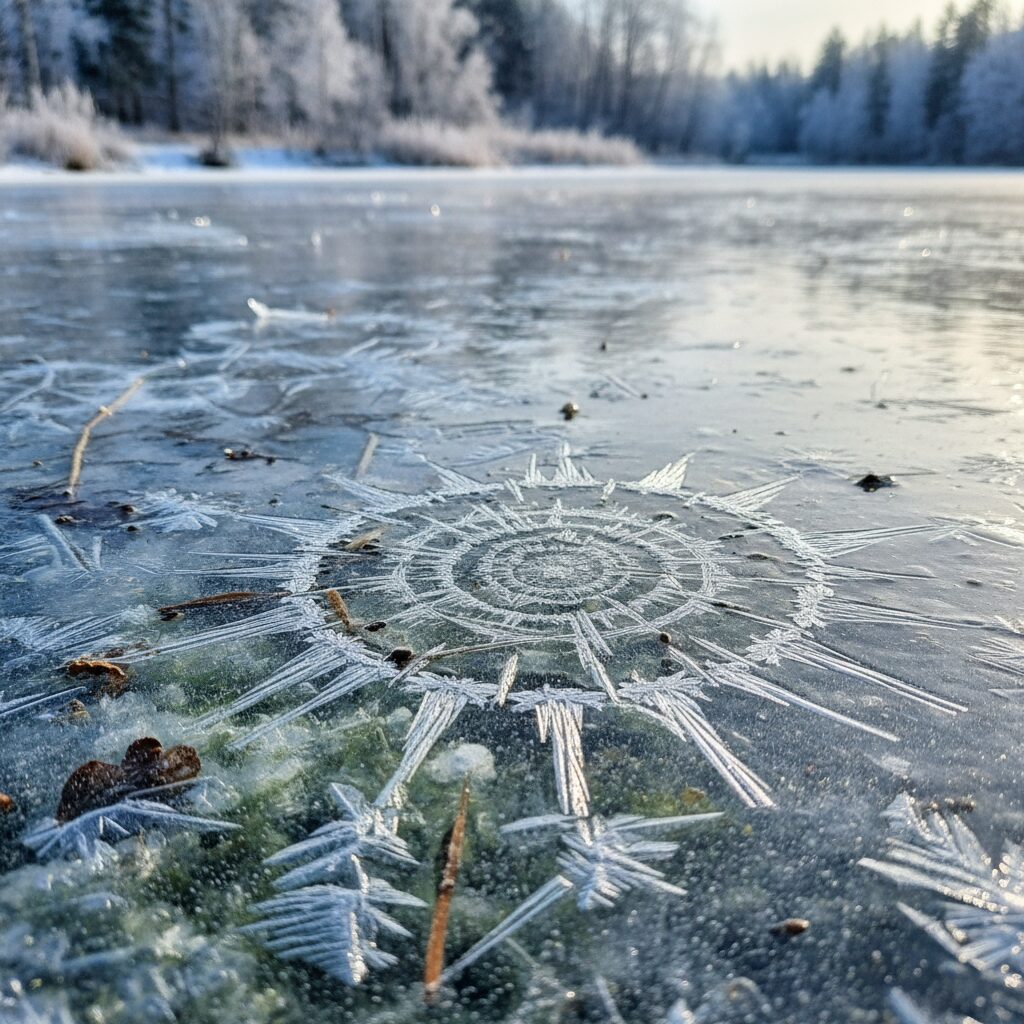
The clock-like patterns often appear because the ice crystals grow radially from an initial point that acts as a central axis, much like the minute hand of a watch. Under a complex interplay of temperature and humidity variations, the ice solidifies, creating branches—crystal needle-like structures that spread out in star-shaped or sector-like patterns across the surface of the pond.
The presence of impurities in the water also plays a crucial role. These tiny dust particles, air bubbles, or microparticles act as nuclei around which ice preferentially forms. What is astonishing is that these patterns can be seen as a kind of natural inheritance of the laws of physics. As an old science professor once said:
“Ice is not just frozen water; it’s a giant clock where every molecule counts and is positioned like the hands on a perfectly aligned dial.”
Ces articles devraient vous plaire
PSG: Safonov, a surprising offer that defies expectations
When PSG lands a Russian goalkeeper who wasn’t exactly expected in that position, it’s more of a shock than the Eiffel Tower on a windy day. Matvey Safonov, a name that slips through fans’ fingers…
Discover why ice forms fascinating clockwork patterns in frozen ponds, exploring the natural phenomena and climatic conditions behind this unique phenomenon.
Why do ice crystals form specific geometric patterns in frozen ponds?
One might think that water freezes haphazardly, but nature loves things to be neat and tidy. If ice forms clockwork patterns, it is primarily thanks to the intrinsic structure of water molecules. Once solidified, these molecules organize themselves into a hexagonal lattice, generating very particular crystalline forms. These patterns are often described as plates, columns, needles, or dendrites (those icy, fern-like shapes), and temperature plays a major role in the type of pattern formed.
| The table below gives a clear idea of the different shapes that crystals can adopt depending on the temperature range: | 🌡️ Temperature (°C) | |
|---|---|---|
| ❄️ Crystal Type | ⚙️ Observed Shape | 0 to -4°C |
| Plates | Thin hexagonal plates | -4 to -10°C |
| Prisms | Thin needles with a hexagonal cross-section | -10 to -16°C |
| Plates and Dendrites | Star-shaped petals and “ferns” (dendrites) | -16 to -22°C |
| Plates | Sector-shaped plates and dendrites | -22 to -50°C |
Columns
Hollow columns, thick needles
These temperatures aren’t just theoretical figures in a laboratory setting; they truly determine how ice spreads in frozen ponds and why natural clocks appear, much like the tides synchronize with the lunar cycle. Essentially, temperature dictates the rhythm of crystal formation and therefore the complexity of their patterns.
Humidity levels are also crucial. In very humid environments, prism-like crystals take on more complex shapes, such as hollow columns or long, pointed forms, adding variety to the patterns. It’s as if nature itself has its own artist, varying their brushstrokes according to the local weather and the micro-environments surrounding the pond.
Finally, the ambient air and its invisible particles—aerosols or suspended particles—act as anchors for these crystals. The concentration of these particles impacts the fineness and final aesthetic of the clock patterns. This will impress your friends on your next winter walk by explaining that these patterns are the result of a multitude of intersecting natural parameters and rigorous physics.
Ces articles devraient vous plaire
How can rock produce light when in contact with water?
Get ready for a luminous journey that’s a little off the beaten path! Have you ever walked past a rock that lights up strangely when it comes into contact with water? No? Not yet? No…
An analogy to help you understand: Imagine that each water molecule is a tiny craftsman, able to place its stone only in a very precise position to build the icy cathedral. The final result? A watch sculpted in ice, with its hands, spokes, and symmetrical patterns, fascinating both curious minds and scientists of all stripes.
Influence of temperature variations and impurities on the formation of patterns on frozen ponds
No one will tell you that ice is a simple substance, especially when it forms in a frozen pond exposed to the open air. Ice formation is a dynamic process where every temperature fluctuation has incredible consequences on the frozen surface.
- In natural ponds, temperatures never remain perfectly stable. Nighttime frosts can be intense, with lows of -20°C or even lower, while the day brings a mild -5°C. This temperature oscillation causes both the growth and partial contraction of the crystals on the water’s surface, sculpting and complicating the patterns that then appear frozen in motion, like an ice ballet.
- Furthermore, the phenomenon is cleverly complicated by impurities. Silt, leaves, or pollutants suspended in the pond create numerous micro-nuclei for the formation of crystals. The effects are twofold: the patterns can become more complex, even fractal, or conversely, more chaotic, depending on the nature of the impurities. Here are some key parameters that determine the shape of the patterns: 🌬️
- Temperature variation: The faster the temperature change, the simpler the ice crystallizes.
- 💧 Atmospheric humidity: Influences the size and growth of the crystal branches.
- 🧹 Presence of impurities:
Promotes nucleation at the start of ice formation.
Ces articles devraient vous plaire

Surprise! This former OL striker is now starring in a hit Netflix series
Did you think retired footballers were content to commentate on matches or invest in pizza chains? Well, prepare for a surprise that’s out of the ordinary: a former striker for Olympique Lyonnais, the iconic Lyon…
🌊
Water movement:
Can cause cracks and deformations in the patterns.
✨Atmospheric pressure:
Small variations, but they affect the saturation of water vapor.
This extraordinary interaction of natural elements explains why ice is so fond of clockwork patterns. In short, the more stable and cold the conditions, and also the less turbulent the conditions, the finer and more ordered the patterns will be. You could almost bet that ice invented abstract art!
- https://www.youtube.com/watch?v=WG8JOM_kebg Clock Patterns in Frozen Ponds: A Natural Phenomenon at the Crossroads of Science and Art It seems that nature is the undisputed master of design, and if you’ve ever admired these clock-shaped crystals on a frozen pond, you know how both logical and magical it appears. What seems to be simply traces frozen in the ice is actually a tool for understanding ice dynamics and the natural processes that regulate our environment—a true geometric spectacle offered by Mother Nature.
- The formation of these patterns is a perfect example of how the rigorous rules of physics take on an artistic air. Their complexity is the subject of several studies to better understand the climate and the evolution of cold regions. Current weather modeling also relies on detailed observations of these structures to predict frost formation, melting, or a surface’s ability to reflect light, known as albedo. But these patterns aren’t the only fascinating examples in nature. To marvel at other amazing phenomena in the natural world, be sure to check out
- the phenomenon of synchronized firefly migration in Southeast Asia, a visual experience as unpredictable as the ice patterns on your local pond.
- Thanks to these observations, we better understand how everything is connected; the smallest changes in temperature or air composition have a visible impact for those who know how to look. The clock pattern then becomes a frozen story, a memory of past temperature and humidity. All this gives you a great argument to sound super knowledgeable on your next winter outing! The 5 essential factors that influence ice clock patterns
- ❄️ Temperature: The mastermind behind the style of the crystals, it dictates their shape and finesse.
🌬️ Local humidity:
Allows the arms to lengthen or remain stubby.
🧪 Impurities in the water:
Essential nuclei that initiate formation.
🔄 Fluidity and movement:
Can modify or alter the details of the crystal pattern.
🌡️ Atmospheric pressure:
Ces articles devraient vous plaire
Why does sand sometimes become magnetic in certain deserts?
Sand, that indestructible companion of beaches and deserts, is often thought to be simply an inert substance, a bit like those socks lost in the washing machine. Yet, in certain deserts, this sand sometimes reveals…