
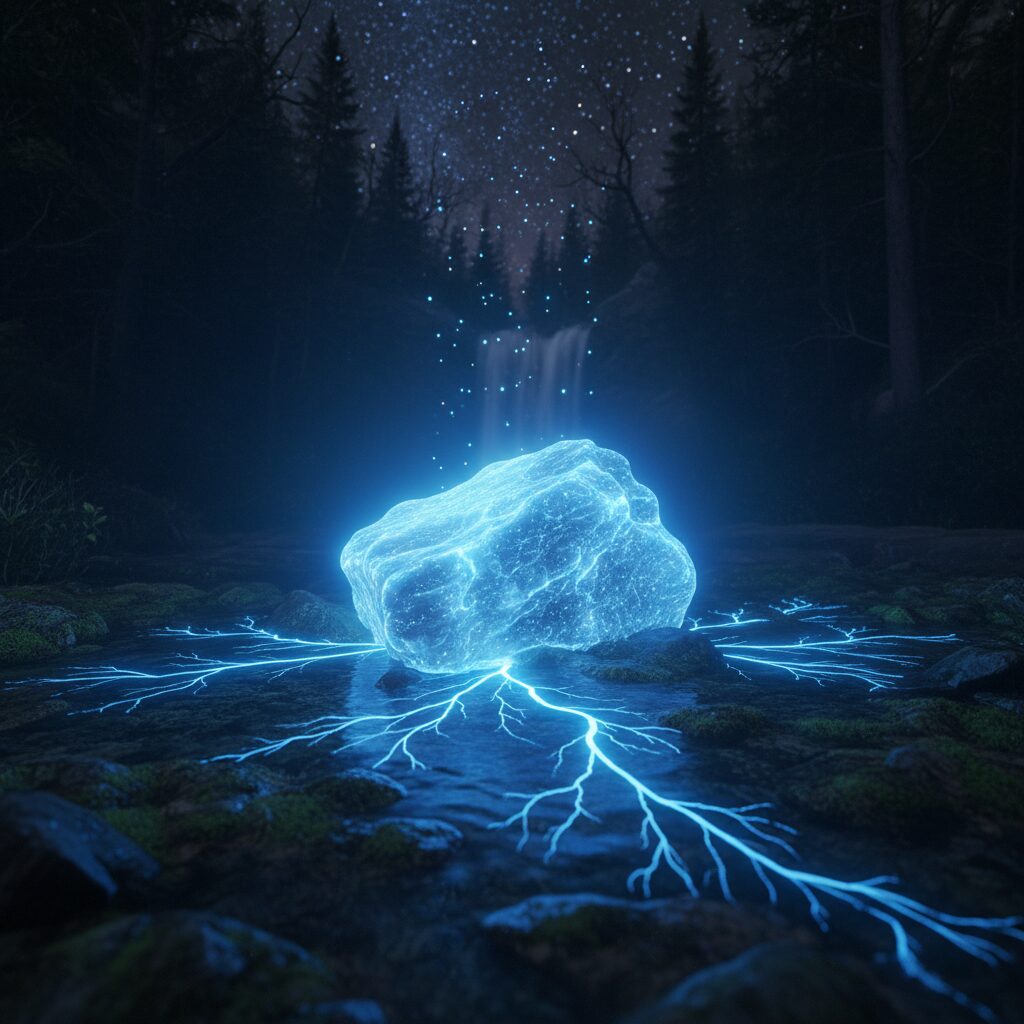
Get ready for a luminous journey that’s a little off the beaten path! Have you ever walked past a rock that lights up strangely when it comes into contact with water? No? Not yet? No problem, because this natural phenomenon is as rare as it is amazing. Imagine a rock, which normally looks like an ordinary mustard-colored pebble, that upon contact with water begins to emit a strange light, not like Christmas lights, but something intriguing on the border between science and fantasy. This spectacle, which seems straight out of a science fiction film, is actually a molecular and electrical ballet that plays with photons, the energy stored in minerals, and might even lead you to talk about triboluminescence and piezoluminescence (sounds cool, doesn’t it?). Much like those beaches that glow at night without anyone seeing a single firefly, or those mysterious caves illuminated without a lightbulb, rock in contact with water tells us a story of chemical reactions, rock-water interactions, and of course, the emission of photons. This luminous phenomenon is one of the many mysteries that nature carefully guards, but which we can unravel with the light of science—and with a touch of humor, because it’s more fun that way.
How does triboluminescence explain the light that emanates from wet rocks?
Triboluminescence—now there’s a word that could be used to scare your friends at a quiet get-together: “Hey, did you know that some crystals can light up when you crush them?” Basically, it’s a phenomenon where certain materials, often minerals, emit light when they are broken, rubbed, or subjected to mechanical pressure. It’s not magic, but rather a dance of electrons rearranging themselves and producing photons, these tiny particles of light.
In the case of rocks, imagine a thin layer of crystals on the surface which, upon contact with water—whether through friction, dissolution, or rapid temperature changes—undergo subtle mechanical stress. These deformations cause microscopic breaks in the chemical bonds. And bam! A localized emission of light appears. It’s not the light we’re familiar with, like a flashlight, but rather an almost magical twinkling at the molecular level. Luminescent minerals like quartz or certain forms of calcite are perfect candidates for exhibiting this triboluminescence. Their crystalline structure is a real marvel: when the crystals are broken or rubbed, they release energy in the form of visible light. This phenomenon is also why some hard candies squeak and glow when you bite into them—nothing to do with a first romantic date, right? The combination of water and rock often creates a change in volume and friction, amplifying these tiny bursts of light. This mechanism, though subtle, explains the glow sometimes observed on certain wet natural stones. It’s a bit like a litho-disco party for your nature-themed evening.
Piezoluminescence: when pressure transforms rocks into surprise lamps 🌟 Another player in this ultra-silent light show is piezoluminescence. Not easy to bring up in a bar conversation (unless you’re aiming for the rock ‘n’ roll physicists’ fan club), it’s a phenomenon where certain materials glow when subjected to pressure, without necessarily breaking. It’s not a trick, but a real transformation of mechanical energy into light, caused by a shift in the rock’s internal electrical charges.
When a rock comes into contact with water—and not like a simple handshake, but more like a noisy neighbor shaking the rock—the pressure exerted on sensitive minerals triggers piezoluminescence. This emission of photons is often so faint that it requires a pitch-black night or sensitive equipment to detect. But hey, for the curious, it’s a fascinating phenomenon that highlights how nature harnesses quantum mechanics without boasting about it.
Ces articles devraient vous plaire

Surprise! This former OL striker is now starring in a hit Netflix series
Did you think retired footballers were content to commentate on matches or invest in pizza chains? Well, prepare for a surprise that’s out of the ordinary: a former striker for Olympique Lyonnais, the iconic Lyon…
Some minerals are better known for their piezoluminescence, like quartz, very popular in solar-powered watches, which, coincidentally, work because light excites similar phenomena—but shhh—water, too, can play the role of a luminous disruptor in this little world of energy. This form of luminescence, sometimes used in research, reminds us that behind our silent rocks lie behaviors bordering on the magical, yet very real and measurable.
Discover how certain rocks can emit light when they come into contact with water, a fascinating and little-known natural phenomenon.
Chemical reactions between rock and water: the little chemical spark ⚗️
Ces articles devraient vous plaire

How can atmospheric pressure change the color of clouds?
Ah, clouds! Those fluffy cushions that reign in the sky, sometimes dazzling white, sometimes ominous gray, or even fiery red at sunset. But have you ever noticed that no two clouds are truly alike, especially…
For example, some rocks contain sulfur or metallic compounds which, when oxidized in water, release energy in the form of photons. This is a luminescent chemical reaction called chemiluminescence. This rock-water interaction, while slow, nevertheless produces a growing and steady flow of light energy that could almost be called the Earth’s “light breathing.”
For this to work, the rock must be porous enough to allow water to penetrate and trigger these reactions. This type of phenomenon also explains why some spring waters appear slightly “red” or strangely colored, all in secret. To better understand these liquid and mineral mysteries, feel free to read about why
the water in some rivers appears naturally reddish ; it’s also a green chemistry trick that makes the eyes of the curious sparkle.List of phenomena responsible for rock-water light 🌈✨:
✨
- Triboluminescence : emission of light due to the mechanical breakdown of crystals. 🔷 Piezoluminescence: Light produced under mechanical pressure without fracture.
- ⚗️ Chemiluminescence: A chemical reaction that produces photons.
- 🌊 Water-rock interaction: Water penetration promotes reactions and physicochemical changes.
- 💡 Luminescent minerals: Such as quartz, calcite, and certain metallic sulfides.
- https://www.youtube.com/watch?v=jCG8RAL8_gI Why do the optical properties of minerals play a key role in these luminous phenomena?
Ces articles devraient vous plaire

Why do some natural springs produce a sound similar to a whisper?
Have you ever strolled by a stream, atop a cliff, or in a sea cave, and suddenly, a mysterious sound tickles your ear, somewhere between a whisper of the wind and a secret murmur? Don’t…
Their ability to absorb, reflect, or re-emit light depends heavily on this structure. For example, observe a polished quartz crystal under a polarizing microscope and you’ll see that the light is filtered and manipulated in every way. It is precisely this effect that allows certain minerals to be luminescent or phosphorescent.
Furthermore, solar radiation, especially its UV form, is an invisible but influential partner. By heating rocks, it stores energy in their crystallochemical structures, and when water interferes, it triggers the release of some of this energy in the form of light. In other words, the rock acts as a mini battery rechargeable by the sun, and the water is the trigger for a surprising luminous reaction.
You can delve deeper into the mystery of light in rocks by discovering why some caves are naturally lit without a visible source; it’s a fascinating clue about the secret powers of minerals and their interaction with their environment.
Table: Impact of Mineral Composition on Light Emission 💎🌟
| Minerals | Type of Luminescence | Typical Color | Use or Natural Occurrence |
|---|---|---|---|
| Quartz | Triboluminescence and Piezoluminescence | White-Blue | Solar-Powered Watches, Clocks |
| Calcite | Fluorescence and Luminescence | Red, Orange, Pink | Mineral Decorations and Natural Phenomena |
| Willemite | Phosphorescence | Bright Green | Fluorescent Deposits, Rare Minerals |
| Metal Sulfides (e.g., galena) | Chemiluminescence | Blue to White | Reactive Mineral Sources |
Ces articles devraient vous plaire

The unusual moment: this magic mushroom transports you to a world populated by miniature characters.
Imagine that among the mysterious world around you, there’s one very special one, capable of transporting you to a fantastical universe where tiny, magical creatures frolic, as if straight out of a fairy tale. Nothing…
In short, this mysterious mixture of fresh water and rock, a chemical and physical cocktail, manifests as a light emission that only the most observant notice. This brilliant phenomenon isn’t just a trick of nature, but a delicate balance of pressures, crystalline tensions, chemical reactions, and complex interactions between luminescent minerals.
If this phenomenon has piqued your interest, it’s even more amazing to see that this magic can be found in surprising places, like the waves that shimmer at night on certain beaches—a phenomenon you can explore to impress your friends at this fascinating link.
Water, rock, and light: an inseparable trio that also allows us to better understand other natural luminous phenomena—a real goldmine for the curious and those who enjoy slightly offbeat science. And for those who enjoy curiosities, you can also take a look at how some watches manage to function solely on solar energy, or even ambient light, as a technological nod to what nature has mastered for millions of years:
solar-powered watches that only work at night.
This just goes to show how much we still have to learn about natural light phenomena and their interaction with the Earth’s matter!
What is triboluminescence?
Triboluminescence is a luminous phenomenon where certain crystals emit light when rubbed, broken, or subjected to mechanical pressure. It’s not illumination, but a flicker linked to the microscopic breaking of chemical bonds.
Is piezoluminescence the same as triboluminescence?
No, piezoluminescence is a light emission due to the mechanical pressure exerted on certain crystals without necessarily breaking them, while triboluminescence involves the breaking of the crystals.
Why do some rocks glow when wet?