
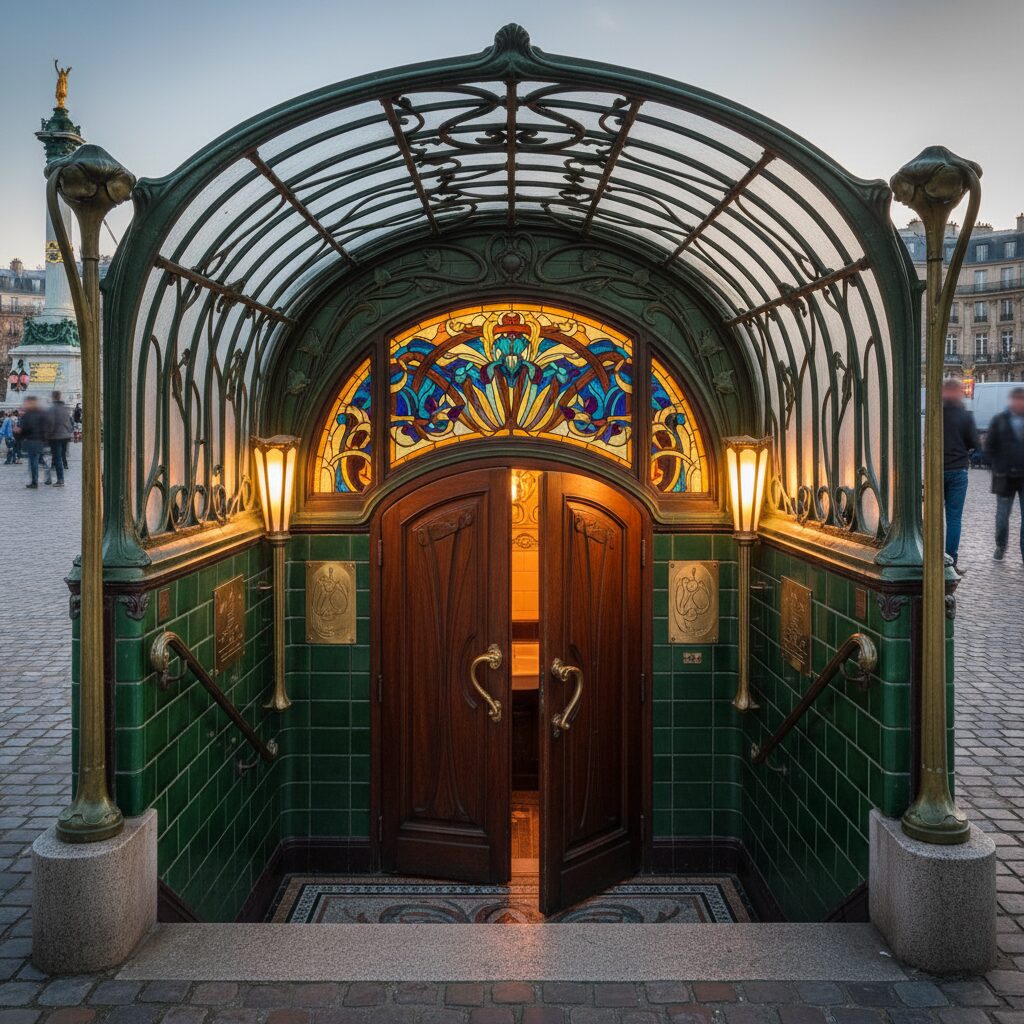
If you think public restrooms are synonymous with cheap tiles and questionable smells, it’s time to update your preconceptions. Beneath the elegant Place de la Madeleine in Paris, a discreet, almost secret gem has emerged from the heart of the capital: Art Nouveau restrooms, a concentrated dose of architecture and design dating back to 1905. Because in Paris, even restrooms have style, we invite you to delve into this curious discovery where historical heritage and functionality blend with consummate artistry. Ready to discover why these toilets are unlike any other and why they now serve as a cultural attraction? Be warned, behind their doors lies a fascinating world, both surprising and, above all, very classy.
- In short: The Art Nouveau restrooms under the Place de la Madeleine date back to 1905, inspired by 19th-century London lavatories, a Parisian rarity. Listed as a historical monument in 2011,
- they reopened in 2023 after meticulous restoration.
- Elegant design and luxurious materials:
- varnished mahogany wood, stained glass, decorated ceramics, and sumptuous mosaics.
- A symbolic fee of 2 euros
helps preserve the site and its upkeep, ensuring a clean and refined experience.
A testament to the Belle Époque,
where attention to detail rivaled comfort, once including porter and shoe-shiner services.
Why are these Art Nouveau restrooms a hidden historical monument beneath Paris?
In Paris, you might think every corner holds its share of art and history. But stumbling upon a public restroom listed as a historical monument is a bit like discovering that your favorite kettle is actually a museum piece. These restrooms beneath the Place de la Madeleine represent a rare glimpse into what Paris had to offer at the beginning of the 20th century: an unlikely marriage of public utility and decorative splendor. Dating from 1905, they were built by the Porcher company, who drew inspiration from late 19th-century London restrooms but imbued them with a truly unique Parisian touch. They embody all the splendor of Art Nouveau, the artistic movement that celebrated natural curves, floral motifs, and noble materials. Previously closed due to their poor condition and lack of accessibility for people with reduced mobility, these restrooms received the historical monument designation in 2011, a decision as unusual as it was justified. Their recent return in 2023, after a long and costly restoration, symbolizes a true victory: restoring the luster to public spaces once considered outdated or useless, but which reveal so much about our heritage.
Ces articles devraient vous plaire

Gourmet and Festive Challenge: Truffle Brie and Unusual Christmas Jumpers
Want to spice up your Christmas with a touch of originality and a hint of the unexpected? From truffle brie that would melt even Santa Claus in his red suit, to Christmas sweaters that boldly…
According to some architecture enthusiasts, these restrooms embody the delicate balance between aesthetics and essential urban comfort, a luxury that may seem quaint today but which, at the time, demonstrated that one could sometimes “think small” without sacrificing style.
Discover this unusual story here
or delve into the details of the restoration
with this breathtaking report.
What does the inside of these restrooms look like, and why is it more than just a toilet? Did you think public restrooms were synonymous with foul odors and questionable cleanliness? Think again: the Madeleine restrooms are a work of art in themselves, a veritable museum hidden beneath the cobblestones. As soon as you descend the few steps into this subterranean world, you step onto a mosaic floor meticulously laid by hand. Imagine a colorful patchwork that would make any DIY enthusiast green with envy. The furniture, crafted from varnished mahogany, still gleams with age, lending the space a luxurious simplicity. The stained-glass windows with their warm hues filter through a soft, colorful light, while the decorated ceramics adorn the walls, a testament to the Art Nouveau attention to detail. Each stall is equipped not only with a toilet seat and flush (obviously), but also with a sink and a mirror! Yes, you read that right, a mirror! At the time, it was the epitome of elegance for a place intended to satisfy even the most basic needs. This desire to create a truly immersive experience, blending aesthetics and functionality, was a hallmark of the Belle Époque in Paris. Other now-vanished extras, such as a doorman and even a shoeshine boy, confirm that these restrooms were nothing less than places for socializing and displaying prestige. In short, you understand that restrooms, in this context, were like a small palace where one entered for a regal respite.
Ces articles devraient vous plaire

The unusual moment: this magic mushroom transports you to a world populated by miniature characters.
Imagine that among the mysterious world around you, there’s one very special one, capable of transporting you to a fantastical universe where tiny, magical creatures frolic, as if straight out of a fairy tale. Nothing…
To learn all about this unique design,
you can also see
the photos and anecdotes published
by enthusiasts of the unusual. How has the recent restoration breathed new life into this Parisian heritage? Imagine finding a relic over a century old, full of charm but completely ruined, and having to restore it to its original splendor, respecting every last detail. This is the challenge the teams in charge of renovating the Madeleine church restrooms took on. Closed since 2011, they reopened in February 2023 after a restoration that lasted several years and was overseen by heritage experts.
Ces articles devraient vous plaire

How can we explain the regular, muffled noise emanating from extinct volcanoes?
Have you ever wondered what that muffled sound that seems to emanate from certain extinct volcanoes is all about? No, it’s not a herd of elephants marching under the mountain while you sleep, nor is…
The main challenge, beyond the need to preserve the Art Nouveau spirit intact, was adapting these structures to modern standards, particularly in terms of accessibility and hygiene. In this way, the site is now accessible to everyone, without denying the history of the place.
The result? A haven of refinement where every material, from the wood to the earthenware, is either restored to its original state or replaced with handcrafted replicas. The mosaic floor was cleaned and reinforced, the stained-glass windows restored by hand, and the original light fixtures put back into operation. Incidentally, the €2 entrance fee helps ensure rigorous daily maintenance, a rather clever way to prevent this little gem from falling back into disrepair.
- This exemplary project reminds us that preserving historical heritage, even if it lies beneath our feet and in a place as mundane as a toilet stall, can sometimes be a real mission. It all proves that the effort is worthwhile and encourages us to cultivate a curiosity for hidden treasures, often overlooked by the general public.
- Discover the behind-the-scenes story of this incredible restoration
- or delve into this in-depth report
- for the truly passionate. What are the historical and unusual anecdotes surrounding these Parisian toilets?
- It must be said that between their birth during the Belle Époque and their forced slumber of over ten years, these restrooms have witnessed their fair share of cultural stories and little curiosities. For example, did you know they originally had a doorman? A human coat rack for your coats, if you will. And what about the shoeshine boy, a luxury that has fallen out of fashion but perfectly illustrates the status of the era? More recently, in 2023, their reopening sparked a real wave of enthusiasm among fans of the unusual and architecture. They are hailed as a rare example of how cleanliness and functionality can serve as a true visual spectacle. It even seems that some Parisians deserve a medal simply for having kept the existence of such a treasure beneath their feet a secret! In terms of hidden places to discover, these restrooms rank among the top must-see curiosities for lovers of architecture and urban history. It shows how heritage isn’t necessarily just a castle or a dusty museum, but can also be a simple restroom that the city wanted to make exceptional. A doorman and shoeshine service, gone but which evoked grandeur.
A model inspired by 19th-century London lavatories, adapted to Parisian fashion. A modest entrance fee to preserve the space from the flow of visitors and tourists. Rich archival documentation,preserved to rediscover daily life around these restrooms.
Ces articles devraient vous plaire

Unusual: A couple launches a raffle to try and sell their unsold apartment
In short: A British couple is struggling to sell their second home in Wales.The initial price of £365,000 is reduced by £40,000, but to no avail.They launch a raffle with tickets at £5.50 to boost…
A forgotten social hub,
where elegance and civic duty converged.
You’ll find other gems of anecdotes by following this link,
and for the more curious, the Trocadéro Lavatory, another hidden gem in Paris, is also worth a visit.
Can we really talk about tourist and cultural restrooms in Paris?So, yes, it might seem strange to be raving about a toilet, but in Paris, everything takes on a different dimension. This passion for architecture, design, and historical heritage makes these kinds of sometimes overlooked curiosities possible. In 2023, the reopening of the Madeleine toilets attracted both curious Parisians and astonished tourists. Some visitors come for the practicality, others to immerse themselves in a historical atmosphere where every detail has its own story. The place has become a kind of micro-museum accessible to everyone, blending aesthetics and basic needs. In short, a hybrid concept between utility and spectacle, which commands respect.
Added to this is the commitment of the City of Paris, which recognized that preserving heritage isn’t limited to museums and grand monuments, but also extends to everyday spaces. It’s a way of giving meaning and attention back to urban spaces that are often neglected. This philosophy, combined with an economy geared towards more inquisitive tourism, even transforms restrooms into unexpected destinations.The small €2 entrance fee doesn’t just pay the cleaning staff; it also contributes to the preservation of a heritage that pays homage to a period when public architecture was beautiful down to the smallest details. A video tour is worth a thousand words here, and more information on the history of Art Nouveau restrooms in the capital.
| Decorative Elements | Materials Used | Features (1905) | Condition in 2023 |
|---|---|---|---|
| Stained Glass | Mahogany Wood, Earthenware | Booths with Sinks, Mirrors, Doorman, Shoeshine | Complete Renaissance Restoration, Easy Access, Guaranteed Cleanliness |
| Mosaic Flooring | Handcrafted Tiles | Full Service Open to the Public | Enhanced security, daily maintenance |
| Decorated ceramics | Colored glass and earthenware | A place for socializing | Opening fee (€2) for maintenance |
Are these restrooms accessible to everyone?
Yes, following restoration, the restrooms are now accessible to people with reduced mobility as well as all visitors.
Why charge €2 for these restrooms?
The entrance fee covers daily maintenance and ensures a clean and well-maintained space, as well as preserving this valuable heritage.
Have the restrooms always been in the Art Nouveau style?
Yes, since their construction in 1905, they have proudly displayed their Art Nouveau style, a tribute to the Belle Époque.
Can these restrooms be visited like a museum?
Absolutely, the site is a true cultural experience where aesthetics and history meet, accessible to all.
Are there other historic restrooms in Paris?
Yes, the Trocadéro Lavatory is another remarkable example of a historic public restroom that has also recently reopened.