
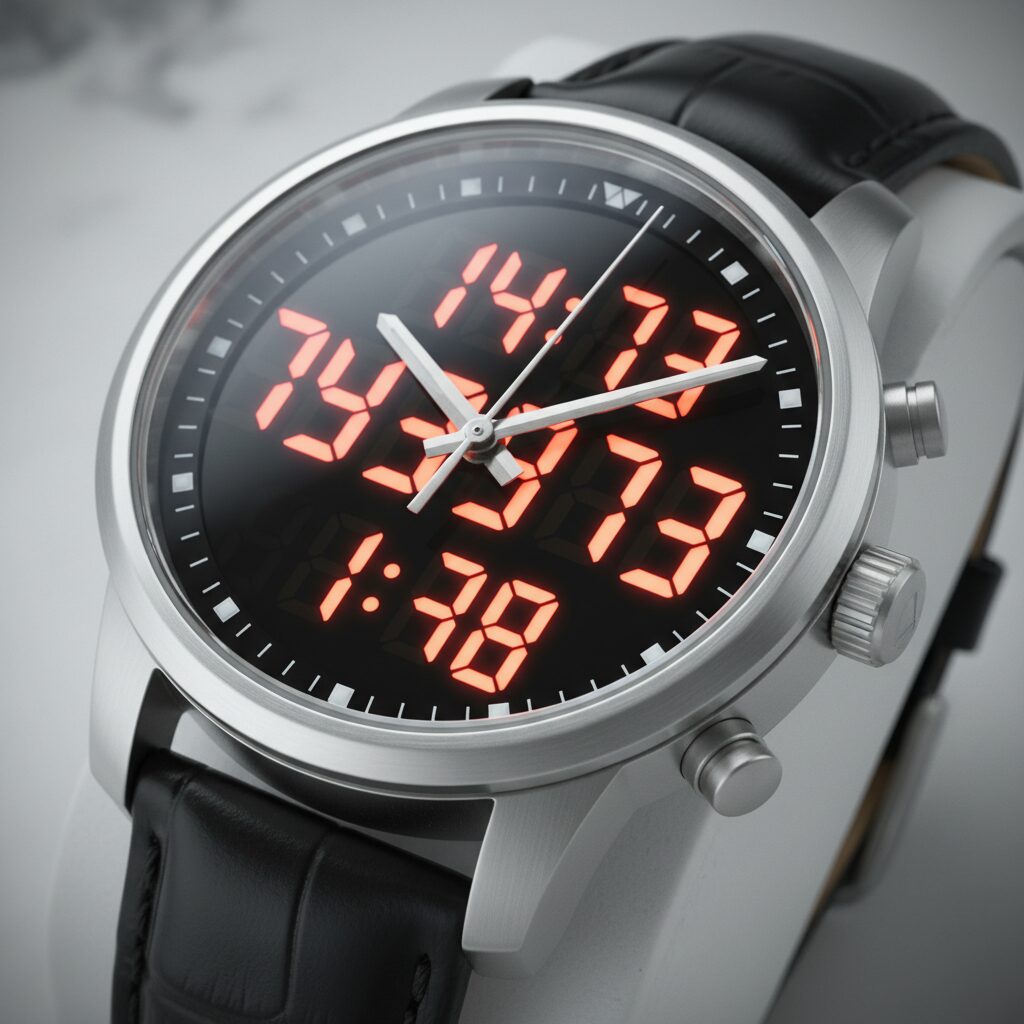
Imagine yourself in the middle of a meeting, absentmindedly glancing at your watch to check the time. But then, your watch displays digital hands. Yes, those bizarre hybrid things where the classic meets the future, but where your brain suddenly starts slamming in confusion. Why on earth does this improbable mix send you into a cognitive labyrinth? Why does this visual torture of classic hands and desynchronized digital numbers make your heart beat faster, but not with excitement? Watches, everyday objects, in 2025 have never been so sophisticated, straddling tradition and technology. Yet, when hybrid design dares to mix digital hands and digital displays, it feels more like a “mental glitch” than “showtime.” Halfway between vintage dials and futuristic screens, these hybrids play with the concept of time, questioning our visual perception and our relationship with watch technology. So, where does this strange confusion come from? It’s this cocktail of simultaneous display systems, a counter-intuitive user interface, and questionable visual ergonomics that’s messing with your head. The result is a strange “what is this watch?!” effect that makes you doubt your own sanity. Don’t panic, we’ll break it all down with the necessary scientific rigor, sprinkled with a touch of humor so you can shine in social situations with your improbable anecdotes about the whys and wherefores of digital hands 🕰️🤯.
How watches with digital hands disrupt timekeeping If you thought telling time on a watch was as simple as drinking coffee, think again. Timekeeping relies on a well-oiled mechanism in our brain, or in plain English, a visual perception
Calibrated by habit. The discrepancy between traditional and digital displays in digital analog watches creates a real sensory glitch. How does it work?
Traditional analog watches rely on spatial cues: the position of the hands on the dial. From a very young age, our brains learn to decipher these visual cues to get an almost instantaneous estimate of the time. It’s so ingrained that even without counting the numbers on the dial, we understand immediately. But with a hybrid watch, you have digital hands on one side (yes, digital doesn’t necessarily mean “LED display”; here it’s more of a digitized visual effect of the mechanical hands), and on the other, a purely digital display of numbers. Your visual cortex therefore receives two completely different codes: a spatial code and a distinct digital code. Your brain, in 2025, is still trying to choose sides. This situation triggers a greater cognitive effort,
an overload of the brain’s user interface.
Imagine your brain is a web server, and suddenly it’s bombarded with two incompatible requests. The result: it lags, and you’re left with a latency worthy of a 56k connection. That’s why you might find yourself looking at your watch for several seconds before realizing whether it’s 3:45 or 4:15.
Another layer of confusion comes from the often-adopted hybrid design: neither entirely digital nor completely analog, the watch fails to provide a clear and dominant visual signal. The digital hands, sometimes backlit or animated, catch the eye, but the numerals, also present, offer a secondary reference. The serious consequence is that this creates cognitive ambiguity. In short, the problem stems primarily from ergonomics. which fails to harmoniously combine two very different watchmaking languages. This creates an awkward interface, mixing the old and the new, which makes the visual part of the brain struggle, resulting inintense confusion.
Ces articles devraient vous plaire

Why do scale and weight trackers make diets absurd?
In the hyper-connected world of 2026, where even your watch seems to know your fitness level better than your mother, weight and scale trackers have become the darlings of weight-loss enthusiasts. They promise weight-loss tracking…
Discover why watches with digital hands can be confusing by exploring their unique hybrid design and its impact on telling time.
The Psychological Reasons Behind This Strange Visual Confusion If your head is in knots looking at digital hands, you’re not alone. Our brains love routines, especially well-oiled ones like telling time. Watches with digital hands disrupt these routines and plunge us into a bit of inner chaos. Why is that?
Visual perception is a wild beast. It likes clear and predictable cues. Classic hands are spatially positioned cues that immediately give the “big picture” of time. Digital numbers, on the other hand, force you to decode a symbolic, encrypted message, a bit like a mini mental calculation. The human brain is slow to adapt when two radically different formats arrive simultaneously, especially when they provide seemingly redundant information that isn’t always perfectly synchronized (a slight discrepancy on a hybrid watch, and it’s internal panic). This duality causes what psychologists call a
visual mental load
: it’s like trying to follow two conversations in two different languages without subtitles.
To better understand, imagine you’re looking at a road map and a GPS at the same time, but the directions are slightly different. You have to decide which one to trust. That’s exactly what happens with these hybrid watches. Your brain gets flustered, confused, and telling the time becomes a moment of doubt and hesitation. Moreover, this visual confusion often impacts your attention span. You’ve probably experienced that situation where, despite your best intentions to read the time quickly, you end up staring at your watch as if hypnotized, thinking, “What on earth is this thing saying?” Watches with digital hands can create this infamous “mental freeze” where the user interface becomes one with your distraction.
Ces articles devraient vous plaire

Automatic hand dryers that soak more than they dry
In the bustling world of public restrooms, the automatic hand dryer reigns supreme, touted as the modern, eco-friendly, and ultra-hygienic solution for perfecting handwashing. Yet, behind this blast of air meant to save us time…
perceptual data conflict.
| It’s very common with poorly designed visual interfaces: only a clear and unified interface allows for quick and intuitive processing. And all of this ultimately influences consumer choice, often leading them to prefer more classic or distinctly digital designs. | Basically, the concept of digital hands, which initially seemed to have a certain futuristic appeal, ends up clumsily combining two opposing graphic interface styles, thus disorienting most wearers. A real visual puzzle for someone who just wanted to know if it was time for a coffee break ☕. | ||
|---|---|---|---|
| https://www.youtube.com/watch?v=WyD_yd2MUtU Hybrid Design Comparison: Digital Hands vs. Traditional and Digital Watches | How do these watches with digital hands fit into the watch market? Let’s take a closer look with a small comparison chart that will give you a clear idea of the aesthetic and functional paradox of these hybrids. | Criteria 🚩 | |
| Traditional watch 🕰️ | Purely digital watch 🔢 | Digital watch with hands 🔄 | Time display |
| Instant thanks to the hands | Direct, clear numbers | Dual code, slower 😵💫 | Visual perception |
| Simple and effective | Precise but requires concentration | Confusing, frontal visual mix | Ergonomics |
| Optimized for the wearer | Intuitive user interface | Often clumsy | Design |
Timeless and elegant
Modern and functional Stylish confusion Battery life Mechanical or battery, very reliable Short battery life
Ces articles devraient vous plaire

connected backpacks that weigh more than their contents
In the fast-paced world of 2025, where wearable technology is finding its way into our pockets and onto our shoulders, smart backpacks have arrived with a bang. These connected devices, equipped with USB ports, built-in…
You see, the digital analog watch, by trying to combine analog and digital, takes the wearer on a journey between two worlds. Yet, the intention is good: to offer the charm of the movement of hands with the clarity of digital numbers. In reality, it’s often a mess.
However, let’s remember, watch technology is constantly evolving. Some models try to optimize this fusion for better ergonomics and a more user-friendly interface. But so far, these prototypes remain marginal, and the majority of users prefer the comfort of a clear display to visual originality.
https://www.youtube.com/watch?v=KJGlFa4tB2o Other natural and psychological phenomena amplifying confusion with digital hands
Beyond visual brain programming, there are natural and cognitive phenomena that amplify the confusion caused by watches with digital hands. The first concerns the
time updatespecific to these hybrid watches. Digital hands can sometimes be a little slower to indicate a change of time, especially in designs where the animation of the digital movement replaces the simple sweep of mechanical hands. This small delay, imperceptible on a standard watch, becomes a micro-dissonance that is difficult for the brain to ignore, as it expects an immediate response.
Then, the
- brightness and contrast play a major role. On some models, luminous digital numerals on a dark background sit alongside low-contrast or semi-transparent digital hands. The result: a visual duel that tires the eye, making it less quick to decode time information and increasing confusion.
- Finally, a less expected aspect is the emotional and cognitive impact induced by this clash between two styles. When watches don’t meet the wearer’s conscious or unconscious visual expectations, it generates a form of frustration linked to the difficulty of reading them. Frustration, like any good psychological ingredient, increases mental load. It’s the perfect recipe for provoking a rejection, even a silent one, of hybrid design. But let’s look at a list of 5 natural and psychological phenomena that amplify confusion:
- 🧠 Cognitive overload: Your brain is multitasking involuntarily.
- 👁️ Perceptual dissonance: The eye wants only one visual truth, not two. ⌛
- Update Lag : The watch adapts more slowly than expected.
🌗
Ces articles devraient vous plaire

Why do electronic keys refuse to open when it’s raining?
Imagine: you finally get your hands on your car after a day of torrential rain—shoes soaked, hair refusing to cooperate, in short, everything to make you frustrated. You pull out your electronic key, that little…
Poorly Calibrated Contrast
: Eye strain guaranteed after 1 hour of looking.
😠Cognitive Frustration
: Your patience is sorely tested. Suffice it to say that these digital hands, far from being a mere gadget, elicit a whole host of natural reactions that demonstrate the complexity of harmoniously combining design and technology in modern watchmaking.How can we improve the perception and ergonomics of watches with digital hands?
To conclude this journey between the future and the past on the wrist, let’s examine some serious and less outlandish approaches aimed at making these hybrid timepieces with digital hands less confusing. 1. Prioritize Visual Consistency
The watch should adopt a unified and clear visual language. For example, minimize conflicting visual elements, or animate the digital hands so they perfectly match the digital display. This improves cognitive processing. 2. Optimize the layout of information
Place the digital numerals and hands in a complementary, rather than competing, manner. Some designers suggest a dial divided into distinct zones for each type of display. 3. Improve contrast and readability
Use a bright, high-contrast display for the numerals, and a different but harmonious visual texture for the digital hands. The goal: to promote quick reading without eye strain. 4. Introduce personalized settings
Allow the wearer to choose their preferred display mode, or even turn off one of the two displays according to their preferences or usage context. 5. Use AI technology
to automatically adapt the display and animations based on lighting conditions or the wearer’s lifestyle. These approaches, if implemented by 2025, could transform the user experience of digital analog watches, reducing confusion and significantly improving ergonomics and visual perception.
It would be a shame to keep watches that look so cool on paper but are so complex to use, when a simple adjustment to the user interface could change everything.
Why do digital hands create more confusion than traditional watches?
Digital hands combine two different display languages (analog and digital), which overloads visual perception and complicates time reading.
Are hybrid watches less accurate than purely digital watches?
No, accuracy depends primarily on internal mechanisms. Confusion arises mainly from the visual presentation, not from timekeeping reliability.
How can you avoid confusion with digital watches? Choose a minimalist design that promotes a clear and uniform display, or opt for a watch with customizable displays.
Are digital watches a passing fad?