
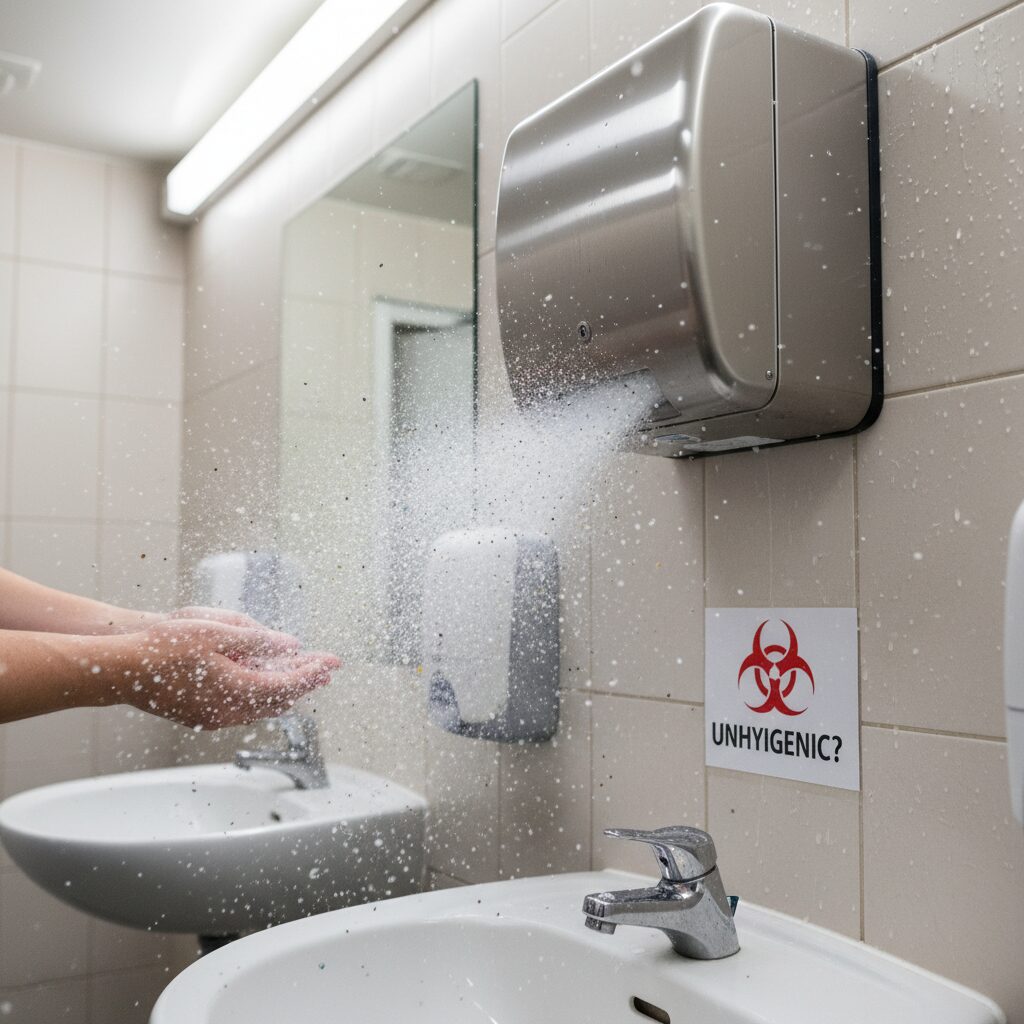
In the bustling world of public restrooms, the automatic hand dryer reigns supreme, touted as the modern, eco-friendly, and ultra-hygienic solution for perfecting handwashing. Yet, behind this blast of air meant to save us time and prevent paper waste lies a surprising truth: these technological marvels dry… mostly other people’s hands, but not always yours. Worse, they could well make your experience significantly wetter and more contaminated than it seems. At a time when drying quality is becoming a crucial health issue, especially in high-traffic areas like hospitals, schools, and shopping centers, should we reconsider our blind faith in these automatic hand dryers? Between persistent humidity, the spread of microbes, and often neglected maintenance, they seem to have more than one trick up their sleeve. Discover why what you thought was a cleanliness ally is sometimes the champion of splashes and unwanted soaking. Why do automatic hand dryers dry so poorly? The Forgotten Soaking Syndrome
At first glance, the promise seems simple: a powerful blast of air to evaporate the moisture from your hands in seconds. On the surface, the automatic hand dryer ticks all the boxes for efficiency. However, several experiments conducted in recent years, particularly in hospital settings in the UK, France, and Italy, have demonstrated the opposite. These devices, far from perfecting the drying process, often leave your hands as damp as if you’d just stepped out of the tap. But why this failure?
The secret lies partly in the
hand dryer technology These compressed air hand dryers don’t just expel lukewarm air; they project powerful jets capable of stirring up not only water, but also microbes and other particles into the surrounding air. As a result, the water is sometimes dispersed laterally and redeposited on your hands or forearms, a phenomenon many experience as a welcome, unexpected soaking. This poor drying quality, coupled with unfiltered air and often inadequate hand dryer maintenance, exacerbates the problem. Furthermore, the very design of automatic hand dryers can be counterproductive. In some installations, they blow air from bottom to top, spreading droplets on nearby surfaces instead of directing them toward efficient evaporation. In short, the “power” of these devices doesn’t guarantee optimal performance; on the contrary, it can work against the expected drying. And that’s where the spiral of inefficiency begins.
It should also be noted that for a hand dryer to be fully effective, the user must remain under the airflow for a considerable amount of time. However, in reality, most users leave the device as soon as their hands seem only slightly less dripping wet. This behavior, understandable in a bathroom where time is of the essence, reduces overall effectiveness and increases residual moisture. The perfect combination for prolonged soaking and the feeling that this hand dryer is a high-volume joke.
In short, these hand dryers create a fragile illusion of effectiveness. They blow hard, but what about the actual drying? Many users leave wet and sometimes even more contaminated, which gives these devices the aura of hygiene inefficiency generators rather than true handwashing heroes. Discover why some automatic hand dryers wet your hands more than they dry them, and how to choose an effective device for optimal hygiene.
Automatic hand dryers: a hygiene problem that has scientists talking.We like to think that drying our hands with an automatic hand dryer is part of an ultra-clean and scientifically sound routine. Spoiler alert: this isn’t always the case. Recent studies published in the Journal of Hospital Infection show that these hand dryers can spread up to five times more bacteria than traditional paper towels. In a comparative study conducted over 12 weeks in hospitals in the UK, France, and Italy, researchers measured bacterial contamination levels on different surfaces and in the air when either paper towels or automatic hand dryers were in use. The verdict: floors, sinks, and even the ambient air were noticeably more contaminated in restrooms equipped with jet-air hand dryers. Professor Mark Wilcox, a renowned microbiologist at the University of Leeds, emphasized that contamination is not simply a matter of harmless bacteria. Some detected contaminations were due to resistant bacteria, notably those originating from fecal matter, and therefore entirely undesirable in an environment intended to be clean. He therefore advises against the use of these hand dryers in places with a high risk of infection, particularly hospitals.
Ces articles devraient vous plaire
Why are watches with digital hands confusing?
Imagine yourself in the middle of a meeting, absentmindedly glancing at your watch to check the time. But then, your watch displays digital hands. Yes, those bizarre hybrid things where the classic meets the future,…
The air blower propels not only water from hands, but also microbes suspended in the water, creating a kind of invisible mist that settles everywhere. This wind of unintentional contaminants transforms the restroom stall into a health hazard zone, a cloud of bacteriological problems ready to contaminate freshly washed hands, as well as surrounding surfaces and faces.
Moreover, poor hand dryer maintenance exacerbates this problem, since the air filters, sometimes clogged or dirty, fail to properly purify the airflow. Bacteria can thus proliferate in the device and be dispersed with each use. This lack of regular maintenance is an aggravating factor that many are still unaware of in 2026, even though the information is increasingly circulating in health and public hygiene circles. What if, paradoxically, the number one culprit wasn’t the technology itself, but rather our user experience? Insufficient handwashing, often done hastily, leaves behind germs that the hand dryer then spreads in aerosol form. The automatic drying technique thus becomes an amplifier of errors rather than a corrector. Why paper towels win the hygienic drying battle
In the great duel of hand-to-hand hygiene (pun intended 👋), the paper towel often emerges victorious. Why? Because the traditional method is simple, direct, and particularly effective at reducing the hygiene problem related to moisture.
Rubbing your hands with a paper towel removes not only water but also a significant portion of residual microbes. This mechanical action, often overlooked, reduces the towel to a mere tool, but it actually acts as a secondary cleaner. Furthermore, the towel physically absorbs water and bacteria, which are then eliminated when the towel is disposed of properly.
Practical differences aside, the paper towel also has its ecological advantages—but that’s another debate where paper consumption must be weighed against the lifespan of automatic hand dryers. For now, science leans toward the safer alternative, especially in spaces where public health is at risk, such as schools, daycare centers, medical facilities, and even busy offices.
The table below summarizes some key points comparing automatic hand dryers and paper towels: Appearance 🔍 Automatic hand dryer 💨
Paper towel 🧻 Drying quality Powerful airflow but risk of side soaking and uneven drying
Ces articles devraient vous plaire

connected backpacks that weigh more than their contents
In the fast-paced world of 2025, where wearable technology is finding its way into our pockets and onto our shoulders, smart backpacks have arrived with a bang. These connected devices, equipped with USB ports, built-in…
Direct absorption, active friction to eliminate microbes
Hygiene Creation of aerosols, spread of bacteria Bacteria trapped in the disposable towelEnvironmental impactElectricity consumption and regular maintenance required
Generates waste but low carbon footprint
Ease of use
Contactless but sometimes incomplete drying
| Simple handling but requires a nearby trash can | Long-term operating cost | High equipment and maintenance costs |
|---|---|---|
| Recurring cost related to towel purchases | Hand dryer maintenance: why neglecting it is like playing with fire The vicious cycle of hand dryers that soak more than they dry wouldn’t be so disastrous without regular and rigorous maintenance. Yet, in real life, this is a true Achilles’ heel. One might think that these high-tech devices self-clean between uses, but unfortunately, this isn’t the case. | Hand dryer maintenance |
| encompasses several essential operations: cleaning the filters, disinfecting the air ducts, and replacing worn parts. A neglected device inevitably results in a decline in drying quality, an increase in bacteria in the air, and a degraded user experience. | In public places, particularly in hospitals and schools, failing to perform these maintenance tasks creates a breeding ground for microbial growth. Because of this lack of attention, the device becomes a breeding ground for germs rather than an ally in maintaining cleanliness. | |
| To give you an idea, here’s how an automatic hand dryer can quickly become a bacterial nightmare if it’s not maintained: | 🔧 Clogged filters: prevent proper air filtration, thus dispersing dust and microbes. | |
| 🦠 Accumulation of bacteria: in the damp ducts, which are then sprayed onto hands and surfaces. | ||
| 💨 Reduced airflow: leading to longer drying times, and therefore more soaking. | 🕰 Wear and tear on the motors: reducing power and increasing the risk of breakdowns. |
Ces articles devraient vous plaire
Why do electronic keys refuse to open when it’s raining?
Imagine: you finally get your hands on your car after a day of torrential rain—shoes soaked, hair refusing to cooperate, in short, everything to make you frustrated. You pull out your electronic key, that little…
In 2026, awareness of these issues is higher, but practices don’t always keep pace. Many public facilities prefer to cut costs and neglect these key steps, to the detriment of public health. Remember that the best hand dryer technology is worthless without proper and consistent maintenance.
https://www.youtube.com/watch?v=neghUOLwhA4 Changing your habits: simple steps for safer and more effective drying
Ultimately, the real secret to proper drying isn’t always the device itself, but how you use it and how vigilant you are. Here are a few tips to avoid leaving dripping wet or kissing a colony of bacteria in the process:
🧼 Take the time to wash your hands thoroughly with soap for at least 30 seconds.
- 👐 If an automatic hand dryer is your only option, stay long enough to ensure complete drying.
- 🧻 When possible, opt for paper towels, which are more effective at absorbing moisture and eliminating germs. 🚪 Avoid touching shared surfaces immediately after drying (handles, faucets).
- 🧽 If you use a hand dryer, avoid leaning your face too close to the airflow to prevent inhaling aerosols.
- 🛠 Report any visibly dirty or defective hand dryers to the relevant authorities to ensure proper maintenance. https://www.youtube.com/watch?v=l3Gilb8Kkyw
Are automatic hand dryers really less hygienic than paper towels?
Ces articles devraient vous plaire

How an electric citrus juicer flooded the entire kitchen with juice
Imagine a peaceful morning that turns into a domestic disaster: suddenly, an electric juicer decides to transform your kitchen into a juice pool without warning. No, this isn’t the latest experiment from a homemade cocktail…
Yes, several studies show that hand dryers can increase the spread of bacteria through aerosolization, while paper towels physically trap microbes and are disposable.
Does staying under the hand dryer longer actually improve drying?
- Absolutely. Most inefficiencies stem from people not taking enough time to dry their hands thoroughly, leaving moisture that promotes bacterial growth. How can you avoid contaminating surfaces after drying your hands? The best way is to use a paper towel to open doors or handle faucets after drying. This limits direct contact with potentially contaminated areas.
- https://www.youtube.com/watch?v=l3Gilb8Kkyw Do automatic hand dryers consume a lot of electricity? They do consume electricity, but this is generally moderate compared to other appliances. However, their environmental impact also depends on their lifespan and maintenance frequency.Do air filters need to be changed regularly?
- Yes, regular maintenance is essential to ensure proper filtration and prevent the spread of bacteria through the airflow.