
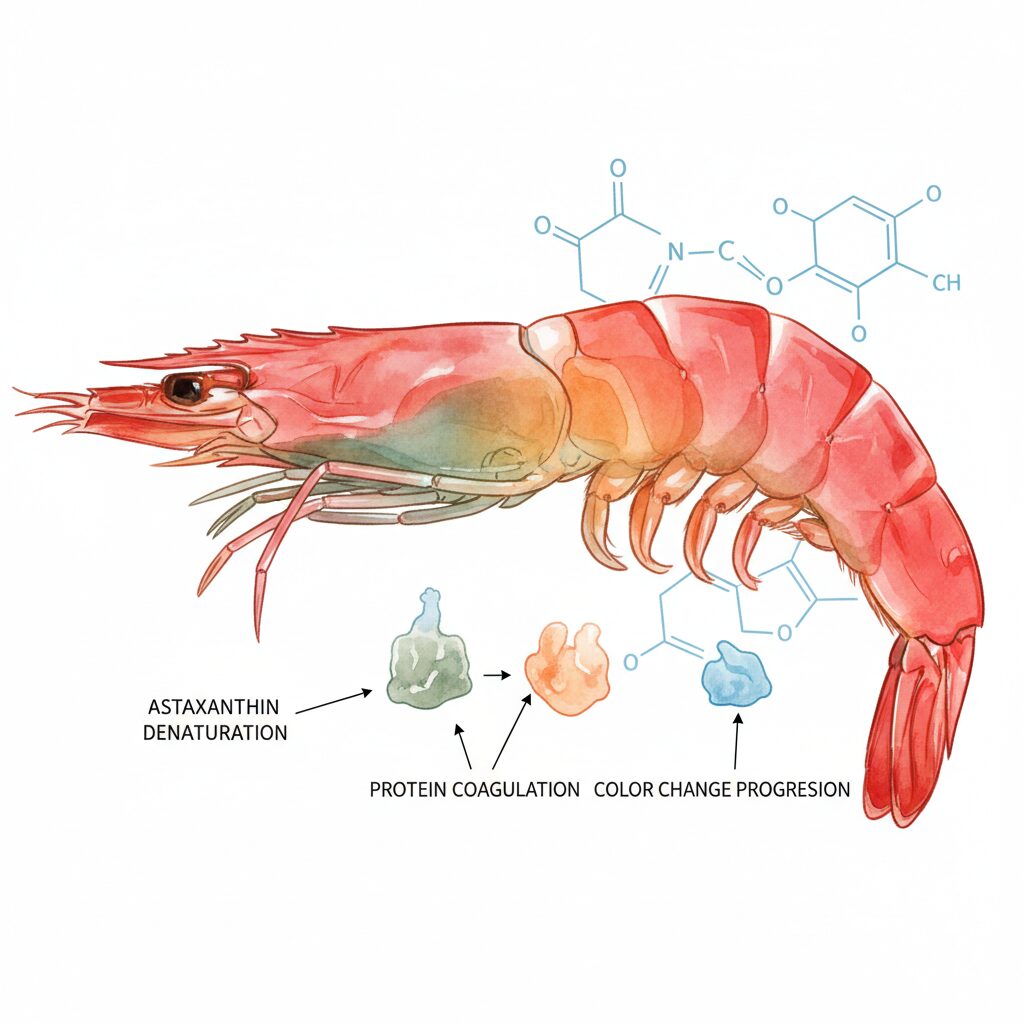
Shrimp and shellfish in general have this magical ability to transform from a dreary gray to a vibrant pink as soon as they encounter a little heat. It’s the kind of thing that fascinates everyone, even if no one had ever really looked into it seriously before thinking, “Wait, why does it turn so vibrant in the kitchen?” The colorful transformation is a spectacle as rapid as it is impressive, and far more scientific than you might imagine. Behind this spectacular metamorphosis lies a story of molecules, heat, proteins performing a dance, and above all, a crucial molecule called astaxanthin, as mysterious as it is essential. Between food chemistry, marine physiology, and little cooking anecdotes, get ready to discover why your shrimp turns such a flashy pink, and how this color becomes a true culinary indicator. Embark on an unexpected dive into the world of carotenoids and thermocolor reactions that will make you look at your pan in a whole new light! How many minutes does it take for shrimp to turn pink, and how does it really work?
Ah, the cooking time of a shrimp, that well-kept secret of culinary mastery! The speed with which this little crustacean changes from dull gray to vibrant pink is no accident. The heart of the phenomenon lies in the molecule called astaxanthin, a pigment naturally present under the shrimp’s shell. Raw, these molecules are concealed by a protein called crustacyanin, which masks their vibrant color. But as soon as heat hits, this protein denatures, meaning it changes structure like a melting plastic wrap at the corner store. The result? The astaxanthin is released, unleashing its vibrant pinkish-orange hue—that famous sign that the cooking process is underway. On average, when cooked in boiling water…The color change show lasts between 2 and 3 minutes. You don’t need to be a Michelin-starred chef to spot the moment your shrimp turns pink—it doesn’t take long! In a pan, where it heats up faster and hotter, this time usually drops to between 1 and 2 minutes per side, enough to get a beautiful bright pink with a hint of caramelization. The oven, true to its slow cooking method, requires 5 to 7 minutes at 200°C (390°F) for an even pink color and perfectly cooked shrimp. 🔥 Cooking Method ⏱️ Approximate Time 👀 Observation
In boiling water 2 to 3 minutesUniform pink, firm flesh
| In a pan | 1 to 2 minutes per side | Light caramelization, bright pink |
|---|---|---|
| In the oven (200°C/400°F) | 5 to 7 minutes | Deep pink, evenly cooked |
| Steamed | 3 to 4 minutes | Translucent pink, tender texture |
| It’s also important to keep in mind that shrimp flesh has a relatively low density, meaning that heat penetrates very quickly, causing a change in color and texture almost simultaneously. This acceleration is due to a | thermal reaction | where |
| the shrimp’s proteins | contract, expelling water and thus revealing astaxanthin like a magician pulling a rabbit out of a hat at the last minute. |
For those who like precise figures, just remember that the pink color isn’t just a fun aesthetic effect: it’s primarily a reliable indicator that the heat has reached the flesh. It’s a bit like the marine equivalent of the four-pronged fork, ultra-precise in its task, but in biochemistry. Discover why shrimp change color when cooked with simple explanations of pigments and the chemistry of cooking. Why don’t shrimp start out pink? The role of proteins and carotenoids. Legend has it that shrimp are naturally pink, like flamingos, which owe their elegance to their diet rich in carotenoid-rich shrimp. However, in reality, most live shrimp are a rather dull gray. This comes from a complex chemical duo: proteins and carotenoids, which play hide-and-seek with color. The star pigment, astaxanthin, belongs to the carotenoid family, fat-soluble molecules responsible for all the beautiful orange to red hues found in the animal and plant kingdoms. But in raw shrimp, this molecule is trapped within a protein called crustacyanin, which alters the visible color. Essentially, marine physiology loves to play with these combinations to make shrimp inconspicuous and somewhat chameleon-like in their environment. When shrimp are heated, this crustacyanin breaks down, releasing the astaxanthin, which finally shines through in its vibrant pinkish-orange coloration. It is precisely this chemical process that explains why cooking is a kind of molecular undressing that reveals the crustacean’s true, vibrant beauty.

Ces articles devraient vous plaire

Why are fingerprints unique to each individual?
You’ve probably seen a scene from a police procedural where the detective proudly pulls out a fingerprint from their fingertip and announces that they’ve got the suspect. But why on earth does each finger have…
If you thought cooking shrimp was just a matter of plunging them into boiling water to get the perfect color, you’re mistaken. In reality, many factors influence the famous “thermocolor” of shrimp, ranging from physical characteristics to cooking conditions. Understanding this ensures culinary success without ending up with a rubbery or mushy shrimp steak.
Here are the main key factors that affect the time and quality of the color change:
🐚 Size and caliber:Mini shrimp (size 60/80) turn pink in seconds, while king prawns or tiger prawns require up to 5 minutes in the pan. ❄️
Product condition:
Fresh or frozen, shrimp don’t react the same way—frozen shrimp, even after thawing, release more water, slightly slowing down the cooking and the color development.
Ces articles devraient vous plaire
Why do apples turn brown once they are cut?
Admit it, it’s frustrating: you take a beautiful, fresh apple, carefully slice it, and suddenly it’s browning faster than expected—and on your apple, no less. No need for sunscreen; this browning is automatic, inevitable, and…
🔥
Cooking Method and Temperature: With gentle steaming, the change is slower but the texture is more tender. When pan-fried, they cook instantly, with a beautiful browning. In the oven, the cooking is more gradual and even. Remember: the higher and more direct the temperature, the faster and more pronounced the color change. The cooking method also impacts the texture, which adapts so you don’t end up with a rubbery or mushy shrimp.
- For a truly fascinating read about marine animals with surprising visual abilities, dive into this unusual article that could blow your mind: The Detective Shrimp and Its Colorful Superpowers
- Beyond Color: How to Tell if Shrimp Are Really Cooked? You now know that pink is a useful cooking secret, but spoiler alert: it’s not enough. Some shrimp can display a pinkish hue without being fully cooked through. This is where experience comes in to avoid two major mistakes: 📌 Undercooking: the shrimp remains soft, translucent, and the ultimate flavor is nowhere near perfect.
- 📌 Overcooking: the flesh splits open, becomes dry and rubbery, like sea gum. A little insider tip? Observe the shape the shrimp takes while cooking. When it’s perfectly cooked, it curls into a
“C” If it forms a complete circle, that’s overcooked, you’re playing with fire (and the texture will be disastrous). And to ensure the flesh is perfect, it should be opaque, never translucent, but not too dry either. So, whether you’re team steaming, stir-frying in a wok, or relaxing on the barbecue, keep this guideline in mind: shrimp should always retain a little elasticity under the fork, as explained in this very tasty article on
Ces articles devraient vous plaire

How does gravity stop the rain from falling endlessly?
Imagine rain as an army of tiny water droplets launched into a dizzying ballet orchestrated by nature. They evaporate from the oceans, condense into clouds, and then, whoosh, tumble to the ground. But wait a…
the science behind our favorite utensil!
- https://www.youtube.com/watch?v=gSNL38hPP9M
- Original ideas for cooking these funny pink crustaceans
Now that you’ve mastered the science of color change and cooking, it’s time to jazz up your cooking with ideas where shrimp really takes center stage on the plate. Here are a few tips and simple recipes to take advantage of this famous color change without any mishaps: 🧄 Sautéed shrimp with garlic and cilantro:
Quickly sauté the shrimp in butter with a crushed garlic clove and a little fresh cilantro for an explosive flavor and the perfect color. 🍋 Poached shrimp with thyme and bay leaf:
Ces articles devraient vous plaire
How does flour transform dough into a delicious cake?
Ah, flour! That little white cloud that finds its way into almost every kitchen and works wonders. But how is it that this simple powder transforms, under the influence of baking and its exceptional partners…
🔥 Barbecued shrimp skewers:
- Alternate shrimp and vegetables on a skewer, brush with olive oil and spices, then grill for a few minutes. The bright pink color will be your best friend to prevent your skewer from turning into chewing gum. 🍜 Shrimp in an Asian wok:
- Add them at the very end of cooking to preserve their color and texture, and to benefit from the astaxanthin that boosts your health. 🥗 Refreshing salad:
- Warm pink shrimp with lime, a drizzle of olive oil, cilantro, and sesame seeds. And for those curious to expand their animal horizons, don’t hesitate to discover why
- the narwhal has earned the nickname “unicorn of the sea,” for another very informative journey into marine oddities!
- Why are shrimp gray when raw and pink when cooked? Raw shrimp appear gray because the natural pinkish-orange pigment, astaxanthin, is masked by a protein called crustacyanin. Heat breaks down this protein, releasing the astaxanthin and revealing the pink color.
How long does it take to cook a shrimp to turn pink? Generally, 2 to 3 minutes in boiling water is enough, or 1 to 2 minutes per side in a pan. This depends on the size, condition, and cooking method.Does the pink color mean the shrimp is cooked through?
Pink is a good indicator, but it’s not enough. The texture, the ‘C’ shape, and the opacity of the flesh are also essential for judging perfect doneness.
What is the role of astaxanthin in shrimp?
Astaxanthin is a carotenoid pigment responsible for the pinkish-orange color of cooked shrimp. It also has antioxidant properties that are beneficial to health.
Is it safe to eat frozen shrimp?
Yes, but be aware that frozen shrimp can contain more water and salt. Those with high blood pressure or allergies should exercise caution.