
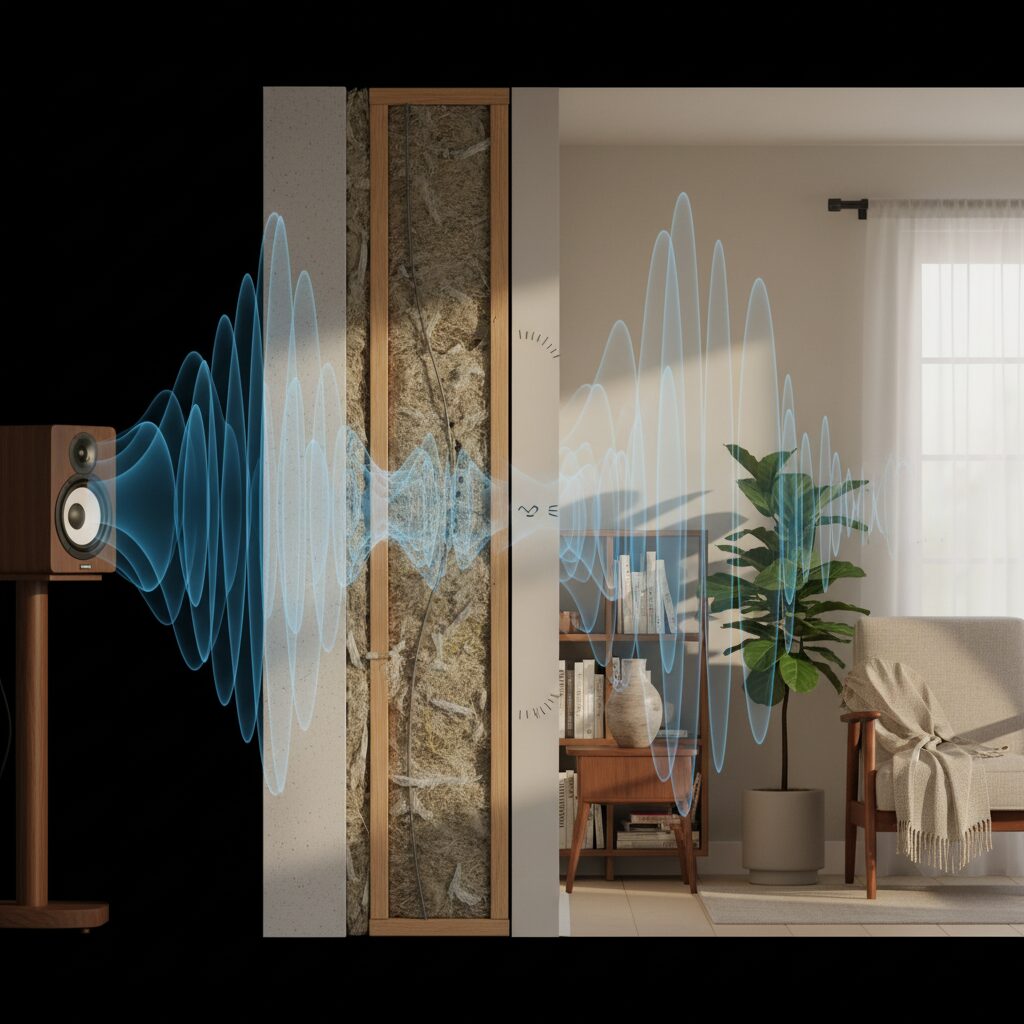
Do you think sound stops abruptly at the door or simply bounces off the walls? Think again. Sound is a clever trickster, capable of gliding, vibrating, and even bewitching you to the point where you hear your neighbor’s argument when you’d much rather have peace and quiet. This traveling vibration pays no heed to the obvious physical boundaries of everyday life. Between the air dancing around you and the walls separating you from the external soundscape, sound takes surprising paths. But how on earth does it manage to cross these barriers without losing its voice? Between reverberation, absorption, and transmission, the invisible world of sound waves reveals mechanisms as fascinating as they are bizarre. Whether you’re pondering this question because you have an incredibly noisy neighbor or simply because you’re curious about how a simple whisper can become a deafening wail, here are five acoustic gems you’ll never look at the same way again.
How Sound Waves Propagate Through Air: The Journey of an Invisible Vibration
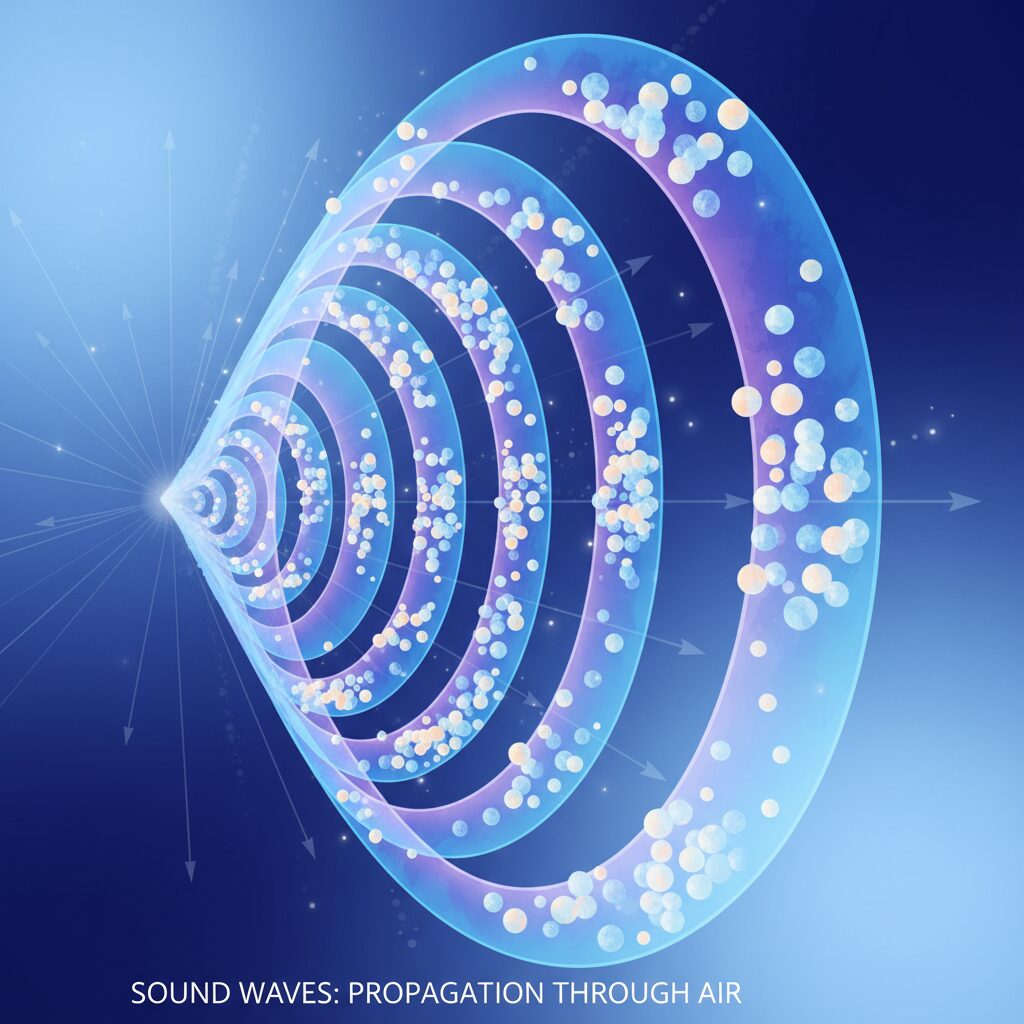
Sound is actually a mechanical wave. Not the kind that sends you signals from your phone, no, but a vibration that travels through the air (or matter) by compressing and decompressing its molecules. Imagine you’re in a corridor filled with millions of tiny elastic balls—those air molecules. When someone shouts “Quiet!”, a vibration (the sound wave) pushes the first balls, which in turn push the next ones. This creates a chain of successive pressures called alternating compressions and rarefactions.
This propagation works by the successive vibration of particles in the medium. There’s no need to transport the particles themselves from one end to the other; they simply take a small step forward and then return to their equilibrium position, a bit like a mosh pit. It’s this boozy back-and-forth of molecules that makes the sound travel, a bit like a domino effect of vibration.
Sound speed is the velocity at which a sound wave travels. In air at room temperature (around 20°C), this velocity is approximately 340 m/s. That’s fast, but compared to light (which travels at 300,000 km/s), it’s like the tortoise in a race. This difference also explains why, during a thunderstorm, you see the lightning before you hear the thunder. If you want to calculate the distance to the storm, take your smartphone, count the seconds between the lightning flash and the thunder, multiply by 340, and there you have it, the approximate distance. But what’s even more interesting is that the warmer the air, the faster sound travels. At 40°C, it can reach 355 m/s. Why? Because the molecules have more energy, move faster, and are therefore more efficient at transmitting these tiny vibrations.
However, be aware that sound propagation in air has its limits: without air (or another material medium), sound doesn’t travel. If you place a speaker in a vacuum chamber, you can see it vibrate, but… don’t expect to hear Stevie Wonder. And for those curious, sound waves travel even faster in water or solids because the molecules are more tightly packed together.
Ces articles devraient vous plaire

How does flour transform dough into a delicious cake?
Ah, flour! That little white cloud that finds its way into almost every kitchen and works wonders. But how is it that this simple powder transforms, under the influence of baking and its exceptional partners…
Discover how sound travels through walls and air, exploring the physical phenomena that allow sound waves to travel and be perceived.
Why and how does sound pass through walls: between vibration and acoustic transmission.
Here’s the part that makes your teeth grind: sound doesn’t pretend. Those walls we think are supposed to block out your neighbor’s whispers? They’re like sheet music for a conductor. Even if you’ve added two layers of reinforced concrete and a velvet curtain, sound always finds a way through. How so? The wall isn’t an impenetrable barrier, but a bridge for vibration.
- When sound hits a wall, it’s not just a “Boom, it hits and that’s it.” The wall, especially if it’s rigid, begins to vibrate. The surface becomes a kind of stage where the initial vibration settles before being transmitted to the other side. This vibration, in turn, creates a sound wave that propagates through the air of the next room. The intensity of this transmission depends on several factors: 📌 The nature of the material: a solid concrete wall will transmit sound differently than a brick, wood, or plasterboard wall. Density, elasticity, and internal structure influence the wall’s ability to vibrate.
- 📌 The frequency of the sound: low-frequency sounds pass through walls more easily than high-frequency sounds.
- 📌 The thickness and acoustic treatment: the presence of insulation, multiple partitions, and sound-absorbing materials can attenuate transmission. A striking example: the bass frequencies of music can penetrate an apartment wall, while a high-frequency sound, like a trill, will have difficulty passing through. This is also why some noise-reduction “solutions” are only partially effective, because they don’t properly target the type of sound wave they are trying to contain. In professional or domestic environments, simple measures such as
soundproofing
or absorbent panels are used to limit this transmission, but the physics of sound remains stubborn. Reverberation and absorption phenomena in the home: why does it sound the way it does in your house? You’ve probably noticed that in a large, empty room, like a church or a gymnasium, your shout of joy echoes back and amplifies. Conversely, in a room lined with curtains, plush rugs, and furniture, the sound seems absorbed, muffled. These effects are due to the way sound interacts with the surfaces it encounters.
Ces articles devraient vous plaire

Why do apples turn brown once they are cut?
Admit it, it’s frustrating: you take a beautiful, fresh apple, carefully slice it, and suddenly it’s browning faster than expected—and on your apple, no less. No need for sunscreen; this browning is automatic, inevitable, and…
Reverberation
is the phenomenon by which sound reflects off hard surfaces without being absorbed, bouncing several times before fading away. This can create an echo of varying duration, sometimes giving the impression that a room is “singing.”
On the other hand, sound absorption is the ability of materials (carpet, foam, thick curtains) to capture these vibrations instead of reflecting them. They transform the sound energy into a very small amount of heat, which reduces reverberation.
| Here’s a short list of materials and their acoustic effects: | Material 🎵 | Reverberation 🔊 |
|---|---|---|
| Absorption 🎧 | Concrete | High |
| Low | Wood | Medium |
| Medium | Carpet | Low |
| High | Acoustic foam | Very low |
Very high
Ces articles devraient vous plaire
How does gravity stop the rain from falling endlessly?
Imagine rain as an army of tiny water droplets launched into a dizzying ballet orchestrated by nature. They evaporate from the oceans, condense into clouds, and then, whoosh, tumble to the ground. But wait a…
So the next time you yell at your roommate to turn the music down, think about the laws of physics that play with reverberation and absorption. It’s a real acoustic theater in your living room.
How measuring the travel time of sound allows us to calculate distances and why it’s useful everywhere
Have you ever wondered how your smartphone or medical devices “see” through matter or determine the distance to an object? The principle is simple and ingenious: we use the travel time (round trip) of a sound wave to calculate the distance.
In the real world, a source emits a sound wave towards an obstacle. This wave is reflected and returns to the sensor after a certain delay. Knowing that sound has a known speed in the medium (for example, 340 m/s in air), you simply need to measure this delay and apply the formula:
d = (v × Δt) / 2
- where d is the distance, v is the speed of sound in the medium, and Δt is the round-trip time. This method isn’t just for measuring the distance between you and a wall. It’s used in several specialized fields:
- 🔍 Medical ultrasound: Ultrasound waves pass through tissues to reveal images of your fetus or organs (hello science!). In this case, the speed of ultrasound is faster (around 1500 m/s in the human body) and allows for more precise measurement of the distance to the organs.
- 🛥️ Nautical sonar : Submarines and boats use sound waves to locate objects underwater by reflecting them.
🚗
Reversing and parking assist systems
Ces articles devraient vous plaire

How do clouds manage to float in the sky?
Have you ever looked up and wondered, between sips of coffee, how those immense, fluffy cushions—aka clouds—manage to float as if by magic in our sky, never collapsing under their own weight? Spoiler alert: it’s…
A fun little calculation: If, during an ultrasound, the echo signal took 6.7 × 10⁻⁵ seconds to return, knowing that the speed of sound in the body is 1500 m/s, the distance to the reflected tissue is:
d = (1500 × 6.7 × 10⁻⁵) / 2 = 0.050 m = 5 cm
A feat of medical technology and a perfect example of the power of sound traveling through various mediums.
https://www.youtube.com/watch?v=hmMak2lMJNs
Resonance, natural modes, and how sound knows how to put on a show in your home
“Sound is a vibration that loves a show,” you might say. For sound to become music, speech, or simply ambiance (you know, even walls can sing if you push them a little), it needs to revel in resonance and natural modes. These concepts, even if they seem technical, are at the heart of why you might say your bathroom is a good stage for singing, but not the living room.
A natural mode is a frequency at which an object or space vibrates naturally, like a swing that loves its rhythm. If you give energy to this frequency, you can amplify the vibrations (amplitude) until they become substantial. This is resonance, and it amplifies certain sounds rather than muffling them. Imagine your room as a giant musical instrument with its own notes to play. The walls, floors, and ceilings each have their preferred vibrations. If the sound emitted by an instrument (or your amateur rockstar voice) corresponds to these frequencies, the vibration “speeds up” and becomes powerful.
From successful concerts to annoying echoes and those infamous, incomprehensible neighbor noises, it’s all explained by the resonance of sound waves that pass through the air and bounce off walls.
Why doesn’t sound travel in a vacuum?