

You’ve probably wondered, while observing the clock hanging on the wall or your watch on your wrist, why on earth the hands always swing in the same direction, the one we pompously call “clockwise.” A question that likely escaped your notice during your Netflix evenings, but one that deserves closer attention. Here’s an everyday mystery, both simple and insidious, because it blends history, science, and a good dose of tradition. Put on your time-traveling explorer’s hat, and let’s discover this strange horological custom!
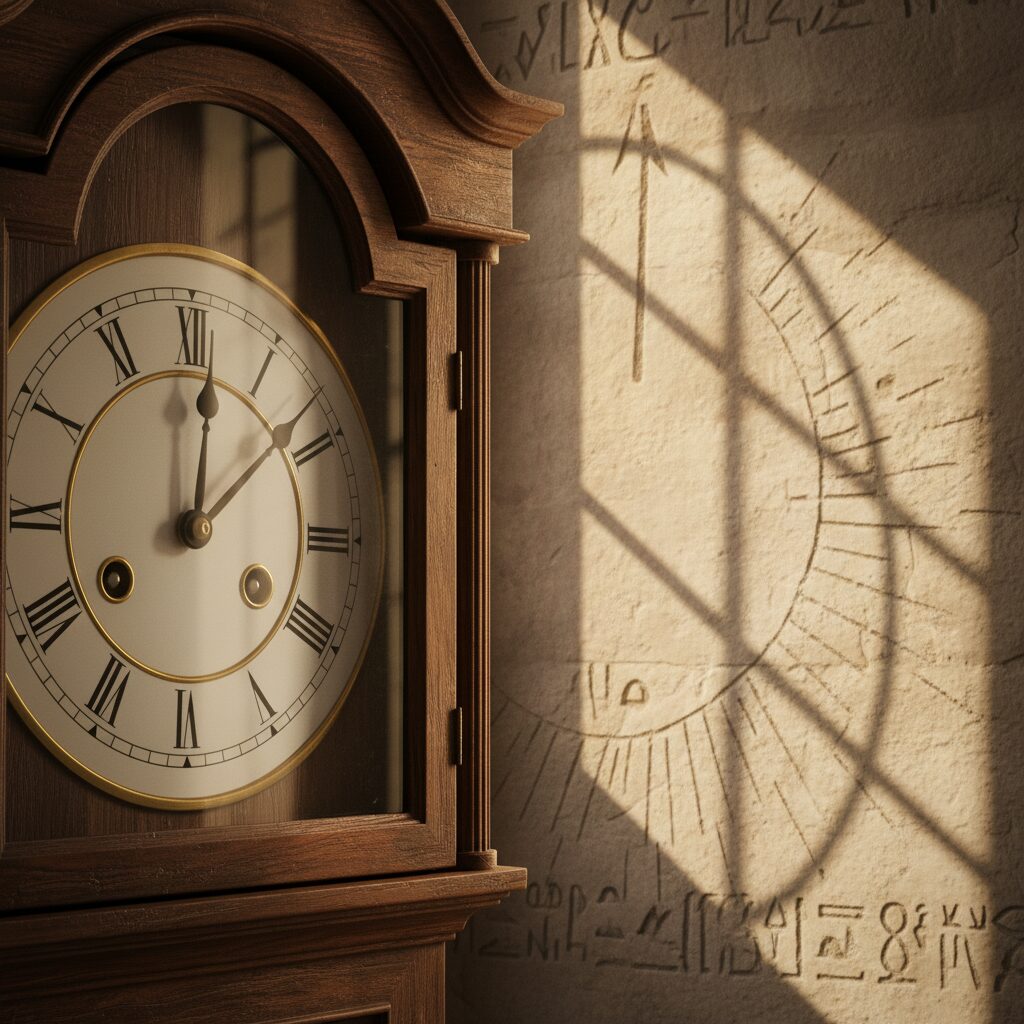
The history of clocks is intimately linked to the great solar dance. If that gentle yellow disc that illuminates our days influences the movement of the clock’s hands, it’s because the first instruments for measuring time, long before the mechanical ticking, were those famoussundials . In the Northern Hemisphere, where the first mechanical clocks were invented, the sun follows a well-defined path: it rises in the east, climbs southward, and sets in the west. The shadow on the sundial therefore naturally moved in a specific direction, which our ancestors captured and adopted. This direction became, over time, the famous clockwise
which has remained unchanged ever since.
How the natural movement of the sun dictated the clockwise direction of clocks Imagine a summer’s day, our Greek (or Egyptian, let’s be fair) ancestors examining a stick planted in the ground, observing the shadow it cast on the hot sand. This isn’t some magical phenomenon, just the famous rotation of the Sun
around the Earth—or vice versa, depending on your preference, since the relativity of motion also applies to the analog world of clocks. On a sundial located in the northern hemisphere, the shadow rotates from left to right, a kind of Circular motion
which seems natural as soon as you see it. This direction is precisely the one adopted for clock hands. Between the years 1200 and 1400, when the first mechanical clocks appeared, the inventors didn’t say to themselves, “Hey, let’s do it backwards, for a change!” No, they simply followed what Nature had shown them for millennia. So why wasn’t this natural choice overturned with the invention of clock mechanisms? Because the direction of the hands became a true
Ces articles devraient vous plaire

The strange stories behind forgotten folk proverbs
We all thought we had mastered our popular proverbs, those little magic phrases that punctuate our conversations and lend an air of wisdom to our replies. Except that some of them have become obscure mysteries…
tradition. And like any self-respecting tradition, it resisted the temptation of reinvention. This direction also allows for maximum uniformity, because what could be worse than having a watch and a clock that run in opposite directions? Imagine the confusion at the airport!
Discover why clocks run clockwise, a convention based on fascinating historical and astronomical reasons.
The Origins of Clockmaking and the Standardization of Clockwise Rotation If you have the patience to listen to a slightly convoluted but fascinating history lesson, did you know that the first mechanical clock
appeared around 1275? A date to etch in your memory the next time you bother to check the time on a vintage watch. These early marvels of engineering, technically barbaric, drew their inspiration from nature, and more specifically from the interplay of sunlight and shadows. The shadow on the dial moved from left to right: the mechanical solution was self-evident. Later, why did this clockwise rotation persist as watches became more widespread? Because thecircular motion
In this sense, it has become the standard for readability. It’s the same principle as reading text from left to right: we get used to a certain direction to simplify things. To convince you, think of those alarm clocks which, in 2025, have often abandoned hands for digital displays, but when you find a clock with hands, it still turns in the so-called “clockwise” direction.
| To delve a little deeper into this subject, you can also explore | the history of the first wristwatches, | |
|---|---|---|
| a fascinating journey where tradition and modernity collide. But to keep it short (we promise), the direction has never changed because it’s the one that naturally appears on the sundial in the hemisphere where it all began. | ||
| A chart to clarify the phenomenon | Element 🕰️ | Explanation 🌞 |
| Consequence for horology 🛠️ | Trajectory of the sun | East to West, passing South in the Northern Hemisphere |
Ces articles devraient vous plaire

Where does the custom of reading under the covers with a lamp come from?
Ah, reading under the covers with a lamp! This nighttime ritual has something magical and slightly rebellious about it, like a little secret shared with your favorite book and that soft glow that slips right…
Shadow moves left to right on sundials → Hands-on movement
First mechanical clocks
Invented in the Northern Hemisphere Adopted shadow movement direction for handsTradition & Standardization
Repeated use and global diffusion
Ces articles devraient vous plaire

Why do brides wear white, and not another color?
You’ve surely seen, at least once in your life, a bride walk down the aisle in a stunning, immaculate white dress, straight out of a fairy tale. But have you ever paused between bites of…
Why the alternating direction of the hands disrupts our logic
Imagine a parallel world where clocks run backward, which would be quite a mess, given that our brain organizes time according to the clockwise direction we’ve been taught since childhood. It would be a bit like reading an Arabic text when you’re used to Latin: it’s very strange!
The choice of clock hands direction isn’t simply a matter of aesthetics. It plays a role in the cognitive optimization of telling time. Indeed, the human brain prefers fixed reference points. It intuitively associates the direction of the hands with the passage of time. This is precisely why complicated alarm clocks with inverted displays make more than one sleep-deprived person sweat! If you want to learn more about the strange relationship between time and alarm clocks, it would be a shame not to take a look at this article
- about alarm clocks that forget the time themselves. Moreover, modern society, too rushed, tends to adopt digital displays, where direction no longer really matters. But watch enthusiasts know that the clock mechanism has its charm, and that the direction of the hands is a kind of universal signature, a silent language passed down from generation to generation. Not to mention that slightly old-fashioned magic that is sorely lacking in digital devices.
- https://www.youtube.com/watch?v=B1frExVE_SM What would be the consequences of a change in the direction of the clock’s hands?
- As you can imagine, changing the direction of the hands—just like that, without warning—would be a horological revolution worthy of the greatest cultural upheavals. Not only would it be cognitive carnage, but it would also complicate the production of everything that measures time. Imagine for a moment corner wall clocks, sports chronometers, or even the simple dial of a smartwatch… Everything would have to be rethought, redesigned, recalibrated. Here is a short list of the elements that would be impacted if the Earth decided to rotate in the opposite clockwise direction:
- 🕰️ Habit and learning:
- We would have to relearn how to tell time and orient ourselves in time. ⚙️
Watch mechanisms: All mechanisms would have to be adapted to the new direction.
Ces articles devraient vous plaire

the unusual habits that have shaped the ritual of the family meal
The family meal: that sacred moment when everyone gathers, not necessarily because they’re starving, but because something magical happens around the table. Yes, even if you’ve already met that friend who ALWAYS eats their pizza…
The universal standardization of clocks would be disrupted.
🧠 Cognitive reflexes: The reversal of natural movements could lead to significant mental confusion.
📱 Connected devices and applications: Graphical interfaces would need to adapt.
To return to something a little less futuristic but just as surprising, it’s fascinating to see that other natural phenomena follow directions dictated by nature, just like the wind, which can sculpt perfect tracks in fresh snow, to revisit a curious topic on
Wonder-Junkies
. This shows that nature loves direction and repetitive patterns, even in domains as unlikely as time.
Clocks in the Southern Hemisphere: a different direction of rotation?
Here’s a little geographical twist: in the Southern Hemisphere, the sun follows an east-west path, but via the north, which logically reverses the direction of the shadow on a sundial. This means that if mechanical clocks had been invented there, we could have had a counter-clockwise direction.
Indeed, on a perfect sundial in the Southern Hemisphere, the shadow would therefore rotate in the opposite direction to the one we know. Yet, strangely, the international standard persists with the clockwise direction that everyone knows, without exception. You could almost see this as a victory of tradition and globalization over local nature.
This paradox is, among other things, an excellent example of a tradition that transcends geography, a cultural phenomenon where habit easily triumphs over geographical logic. To fully grasp this, you can also read about the deeply rooted tradition of the galette des rois (King Cake), which shows how tradition can sometimes take precedence over geographical common sense.
Nature offers us delightful little paradoxes: imagine for a moment a clock in the Southern Hemisphere that runs in the so-called “north-clockwise” direction. Not very natural, but oh so practical!