
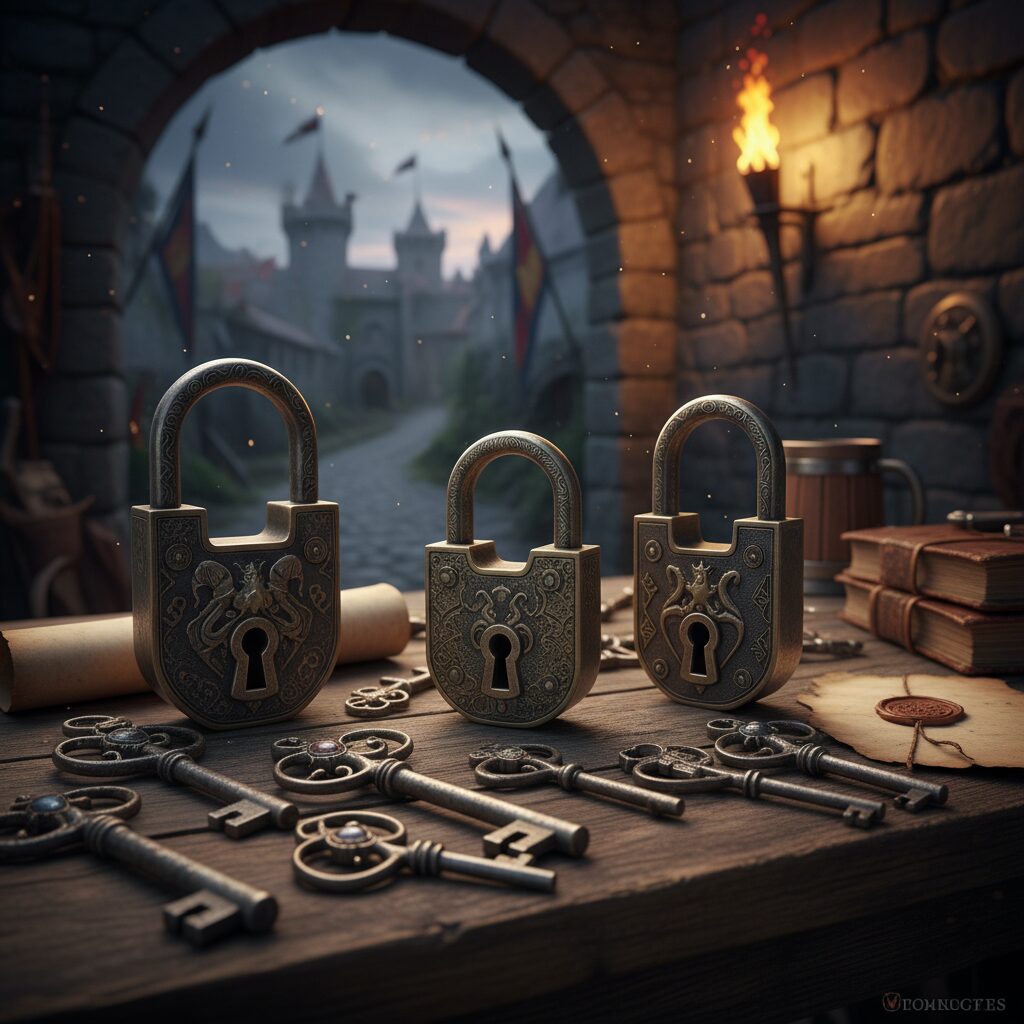
In the vast bazaar of the past, these small metal objects with their decidedly strange shapes aren’t just there for decoration. Antique locks and keys with their improbable silhouettes are the true guardians of an era when security meant not only protecting a chest, but also displaying status, wild ingenuity, and sometimes a touch of mystery. Behind these complex secret mechanisms, which seem straight out of a medieval spy film, lies a fascinating story blending folk art, traditional engineering, and almost magical symbolism. These keys, as long as tavern tales, these locks more fraught with traps than a Chinese puzzle, tell the story of the evolution of
historical security through the ages. It’s hard to imagine that a simple metal object could contain so much ingenuity and history—to the point that some passionate collectors consider them almost works of art, silent witnesses to an era when controlling access to a place was often a near-cinematic challenge.
Why do old keys have such bizarre shapes? A mirror of an era.
Let’s be clear: the shape of a key doesn’t stem from the whim of a delirious artist, but from lock engineering based on logic, the complexity of the mechanism to be protected, and… a touch of ostentation. These keys, long, twisted, sometimes adorned with motifs worthy of a medieval carnival, are first and foremost functional objects, adapted to their respective locks. For example, the famous Gothic key, with its ornate head in the shape of a trefoil or intricate rings, dates from the Middle Ages to the Renaissance. Imagine a blacksmith hammering iron, working by hand, giving each key a unique asymmetry. It wasn’t just a matter of art: the simple, wide bit (the part that fits into the lock) was perfectly suited to the lever mechanism, preventing those with nimble fingers from forcing the door open. In the 19th century, the skeleton key, thinner and made of polished brass, became the preferred tool for opening cabinets and interior doors, with a bit cut with such precision that it almost resembled a handcrafted laser key. Even more substantial was the master key, often made of cast iron or brass, which was nothing less than a specialized key for castle doors or strongboxes, difficult to copy without the expertise of a locksmith. By the way, if you notice a ring on the head of your old key, there’s a good chance it was worn on a belt. Not exactly practical today, but back then, it guaranteed you’d always have the master key close at hand, without risking losing it amidst the daily grind.
What hidden mysteries were these keys designed to hold? Explore the hidden side of these unusual key shapes here, and prepare for a journey back in time when the smallest cog could mean the difference between a secure safe and a royal heist.
Discover the fascinating historical secret of locks and keys with improbable shapes, testaments to ancient and enigmatic craftsmanship. How antique locks blended engineering and decorative art for unconventional security.
Did you know that historical security Was aesthetics as important as robustness? Several types of locks differ in appearance and mechanism, but all sought to make their complex locking system a work of art and a challenge to intruders. The surface-mounted lock, or the one fixed to the exterior face of the door, is a striking example of this symbiosis between art and function. Imagine wrought iron chiseled with motifs of wild animals, human figures, or meticulously engraved rosettes. These decorative plaques, dating from the 16th to the 18th centuries, did more than simply block your entrance; they told a story, displayed the wealth of their owner, and sometimes elicited a nod of admiration from the visitor. Padlocks, for their part, were no less impressive. When they took the form of animals, like bears or lions, it wasn’t just a regional aesthetic whim: these shapes were popular in Northern Europe and aimed to impress visually as much as to intimidate potential thieves. Sometimes, these little secret chests included combinations, making opening them less intuitive than a simple click.An authentic antique lock is recognizable by its complex internal mechanism and deep patina. Don’t get carried away if the metal is smooth and shiny: today’s find might be a pale imitation ready to fool casual collectors.
Ces articles devraient vous plaire

The strange stories behind forgotten folk proverbs
We all thought we had mastered our popular proverbs, those little magic phrases that punctuate our conversations and lend an air of wisdom to our replies. Except that some of them have become obscure mysteries…
Were you thinking of throwing away that old key or rusty lock inherited from your great-uncle? Think again, these relics are actually making a splash in the world of vintage decor and collecting. The new wave of traditional craftsmanship pays homage to these objects forged with sweat and sweat, love and attention to detail.
Keys are now making their mark as trendy pendants or wall hangings in cabinet-of-curiosities style frames. The more beautiful their patina, the more aesthetic value they gain. Padlocks, meanwhile, bring a raw, industrial contrast to light wood furniture or minimalist desks, perfectly balancing robustness and old-fashioned charm. Large surface-mounted locks haven’t been forgotten either: cleaned and waxed, they find their place framed on the wall or placed on a shelf like true minimalist art objects. Their improbable, sometimes gigantic, shape fascinates as much as it hypnotizes—they become essential guests in interiors seeking that “authentically bizarre” touch. Examples of successful restorations: 🔧 A medieval escutcheon lock restored by a local craftsman, now displayed as a living room centerpiece 🗝️ A Gothic key transformed into a unique piece of jewelry, worn by a vintage fashion blogger 🦁 A lion-shaped padlock integrated into a designer piece of furniture, celebrated in an industrial design article https://www.youtube.com/watch?v=Uj3UpTq9Gsk
What are the strengths and weaknesses of antique security systems in the face of modern challenges?
The
Ces articles devraient vous plaire

Why do brides wear white, and not another color?
You’ve surely seen, at least once in your life, a bride walk down the aisle in a stunning, immaculate white dress, straight out of a fairy tale. But have you ever paused between bites of…
secret mechanisms
of antique locks were not just decorative fluff: they met very serious security standards, even if they seem archaic today compared to electronic systems. Wrought iron, used extensively, offered remarkable physical resistance, especially since these were often unique pieces, which drastically reduced the effectiveness of master keys. Each lock was a mechanical enigma in its own right. The main problem was that they were vulnerable to corrosion, to picking when the lever mechanism was poorly designed, or simply to brute force – the infamous “crowbar” and the like were not just movie props. However, some medieval locks incorporated anti-picking systems ahead of their time, thanks to cleverly designed levers and false tumblers.
Out of curiosity, here’s a comparison chart between antique and modern locks to help you see the difference between the two: 🔐 Characteristics ⚙️ Antique Locks
🔒 Modern Locks
🔍 Security
- Variable
- , sometimes very complex
- High
Ces articles devraient vous plaire

the unusual habits that have shaped the ritual of the family meal
The family meal: that sacred moment when everyone gathers, not necessarily because they’re starving, but because something magical happens around the table. Yes, even if you’ve already met that friend who ALWAYS eats their pizza…
⚙️ Complexity
Mechanical and handcrafted Mechanical and/or electronic 💰 Cost
Can be high
for rare pieces
| From entry-level to high-end | 🎨 Aesthetics | Artistic and decorative |
|---|---|---|
| More functional and discreet | ⏳ DurabilityDepends on materials and maintenance | Generally good🛠️ Ease of Use |
| Sometimes tricky | Simple and intuitive | https://www.youtube.com/watch?v=WjpIrUzCvAk |
| How to collect and restore these keepsake chests? | Collecting antique locks isn’t just a nostalgic hermit’s hobby; it’s a profession for history diggers, validated by the legacies of the past. To begin, you need patience, a good guide to antique keys, and you shouldn’t hesitate to frequent flea markets, auctions, and family heirlooms. Condition, rarity, and provenance are crucial factors in estimating a piece’s value. | Restoration requires precise expertise: abrasive cleaning methods that destroy the charm of age are avoided; instead, a gentle citric acid bath followed by light oiling and protection with microcrystalline wax is preferred. This meticulous work preserves the original charm while restoring the robustness of the mechanisms. |
| 🛠️ Gentle and non-aggressive cleaning | 🔩 Replacement or repair of parts with faithful replicas | |
| 🧴 Protection of metals with appropriate products | 🗂️ Storage in dry, dark spaces | Acquiring an antique key or lock is like opening the door to a miniature museum, full of stories and hidden meanings. After all, what better way to preserve a secret than by keeping it locked behind a lock with an unusual design? |
| Why do antique keys come in such varied shapes? | Because their design was a compromise between secure engineering, ease of use, and symbolic decoration, which varied according to the era and function. |
Ces articles devraient vous plaire

Where does the custom of reading under the covers with a lamp come from?
Ah, reading under the covers with a lamp! This nighttime ritual has something magical and slightly rebellious about it, like a little secret shared with your favorite book and that soft glow that slips right…
How to recognize an authentic antique lock?
An authentic antique lock has a complex mechanism and a pronounced patina, often black and rough, evidence of craftsmanship and age. Can you still use an antique lock today? Yes, but they often require regular maintenance and may be less practical than modern technologies, even if they possess an unparalleled charm.
How to start a collection of antique locks? You need to do your research, visit flea markets and antique shops, assess the condition and rarity of the pieces, and favor locks with a history or provenance.
- Are antique locks more secure than modern locks?
- Not really. They are ingenious but often vulnerable to lock picking and brute force, unlike modern locks that incorporate advanced technologies.