
The compass, that small piece of magnetized metal, has undoubtedly changed more destinies than any crystal ball or carnival horoscope. Before its invention, getting lost at sea was practically a national sport for explorers, because navigating without landmarks is a bit like looking for your keys in the dark: you always end up turning the keyhole wrong. But thanks to this magnetically magical tool, navigation received a decisive boost, propelling daring sailors toward unknown continents, uncharted trade routes, and, incidentally, into the world of billionaires before their time. How did this floating magnet manage to tame the infinite blue and radically change the fate of explorers? To understand this odyssey of needles and magnetism, we must go back a long, long way, to the time when the compass was not yet the essential tool for globetrotters. Its story begins in ancient China, a land of wisdom and magnetic spoons—a little less practical than a GPS, but undeniably more stylish. Then, like an ancient rock star, it migrated to Europe, where it was refined and made indispensable. In 2025, despite the ubiquity of high-tech GPS, the compass remains a fascinating symbol of adventure and human geography.
How the Chinese compass sowed the seeds of modern navigation.
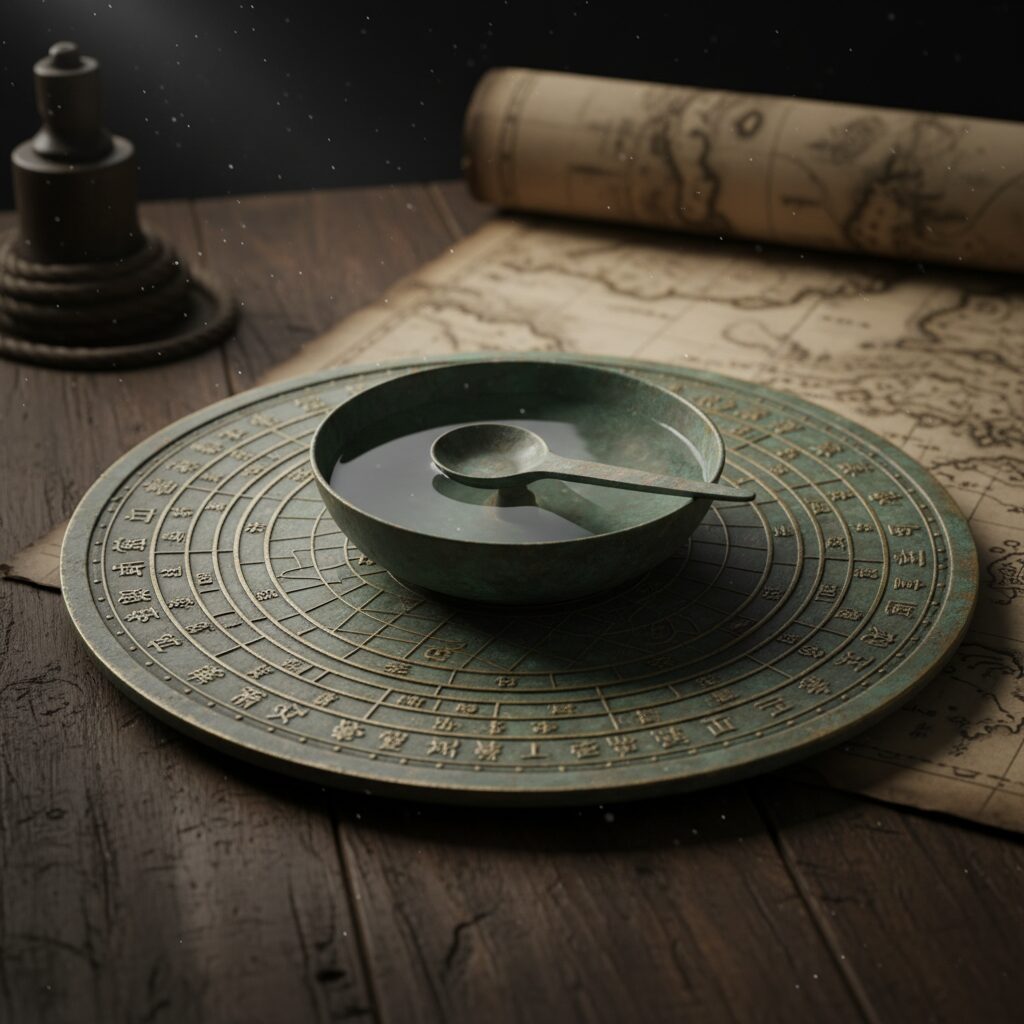
Even before Christopher Columbus dreamed of crossing the Atlantic, the Chinese of the Han dynasty were already playing with small magnetic pebbles. Yes, the compass was invented long before Europe began to dream of great discoveries, and its primary purpose wasn’t to avoid getting lost at sea. In fact, the compass’s first function was more akin to a fortune-telling contest in Feng Shui and divination practices. Now, imagine an explorer using their GPS to choose where to pitch their tent: it just goes to show that the quest for orientation is as old as the fear of spending a sleepless night in a dark forest. The primitive Chinese compass, that famous magnetite spoon resting on a polished bronze plate, floated gently, indicating south (not north, mind you!) thanks to the Earth’s magnetic field. A crucial first step that allowed navigation to move from a vague, artistic approach to a slightly more precise framework, even if, at this stage, it still remained a sport for the brave. To learn more about the fascinating magnetism that makes all this possible, you can take a look at
how magnets know where to attract or repel each other
, in other words, the magic behind this basic compass. The adoption of the compass at sea began more seriously during the Song Dynasty, around the year 1000, when sailors traded their spoons for a magnetized needle on a floating support, much more practical for guiding ships through waters even more unfamiliar than the evenings after a good birthday party. This invention allowed them to put an end to long hours scanning the stars or the coastlines, thus avoiding the risk of ending up like lost tourists. And for those who wonder how animals find their way without GPS, the answer is as magical as the story of the compass.
Because, spoiler alert, nature is always one step ahead of human technology. Why the compass made Europe a superhero of maritime exploration
Ces articles devraient vous plaire

Where does the custom of reading under the covers with a lamp come from?
Ah, reading under the covers with a lamp! This nighttime ritual has something magical and slightly rebellious about it, like a little secret shared with your favorite book and that soft glow that slips right…
Importing the compass to Europe was a bit like giving a state-of-the-art smartphone to sailors still struggling with carrier pigeons. Around the 12th century, thanks to cultural exchanges with the Arab world, where the compass had already traveled via the seas of Asia and trade routes, Europeans discovered this revolutionary little instrument. The city of Amalfi (Italy) claims the glory of this first reception, but it was really over the decades that the compass gained prominence. As early as 1218, a bishop of Acre didn’t hesitate to say that sailors could no longer do without it, which shows just how essential the instrument had become before Netflix.
But Europeans didn’t just copy. With their characteristic local ingenuity, they improved the compass by adding the compass rose in the 14th century, that small round map with numerous directions that would have made any navigation app envious. The protective casing and the needle pivot also contributed to its stability and robustness, making the tool not only accurate but also resistant to sea storms – much more effective than praying to Neptune for a miracle.
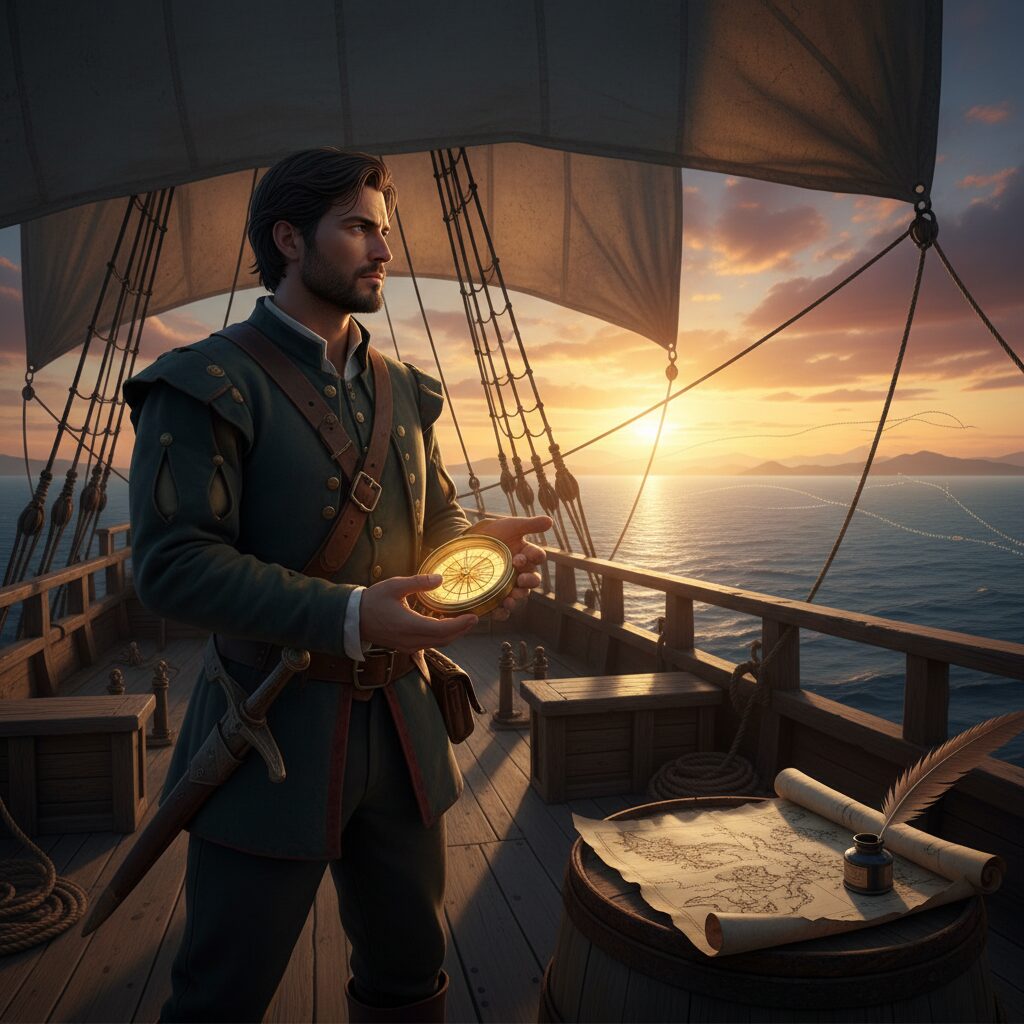
With these improvements, the compass became the key instrument of great European explorations. Christopher Columbus, Vasco da Gama, and Magellan all carried one on their ships, guiding their expeditions to new worlds. Without this magnetic ally, the size of the globe would still be a complete mystery, and the geography we study in high school, a vague, hazy memory. This revolution can also be understood through the progress in map accuracy, a field where the compass clearly made its mark by simplifying the creation of more reliable maps.
Ces articles devraient vous plaire

the unusual habits that have shaped the ritual of the family meal
The family meal: that sacred moment when everyone gathers, not necessarily because they’re starving, but because something magical happens around the table. Yes, even if you’ve already met that friend who ALWAYS eats their pizza…
- A list of adventures made possible thanks to the magic of magnetic orientation 🧭✨
- 🔭 Christopher Columbus’s mysterious crossing of the Atlantic, which opened the way to the New World.
- 🌍 Vasco da Gama’s expeditions to India, breaking the Arab monopoly on the spice trade.
Ces articles devraient vous plaire

Why do brides wear white, and not another color?
You’ve surely seen, at least once in your life, a bride walk down the aisle in a stunning, immaculate white dress, straight out of a fairy tale. But have you ever paused between bites of…
🐉 Zheng He’s voyages in the 15th century, exploring the Indian Ocean and forging links with East Africa.
🚢 The gradual mapping of uncharted seas, which helped secure maritime routes for global trade.
Discover how the compass revolutionized travel and exploration, forever changing the destiny of explorers around the world. The compass versus modern technology: how does it maintain its legendary status?In 2025, with GPS integrated into all smartphones and exploration drones, the compass could have taken a well-deserved retirement in a dusty museum. Spoiler alert: it’s still going strong, and even hardcore hikers rely on it! It remains a reliable, economical, and timelessly cool tool for outdoor activities.
Ces articles devraient vous plaire
the historical secret of locks and keys with improbable shapes
In the vast bazaar of the past, these small metal objects with their decidedly strange shapes aren’t just there for decoration. Antique locks and keys with their improbable silhouettes are the true guardians of an…
Moreover, from a scientific perspective, the compass remains a marvelous example of the Earth’s magnetism at work, and if you want to understand why magnets stick together without magic glue, it’s partly thanks to this mechanism that they point north with such accuracy. Finally, we mustn’t forget that all these navigational feats are also a valuable lesson in cultural adaptation, as demonstrated by successive explorers who integrated and improved this tool in their own way, ultimately shaping the globalization and interconnectedness of today. https://www.youtube.com/watch?v=6NjKoUChTeg
When the Compass Also Guides the Mind and Science: Trends and Applications in 2025
In 2025, the compass will be more than just a gadget for budding adventurers. Its design has inspired fascinating contemporary fields. Future engineers are drawing inspiration from it to create robotic orientation systems, particularly for the autonomous navigation of vehicles and drones. Cognitive navigation techniques, a subject dear to cognitive science, are adopting this simple yet ingenious mechanism. Furthermore, the compass also fosters scientific curiosity in a world where understanding our environments is vital. Modern explorers—on foot, by kayak, or even with a drone—appreciate maintaining a solid grasp of the basics, thus strengthening their connection with nature before relying on technology. Even more interestingly, the compass serves to demonstrate how nature adapts: in the formations of certain migratory birds, naturally oriented by the Earth’s magnetic fields, the parallel is striking. You can learn more at this address:Why do Canada geese fly in V formations for thousands of kilometers?
| Nature has its own built-in compasses! 🌍 Major Explorations | 🧭 Type of compass used | |
|---|---|---|
| 📜 Historical Consequences | Zheng He’s exploration of Southeast Asia | Copper floating needle |
| Strengthened trade with East Africa | Christopher Columbus’s voyages to America | Protected magnetic needle |
| Discovery of the New World and European economic rebound | Magellan’s circumnavigation of the world | Compass rose + needle pivot |
| Confirmation of the Earth’s sphericity | Portuguese expeditions around Africa | Improved compass with protective casing |
https://www.youtube.com/watch?v=R9Xe3FGICK0
Why does the compass always point north?
Because the needle is magnetized and aligns with the Earth’s magnetic field, thus indicating the magnetic North Pole. How did the compass contribute to great explorations?
It allowed explorers to navigate accurately at sea, making long voyages to unknown lands possible.
Is the compass still useful in 2025?
Yes, especially for hiking and orienteering, where electronic technologies can malfunction or lose signal.
Which civilizations contributed most to the evolution of the compass?
The Chinese, Arab, and European civilizations each made significant innovations to the compass.
What is the link between the compass and magnetism?