

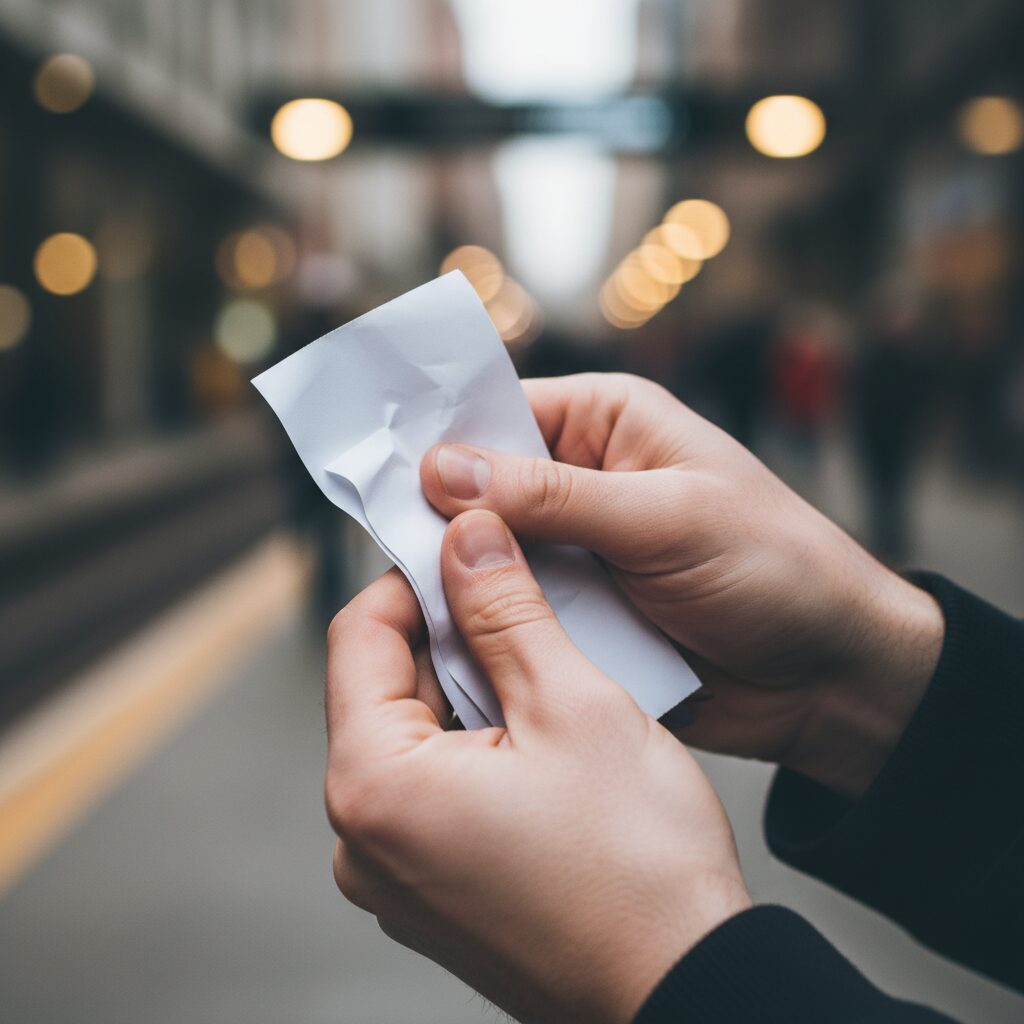
You’ve probably already encountered this strange species at a party, in the supermarket, or even on the subway: the person who takes their receipt, their metro ticket, or any scrap of paper and crumples it as if they’ve just received the worst insult of the century. Why crumple a ticket? It might be more than just an impulsive gesture. This seemingly harmless behavior often hides surprising psychological mechanisms, ingrained habits, or even little automatic responses that reveal our anxieties or, let’s be honest, a certain addiction to the reflexive gesture. In this article, we explore this curious habit with a scientific perspective and a touch of humor. You’ll never look at a crumpled ticket the same way again. Why Crumple Tickets: Between Automatic Gesture and Psychological ImpulseWhen someone folds, crushes, or crumples their ticket, this behavior can seem harmless, almost invisible. Yet, it’s often a sign of an ingrained habit, a kind of gestural tic that allows you to release internal tension or unconsciously express personal satisfaction. Imagine yourself at the checkout, in the middle of a queue, you get your receipt and bam! You crumple it without thinking. This gesture can be a way to channel fleeting stress, guilt about having spent too much, or simply the pleasure of transforming an ordinary object into a shapeless ball destined for the trash. Yes, crumpling is also a small pleasure, a mini-rebellion against monotony. Still not convinced? Some researchers in cognitive psychology suggest this gesture is an unconscious response to boredom or anxiety. Crumpling a receipt is a bit like playing with a rubber band or twisting a piece of paper: it provides tactile stimulation that occupies the mind. This is what some call a self-soothing behavior.
Moreover, other very similar habits—like tapping on your phone for no reason or fidgeting with your leg—operate on the same principle. Sometimes, it’s simply a sign of an addiction to movement.
Basically, the crumpled ticket becomes a fuse that ignites a small cerebral spark to calm the brain. And that alone is already a good reason to better understand this gesture, rather than just watching the pot steaming without doing anything. Discover the psychological and behavioral reasons why some people tend to systematically crumple their tickets. Crumpling as an unconscious ritual: a way to master the moment Now, what happens in the brain when we transform a flat ticket into a crumpled ball? This small act can be perceived as a form of ritual, a way to reassure oneself in sometimes stressful environments. Imagine an endless queue, a rather unfriendly cashier, bags to manage, and that ticket in front of you. Crumpling this tiny piece of paper can become a repetitive gesture that marks the end of a purchase, a symbolic closing to a stressful or monotonous activity. This idea of ritual is important in understanding behavior.
For example, crumpling a receipt is a bit like running your hand through your hair without thinking—it’s instinctive, repetitive, and often soothing. It’s a subtle form of taking control, a mini-gesture that allows you to materialize your presence in the action, in the moment. Psychologically, this kind of habit also relies on our human tendency to repeat simple gestures to manage our stress.and regain a sense of control, even when everything around seems a bit chaotic. That’s why you might also notice that these kinds of people often crumple their tickets systematically, regardless of their mood or where they are.This morning or daily ritual is similar to other little habits like opening and closing the fridge for no reason (yes, it’s a real thing!), or rehearsing a text in a low voice so as not to forget anything (we’ve all done that). Reflexive gestures in managing daily anxiety Crumpling is also often linked to managing anxiety, a more or less conscious mechanism that helps release excess nervous energy. In neuroscience, we sometimes talk about “ritualized actions” or “safety behaviors” that create a zone of psychological comfort. This type of action, repeated without really thinking about it, acts as a safety valve. If you get the impression that some people crumple their tickets even when they’re not stressed, remember that this action can become automatic through habit, a kind of mechanical addiction, unrelated to the situation.
But be aware that this behavior can also be influenced by other factors: fatigue, a noisy environment, or simply ingrained habits. In short, crumpling a ticket, beyond being a strange gesture, is ultimately a way to protect oneself, to refocus.
Ces articles devraient vous plaire
Funny and educational: do chairs have a history?
We sit on them every day without giving it a second thought, and yet, a chair isn’t just a piece of wood with a backrest. It’s an object steeped in history, culture, design… and even…
https://www.youtube.com/watch?v=cHAf-VSnZSQ
Why not all tickets deserve to be crumpled? Wear and tear and real value Surprisingly, aticket
A crumpled note isn’t necessarily a sign of undervaluing it. Some banknotes, especially euro notes, get damaged quickly in everyday life, and that doesn’t mean they’re worthless. In fact, €5 and €10 notes are the most prone to wear and tear, while a €20 note lasts an average of two years before showing signs of wear. But why all this talk about banknotes when we’re talking about tickets? Well, in everyday language, we often confuse these two concepts. Crumpling a banknote, a receipt, or a metro ticket is considered a small piece of paper with little value, whereas in reality, a badly damaged note can still be exchanged at the bank for a new one. The Bank of France even offers a service for exchanging worn banknotes (that’s another little secret of our time).
And you shouldn’t just crumple them any old way either. Any banknote stained with ink—that infamous colored ink released when an ATM is broken into or stolen—becomes unusable. You must then go to your bank branch to verify the banknote’s authenticity, thus avoiding any unpleasant surprises in your wallet. Here’s a small table that gives an overview of the average lifespan of banknotes before they become particularly fragile: Banknote Value 💶
Average Lifespan 🚀Main Reason for Wear and Tear 🔍€512 to 18 monthsHigh circulation, daily creases and wrinkles
€10
14 to 20 months Frequent handling, creasing and tearing €20
18 to 24 months Less frequently used, therefore more resistant In short, crumpling a banknote or ticket is sometimes just a reflex, but it can have a real impact if you don’t pay attention to the condition of your small bills or tickets!
Among the crumpling pros: an unlikely study of bizarre habits
Ces articles devraient vous plaire
surprising habits related to light switches in our homes
Who would have thought that this small button, often invisible but always present in our homes – the light switch – could be the site of some rather surprising oddities and habits? While technology and…
Behavioral studies show that these individuals often share a certain underlying nervousness and a need to move, to do something with their hands. This need falls within the broader context of habits linked to reflexive gestures and can also be interpreted as a reduced form of compulsive behavior. Compulsive crumplers sometimes demonstrate a difficulty in managing frustration and inner tension. Crumpling thus allows them to channel a form of social or situational anxiety, for example, when faced with an overpriced purchase, a delay, or simply the stress of daily life. However, this gesture has also become a deeply ingrained habit: if they don’t crumple their ticket, they feel a slight discomfort, a kind of emptiness to fill. This ties into the idea of a behavioral addiction to small manual rituals, like fiddling with a pen or playing with one’s keys.
https://www.youtube.com/watch?v=U6-cZ_mhgVo Tips to tame this unexpected habit and understand its meaning
If you yourself are a ticket crumper or if you know this type of person, here are some ways to decipher and perhaps, eventually, calm this gesture that is becoming an automatic and sometimes annoying habit.🧠 Understanding its origin:
prioritize reflecting on the behavior and identify whether this gesture is a response to stress or boredom. ✋
Replace the action:
| Try alternatives, such as manipulating a stress ball or a useful object to keep your hands busy without needlessly crumpling things. | 😌 Breathing technique: | |
|---|---|---|
| Use mindful breathing exercises to reduce feelings of anxiety. | 📅 Establish a positive ritual: | |
| Replace the crumpling with a positive action, such as putting away your receipt or carefully slipping it into your wallet (we know, it sounds crazy). | Talk about it: | |
| Speak with a loved one or a professional to understand any underlying causes. | We could even imagine, like | a stone floating strangely |
, that this little crumpling is just a human quirk in an ocean of silent routines.
Ces articles devraient vous plaire
Ordinary object or unsung hero? The incredible story of the lighter
Think the lighter, that little gadget we pull out of our pockets to light a cigarette, a campfire, or even sometimes conduct less-than-safe pyrokinetic experiments, is just a simple, everyday object? Think again! Behind this…
Does crumpling a receipt really damage banknotes?
No, crumpling a receipt or banknote doesn’t necessarily reduce its value, but a badly damaged bill can be refused or exchanged at the Bank of France.
Why do some people crumple their receipts without realizing it? Often it’s an unconscious, automatic behavior, linked to stress management, anxiety, or a soothing reflex for the brain. Can you stop crumpling tickets if it’s a habit? Yes, with a little awareness and simple techniques to replace the gesture, you can reduce this habit.
Is this gesture linked to other compulsive behaviors?Sometimes yes; in some cases, it can be part of a series of small, repetitive behaviors linked to anxiety or nervousness. Is there a link between crumpling and a form of addiction? We can talk about behavioral addiction, where crumpling becomes a kind of habit that’s hard to break.
Ces articles devraient vous plaire
Everyday objects: the joyful history of the tissue box
We see tissue boxes everywhere: at the office, on the living room table, sometimes even on the bedside table when a nasty cold strikes unexpectedly. This simple object, so commonplace that we rarely pay it…