
Imagine rain as an army of tiny water droplets launched into a dizzying ballet orchestrated by nature. They evaporate from the oceans, condense into clouds, and then, whoosh, tumble to the ground. But wait a second: why don’t these drops fall endlessly, like a never-ending waterfall playing overtime in the sky? This question might seem simple, but upon closer examination, it takes us on a fascinating journey involving gravity, atmosphere, and the balance of forces. What if we rewound the film of the water cycle to understand how gravity keeps this capricious rain in check, while preventing an endless celestial flood? Here’s your ticket to a journey into the heart of physics and meteorology, with an invisible universe that plays tricks on our wet heads!
How does gravity slow the fall of raindrops and prevent them from falling to infinity?
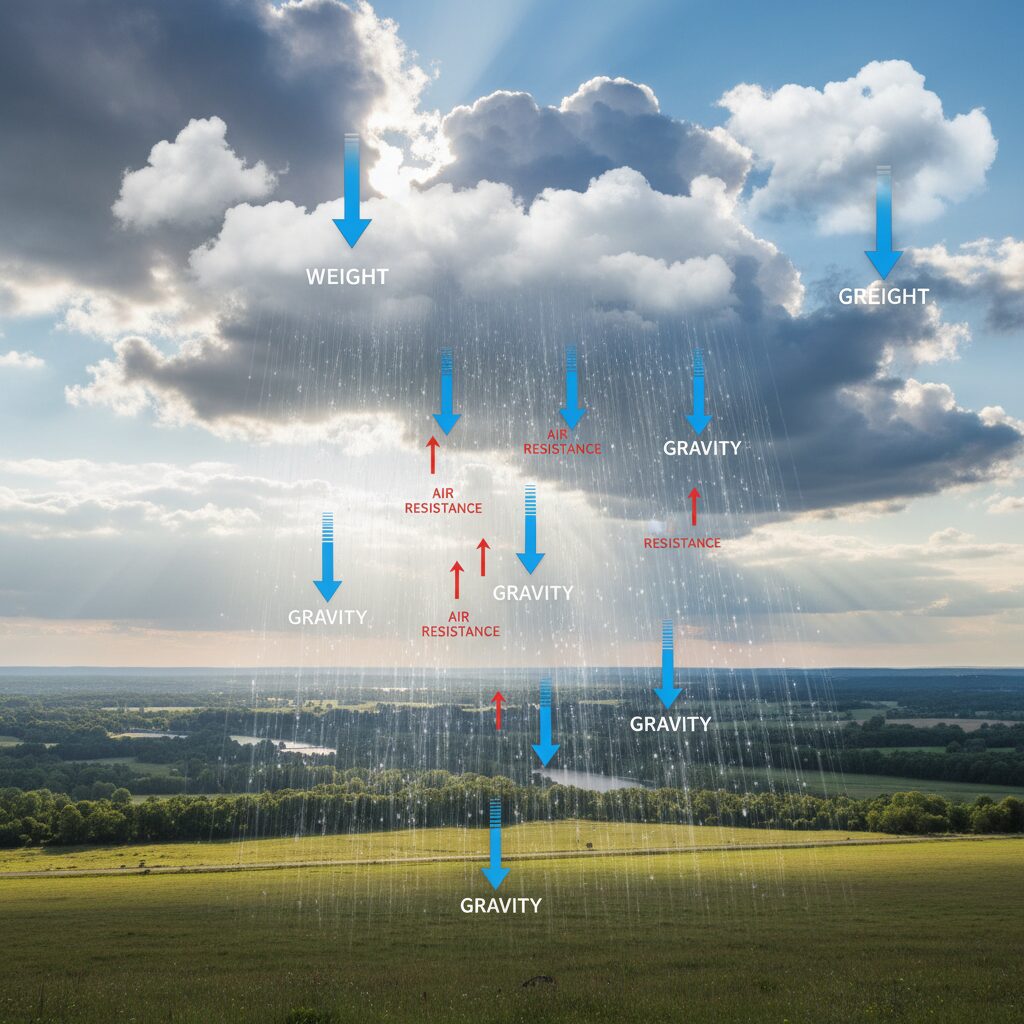
Gravity, this universal force of attraction, is the number one culprit that makes it rain. But it doesn’t let things spiral out of control to the point where the drops plummet endlessly like in a poorly written science fiction novel. In short, gravity pulls water droplets toward the ground at an average acceleration of approximately 9.8 m/s². However, life is rarely that simple: rain encounters air resistance, an invisible friction that opposes its downward trajectory. This resistance acts as an aerodynamic brake. As the rain falls, the speed of the drops increases, exacerbating this resistance until it reaches a point where the gravitational force is exactly counterbalanced by air resistance. This critical point is called the terminal velocity. Beyond this speed, raindrops can no longer accelerate; they fall at a constant rate, thus preventing an ever-faster, uncontrolled, and endless descent. If gravity were a single force, unaffected by anything else, rain would become a kind of liquid Armageddon, except that atmospheric friction saves the day. This distinction is crucial to avoid cataclysms like endless torrents splashing through space, and that’s precisely what we observe in nature.To put it in perspective, a typical raindrop (about 2 mm in diameter) quickly reaches its terminal velocity, somewhere between 6 and 9 meters per second. This figure may seem high, but thanks to the balance of forces, this speed is stable, and the rain therefore chooses its own pace. That’s why it always ends up stopping on the ground, prompting us to consider the existential question of whether or not to use an umbrella.
One might also wonder if, without an atmosphere, this story would take a different turn. Spoiler alert: yes. In an airless environment, raindrops would encounter no resistance, so they would accelerate without limit until they hit the ground, or the nearest surface. The gravitational force remains the same, but the absence of a natural brake changes everything. It’s a bit like going down a slide in a pool of viscous syrup versus a pool of clear water. In the air, rain lives its best life in moderation.
Discover how the force of gravity prevents rain from falling endlessly by keeping water droplets moving towards the Earth’s surface.
From Cloud to Ground: Key Stages of the Water Cycle Influenced by Gravity To better understand why rain stops at the ground, we must delve back into the water cycle, this magical and essential loop that keeps the blue planet going. It all begins with evaporation. When the sun heats the oceans, lakes, and rivers, the water turns to vapor, rises into the atmosphere, and leaves behind a trail of moisture of varying density.
Ces articles devraient vous plaire
How do stars manage to shine for so long?
Stars, those majestic celestial fireballs, have never ceased to amaze humankind for millennia. Yet, behind their seemingly eternal brilliance lies a fascinating scientific secret, worthy of the greatest science fiction novels – but without the…
But everything comes to an end: when the droplets grow large enough (about 0.5 mm in diameter), they become too heavy to be held up by these atmospheric “elevators.” Gravity takes over. The rain then falls, accelerating until it reaches its terminal velocity, as explained above, before finally reaching the ground. This moment marks the culmination of the water cycle, where the balance of forces reigns supreme. This interplay of forces balances Earth’s gravity and atmospheric pressure, and also explains why, even if you’ve always had the impression that rain falls a little “at an angle” or in the wind, gravity remains the dominant force in vertical movement. To delve deeper into this fascinating phenomenon, you can also take a look atwhy clouds sometimes seem to dance to the rhythm of a light breeze, to understand this celestial choreography.
https://www.youtube.com/watch?v=xNuHtbrKwBY Local variations in gravity and their impact on rainfall
Despite its reputation as a universal constant, Earth’s gravity varies slightly depending on your location. So yes, even the somewhat capricious rain seems to have its own idea of ”falling towards Earth,” depending on whether it’s above an alpine peak or a plain. This is a point worth considering:
🌍 Earth’s Shape: It’s not a perfect sphere but a geoid, slightly flattened at the poles and bulging at the equator. The result? Gravity is a touch stronger at the poles than at the equator, which very subtly alters the speed at which rain falls.
Ces articles devraient vous plaire

Why do apples turn brown once they are cut?
Admit it, it’s frustrating: you take a beautiful, fresh apple, carefully slice it, and suddenly it’s browning faster than expected—and on your apple, no less. No need for sunscreen; this browning is automatic, inevitable, and…
🏔️ Altitude
: In high mountains, gravity decreases due to the increased distance from the Earth’s center. Rain at altitude therefore falls a little differently than in the valley, still slowed by the air but with slightly less gravity.
- 🪨 Local Composition
- : The density of the rocks beneath our feet clearly influences the local gravitational force. It’s a bit like the ground playing the role of a strict teacher, forcing the rain to maintain strict discipline on its descent. These subtle variations make gravity, and therefore the fall of raindrops, slightly variable. These phenomena explain why certain parts of the globe can experience very different microclimates, even if geographically close. By the way, if you’re feeling adventurous, you can explore why some stones defy gravity by floating for a moment
- , to see gravity at work from a different perspective. Why doesn’t the rain rise back up into the clouds despite gravity? A fascinating balance.
If gravity pulls rain towards the ground, a question naturally arises: why on earth doesn’t the rain rise back up to the clouds indefinitely? The answer lies in the constant interplay between gravity and other atmospheric forces that interact with the air mass and water. Indeed, vertical air currents play a crucial role. Rising currents of warm air lift water vapor and the still-light raindrops, keeping them aloft. These air movements are caused in particular by solar heating, which stimulates evaporation and energizes the warm air. Rain only falls when the drops become too heavy to be carried by these updrafts.
Ces articles devraient vous plaire

Why are fingerprints unique to each individual?
You’ve probably seen a scene from a police procedural where the detective proudly pulls out a fingerprint from their fingertip and announces that they’ve got the suspect. But why on earth does each finger have…
So, even though gravity tries to pull the rain back towards Earth, the atmosphere is not a simple static carpet. It is a living, turbulent system where gravitational force does not reign supreme. Its interaction with these forces creates a dynamic balance of forces that regulates the presence of water between the sky and the earth.
This also explains some astonishing meteorological phenomena, such as the sometimes surprising stillness of cloud masses despite the presence of wind. In other words, rain is, in a way, a prisoner of gravity, but also captive to the whims of the atmosphere. https://www.youtube.com/watch?v=3Ed7SDPDtQ0When Gravity Flirts with Raindrops: Unusual Phenomena and Wet Anecdotes Gravity, which orchestrates rain, doesn’t just make those water droplets fall like in an old black and white film. Sometimes, it participates in much more whimsical spectacles that delight the curious and those who love scientific anecdotes. For example:
🌧️ Virga : This phenomenon occurs when rain begins to fall but evaporates before reaching the ground. Gravity pulls the drops down, but the warm air below vaporizes them, creating the illusion of phantom rain. ☔ Perfect Drop Formation
: Gravity combined with the surface tension of water transforms the shape of the drops, allowing them to become almost spherical as they fall—a feat of natural engineering. 🌪️ Downbursts
Ces articles devraient vous plaire

How does flour transform dough into a delicious cake?
Ah, flour! That little white cloud that finds its way into almost every kitchen and works wonders. But how is it that this simple powder transforms, under the influence of baking and its exceptional partners…
For curious minds, a dive into the mechanics of rain will reveal even more astonishing stories, like the one about
- pillows that always end up on the ground , proving that gravity has a sense of humor all its own. Phenomenon ☔
- Description 📜 Role of Gravity 🪐 Virga
- Rain evaporates before hitting the ground Pulls the drops downwards, accelerating their fall, but the warm air below vaporizes them Perfect Drops
Spherical formation of falling drops
Gravity stabilizes the shape by limiting the speed DownburstsMass of humid air rapidly precipitates to the ground
| Gravitational force pulls the masses of humid air towards Earth | Why doesn’t rain ever fall faster? | |
|---|---|---|
| Because air resistance increases with speed, reaching equilibrium with gravitational force, which limits the maximum speed of the drops. | Is Earth’s gravity constant everywhere? | |
| No, gravity varies slightly depending on geographical location, altitude, and the local composition of the soil. | Can we see rain falling infinitely in space? | |
| No, in space, without an atmosphere, there is no resistance to slow the fall, but rain doesn’t fall infinitely because there is no water cycle with evaporation and condensation. |
What happens when there is virga rain?
The rain begins to fall but evaporates before reaching the ground due to the warm air below, a phenomenon linked to gravity and the atmosphere.
How does gravity influence the water cycle?
It attracts the condensed water towards Earth, allowing rain to fall and ensuring the renewal of water in the Earth’s various reservoirs.