
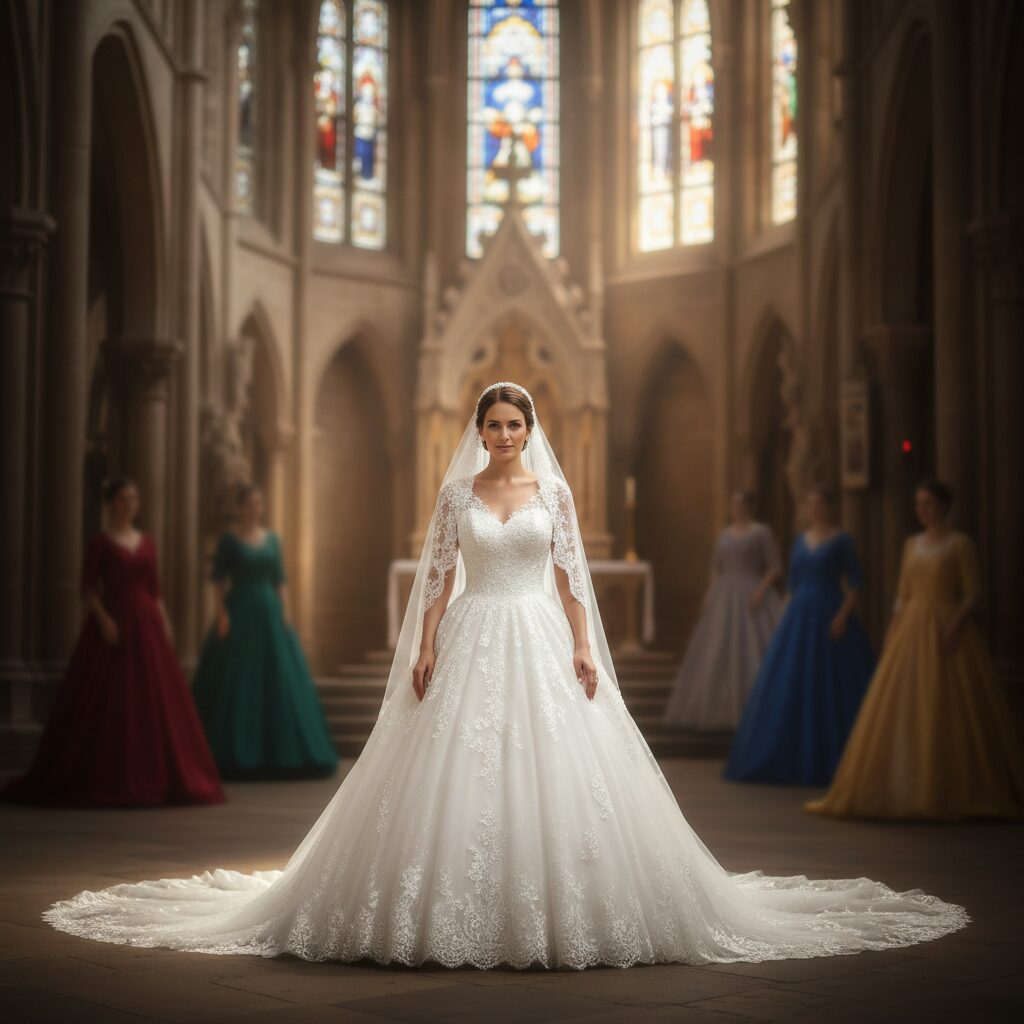
You’ve surely seen, at least once in your life, a bride walk down the aisle in a stunning, immaculate white dress, straight out of a fairy tale. But have you ever paused between bites of wedding cake to wonder why white? Why not red, bright pink, electric blue, or even pistachio green (okay, the last one sounds a bit odd, but we’re not here to judge)? Spoiler alert: white isn’t just a matter of taste or pure coincidence. This color is steeped in centuries of history, symbols, and traditions, some as bizarre as a drunken uncle at a family dinner. In a context where, by 2024, nearly 250,000 couples in France will have officially tied the knot, understanding this sartorial choice becomes almost as important as choosing the playlist for the evening. So let’s delve into this fascinating blend of Western culture, the symbolism of white, and little historical secrets!
Why the White Wedding Dress: The Story of a Not-So-Old Tradition
The white dress seems so deeply rooted in Western wedding tradition that you might think it’s older than sliced bread. Actually, not at all. You could almost say that the white wedding dress is the latest fashion trend straight from the 19th century, something that exploded after a certain English queen showed up in white. In fact, before that, brides more often wore their “Sunday best” or an outfit reserved for other occasions, sometimes even in a very flashy color!
If we go back in time, to ancient Rome, brides-to-be wore a white tunic tied with a special knot that only the groom was allowed to untie – symbolically, as you’ve probably guessed, it was the “gift” of virginity. But this tradition quickly deteriorated: in the Middle Ages, white became THE color of mourning. Yes, you read that right. Rather ironic, isn’t it? Marie Antoinette, the not-so-lucky queen, even went to the scaffold in white, embodying this symbol of resurrection and tragic end rather than any kind of bridal dream. So, white hasn’t always been synonymous with love and purity. Brides usually wore their finest gowns, often red for the wealthier ones (a garnet red, obtained with plants like madder, which was very attractive and resistant to washing). For peasants, black was gaining popularity because it showed less dirt and was practical for the many post-wedding blessings! Needless to say, the “immaculate white dress forever” wasn’t exactly the slogan of the day.
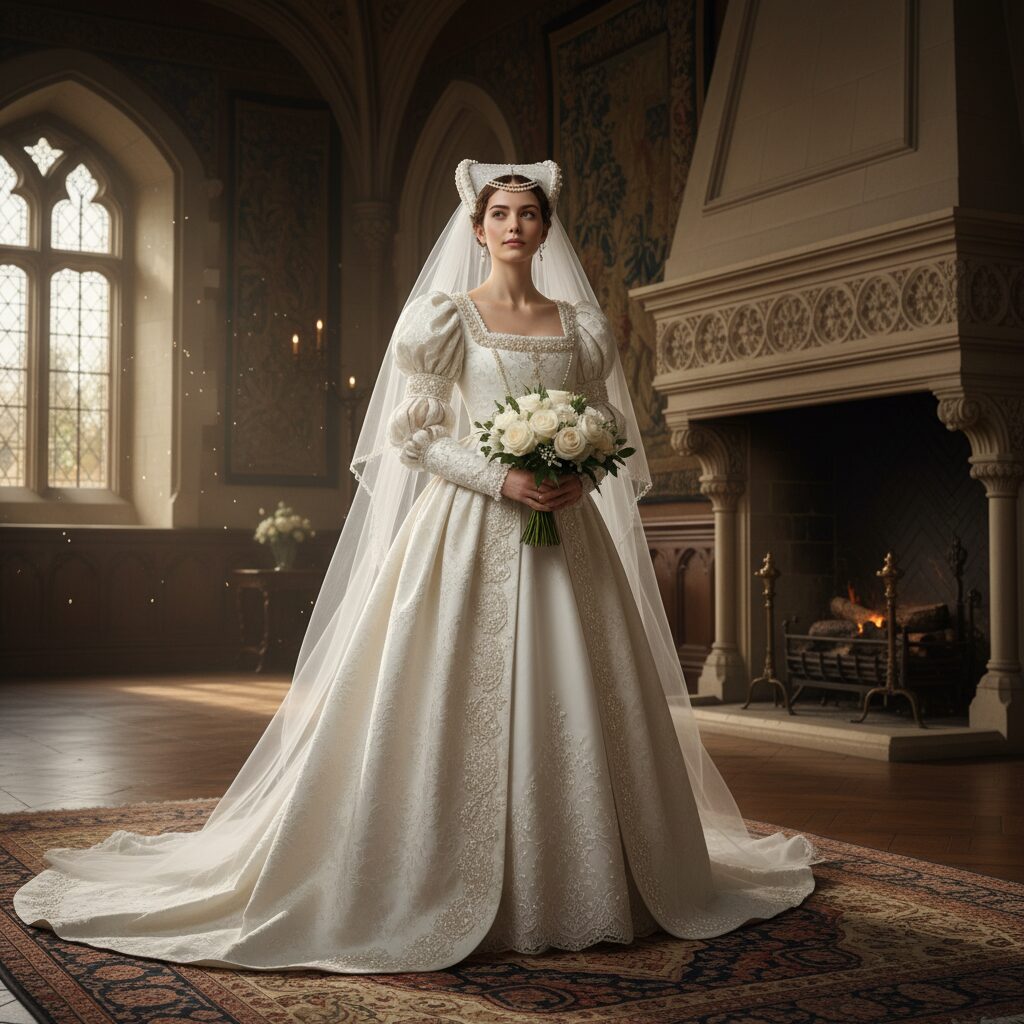
The real white revolution happened thanks to Queen Victoria in 1840. As she prepared to say “I do” to her Prince Albert, she chose a simple and elegant white dress. Not only to coordinate her look with that of her royal fiancé (because white trousers and a military uniform were already quite a combination), but also to stand out from the guests in their multicolored dresses. Since then, the white dress has been all the rage. A bonus of modernity: Victoria and Albert’s wedding was immortalized by the first official wedding photograph, entirely in black and white, making white seem even more radiant and desirable.
The White Dress: A Royal Snowball Effect Spreading to the High Streets
Like any good trend, the “Victorian style” quickly spread to European royal courts. Then, eager to emulate these models of elegance, the upper classes adopted the white dress. It was at this point that department stores jumped on the bandwagon, offering white dresses en masse to the bourgeoisie and the working classes. Of course, these weren’t yet synonymous with immaculate gowns meant to be worn only once. The dress had to be worn again for other occasions to justify the investment (did someone say eco-friendly wedding before its time?).
In the 19th century, the meaning of white narrowed to notions of purity and virginity, but also to a clear distinction between civil and religious marriage, encouraged by the Catholic Church. White became a kind of color code: the bride in white is pure, pious, and faithful.
Ces articles devraient vous plaire

Where does the custom of reading under the covers with a lamp come from?
Ah, reading under the covers with a lamp! This nighttime ritual has something magical and slightly rebellious about it, like a little secret shared with your favorite book and that soft glow that slips right…
The symbolism of white: myth or reality? We often imagine white as the holy grail color of marriage because of its representation of purity.But this symbolism is much more nuanced, and sometimes a little kitschy, worth exploring further. White is first and foremost a color that symbolizes new beginnings, a fresh start. Think green tech, but in wedding dress terms: it’s the idea of a blank slate—or rather, immaculate—commitment to this new chapter of life together. Moreover, tradition dictates that the dress should also be accompanied by four symbolic elements: something old (the past), something new (obviously, the bright future), something borrowed (a symbol of happiness, because we rarely borrow a neighbor’s belongings without hoping for the best), and finally, something blue (a symbol of fidelity, because marriage is also a matter of trust). Not a bad color scheme, is it? But be warned, this is far from a universally accepted meaning. In other cultures, the color of the wedding dress differs completely: in China, red embodies luck and joy, while in India, it is also often this vibrant shade of red that makes weddings so special. In Western history, white is also perceived as a reflection of social status: an immaculate dress meant that the bride didn’t need to wear a practical, reusable gown, a sign of wealth and elegance. Conversely, brides of modest means would juggle multiple uses to offset the cost of their outfit. The popularization of white is therefore no accident. It is the result of economic, social, and religious choices. In short, wearing white is about embracing tradition reimagined with modern colors, a way to be both classic and trendy. Why not other colors? When White Stole the ShowYou might be wondering why no one ever considered a bride in neon orange (okay, don’t get your hopes up too high)? The answer is simple: other colors often carried less flattering connotations. For example, before Victoria changed the rules, red was associated with luxury, but also with sensuality, which wasn’t always compatible with the image of the pure young girl. Black, traditional in Europe for everyday clothing among the working classes, was reserved for more austere occasions or for the postnatal blessing. Orange, green, or yellow didn’t have strong symbolic resonance, as the fabrics could be expensive or artificial at the time.Another key point: the white dress was much easier to find clean in black and white photos, thanks to emerging technology that arose in the 19th century. It is perhaps thanks to this history that the white bride has conquered all of Western culture to this day.
Ultimately, the white dress crushed the colorful competition with a delightful combination of accessibility, media exposure (thanks to the first wedding photo), and cultural significance, all reinforced by a touch of 19th-century romanticism. Who would have thought that a royal choice could influence millions of fashionistas for generations?
Eclectic white dress: the 2025 trend reinvents the classic
Ces articles devraient vous plaire
How the compass transformed the destiny of world explorers
The compass, that small piece of magnetized metal, has undoubtedly changed more destinies than any crystal ball or carnival horoscope. Before its invention, getting lost at sea was practically a national sport for explorers, because…
2025 is here, but the white dress retains its throne, even if its definition evolves over time. Today, the bride no longer simply adheres to the traditional color code. Designers play with simplicity, sustainability, and diversity to combine tradition and modernity. A recent example: Clare Waight Keller, the designer behind the minimalist dress worn by Meghan Markle, offered a sleek and chic design, celebrated for its simplicity and adaptability—a “green-friendly” version of the white dress.
The circular economy is also making its way into the bridal world: more and more brides-to-be are opting for a reusable dress, often bought secondhand or borrowed. The color white remains popular, but its symbolism is evolving toward a more ethical message, where white is no longer just synonymous with purity, but also with respect for the planet.
The growing diversity of weddings today—multicultural, inclusive, sometimes relaxed—opens the door to multiple interpretations of color choices. It’s not uncommon to see brides wearing white with colorful accessories or daring to use subtle shades like ivory, blush, or even soft gold. White is therefore no longer a chromatic prison but rather a backdrop for expressing one’s personality within tradition.
List of items every bride should have on her wedding day 🤵♀️💒🎀
✨ Something old (represents past life, roots)
Ces articles devraient vous plaire

the unusual habits that have shaped the ritual of the family meal
The family meal: that sacred moment when everyone gathers, not necessarily because they’re starving, but because something magical happens around the table. Yes, even if you’ve already met that friend who ALWAYS eats their pizza…
🌟 Something new (symbolizes the new life together)
🔗 Something borrowed (good luck charm and connection to loved ones)
🔵 Something blue (fidelity and constancy)
The white dress: a global cultural phenomenon?
- The success of the white dress in Western culture is a relatively recent phenomenon, but its dominance now extends far beyond European borders. Thanks to the media, globalization, and the fashion industry, this symbol of purity has become such a strong standard that even in countries where red traditionally reigns supreme for weddings, white is increasingly making appearances. Major international fashion houses often mandate the white dress in bridal shows, thus setting standards that sometimes contradict local traditions. However, this classic white aesthetic is experiencing interesting deviations, particularly among brides-to-be who want to push boundaries: red, gold, or even multicolored dresses are becoming increasingly popular as cultural and personal identities assert themselves.
- In short, although white remains a classic, contemporary trends are giving a fresh twist to wedding traditions and challenging its universal appeal. Yes, the white dress is an emblem, but this emblem adapts and reinvents itself, a bit like your uncle pulling out his old-fashioned suit and adding a flashy tie. https://www.youtube.com/watch?v=rtaVHwFq8Lc
- 🔎 Aspects
- 🎨 Color
Ces articles devraient vous plaire

You’ve probably wondered, while observing the clock hanging on the wall or your watch on your wrist, why on earth the hands always swing in the same direction, the one we pompously call “clockwise.” A…
📜 Meaning
⌛ Period of Use
Ancient Rome
White
| Antiquity | Middle Ages | Red / Black | Red for wealth, black for religious uses/mourning |
|---|---|---|---|
| Medieval | Renaissance / 17th century | Various colors, no standard | Local culture and diverse social classes |
| Pre-modern | Victorian era | White | Purity, social status, royal fashion popularized by Queen Victoria |
| Mid-19th century | 20th – 21st century | White, ivory, subtle variations | Purity preserved, durability, modern customizations |
| Modern | https://www.youtube.com/watch?v=0Ror5wEc-fQ | Does the white dress still symbolize the bride’s purity? | Historically, white primarily evoked purity and virginity, particularly due to religious influence in the 19th century. Today, this meaning is more nuanced and personalized for each bride. |
| Why is Queen Victoria associated with the white wedding dress? | She popularized the white dress at her wedding to Prince Albert in 1840, thanks in part to the release of the first official black and white wedding photograph. | What are the alternatives to the white dress for brides? | More and more brides are opting for colored dresses, ivory, blush, or even outfits that blend tradition and modernity to personalize their ceremony. |
No, in many cultures, such as in China or India, colors like red are dominant, symbolizing luck and joy.
What are the four elements a bride should have in her outfit?
She should wear something old, something new, something borrowed, and something blue, each symbolizing a particular aspect of life and commitment.