
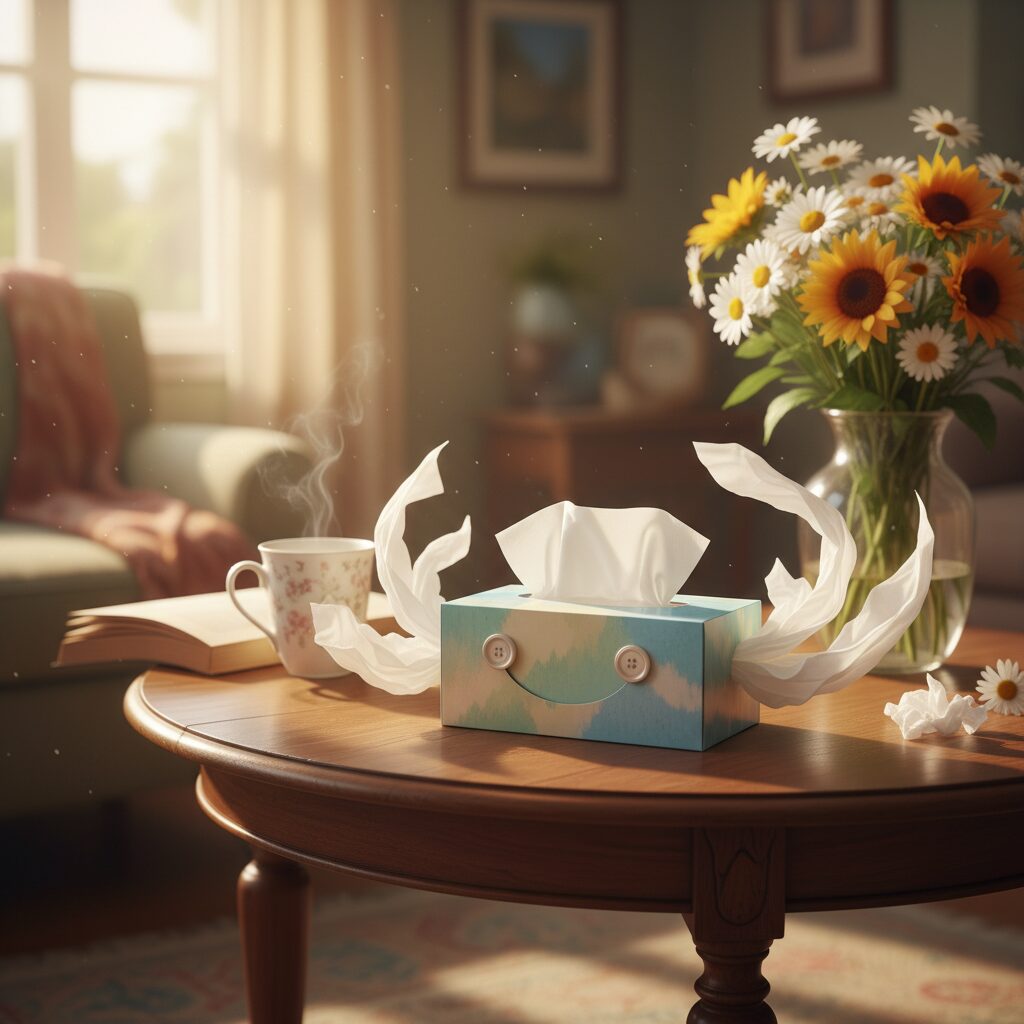
We see tissue boxes everywhere: at the office, on the living room table, sometimes even on the bedside table when a nasty cold strikes unexpectedly. This simple object, so commonplace that we rarely pay it any attention, hides a rich and surprising history. Originally intended to save us from runny noses or unwelcome popcorn shards, the tissue box is more than just a simple cardboard container. Between its design evolution, its unexpected household uses, and its essential role in modern comfort and hygiene, it deserves to be celebrated. Let’s delve into the delightful story of this household accessory that, far from being insignificant, has become indispensable.
Who would have thought that the simplicity of the tissue box held so much ingenuity and even, dare we say, poetry? Over the decades, its practical design has evolved to adapt to our lifestyles, while remaining true to its primary mission: to offer impeccable hygiene and discreet comfort. A top-notch ally for those sometimes awkward moments – hello, sneezing during a video conference. Discover how this everyday object, often underestimated, brilliantly combines simplicity and well-being.
What is the surprising origin of the tissue box in the home?
Before the tissue box became the star of coffee tables, the tissue itself has a history that stretches back several millennia. Originally, our ancestors used fabrics, sometimes even perfumed, to wipe their faces or blow their noses. These small pieces of fabric were often a sign of social status, especially among the elite of ancient Rome. An essential accessory, but not exactly disposable.
The major revolution came with the invention of the tissue in the 20th century. Imagine the impact on hygiene and domestic comfort: no more germ-ridden handfuls, only the simplicity of disposable paper. The tissue box, designed to hold and dispense these fragile sheets, was born from a sanitary necessity coupled with a new taste for practicality.
In the 1920s, the first boxes were primarily utilitarian, made of basic cardboard. But publishing houses and paper manufacturers quickly grasped the importance of design and marketing. The tissue box began to be adorned with colorful patterns and elegant illustrations, thus becoming a decorative accessory in its own right. It can now be found in every room, no longer just in the bathroom.
What’s fascinating is that this object has managed to combine efficiency, simplicity, and aesthetics, all without losing its primary function. Its use at home has multiplied: on the dinner table for noses that rub after eating a dish that’s too spicy, at the office for minor dust allergies, or even in the car, often too cramped to be used otherwise.
Ces articles devraient vous plaire
How the mouse pad invaded our offices without us even realizing it
Have you ever wondered how this small piece of fabric, foam, or sometimes even plastic, often underestimated, became an essential part of your desk? No? Don’t worry, you’re not alone. Yet, the mouse pad has…
the tissue box has established itself without any fuss. It embodies the “elegant simplicity” that appeals to modern households, always seeking a balance between functionality and style. Today, it has become one of the symbols of readily accessible personal hygiene, adding a touch of wellness to your home.
Discover the delightful story of the tissue box, an everyday object that combines usefulness and design in your daily life.
How did the tissue box become a must-have of modern hygiene? If you thought a tissue box was just a place to stack paper in a cardboard box, think again. Behind this unassuming household item lies a major hygiene revolution. Indeed, the widespread use of paper tissues, and especially their distribution in specially designed boxes, has radically transformed our approach to personal well-being.Before disposables became commonplace, cloth handkerchiefs were far riskier hygiene products: they collected bacteria, viruses, and other environmental germs, being passed from hand to hand with questionable courtesy. The tissue box, by making disposables practical and aesthetically pleasing, offered a simple and effective alternative. Suddenly, the home became a sanctuary against microbes.
- But don’t think that manufacturers stopped there. The very design of the boxes was conceived to limit contact with the contents and prevent waste. Practical design often includes a rigid opening or a system that facilitates the dispensing of only one tissue at a time, thus minimizing the exposure of untouched tissues to dust and the potential for splitting.
- One last point deserves highlighting:
- Convenience
Ces articles devraient vous plaire
Amazing little habits around the wallet
Have you ever noticed how your wallet seems to have a life of its own, with its strange little habits that influence your finances without you even realizing it? From always keeping a light-colored coin…
Here are some advantages that have propelled the tissue box into the stratosphere of everyday use:
🧻 Quick dispensing of clean, ready-to-use tissues
🙌 Reduced cross-contamination thanks to controlled dispensing
✨ Enhanced visual comfort with designs to match your décor
♻️ Choice of recycled materials and eco-friendly packaging
| 🏡 Multifunctional accessory, sometimes repurposed as a notepad or cookie holder | https://www.youtube.com/watch?v=87s1l6qmGYQ | Can we talk about practical and aesthetic design in the tissue box? | Yes, don’t roll your eyes, the tissue box is a champion of both practical AND aesthetic design. It’s not talked about enough, but behind every well-designed box lies intense thought, blending ergonomics, tradition, and little whims of interior design. True designer work hidden behind what appears to be a simple cardboard box. | |
|---|---|---|---|---|
| The standard format has been revised several times to improve ease of use: the size, compact enough not to be carried around everywhere, yet large enough not to run out at the first sneeze; the opening, often designed to allow for one-handed removal, even with a cough brewing. | Aesthetically, the tissue box has embraced current trends wholeheartedly. Textured prints, soothing pastel colors, bold graphic patterns, or even limited editions designed by renowned designers—it complements our decorating desires like a sophisticated home accessory. This is how it has shed its original, mundane appearance to become a truly stylish object. | The current success of the tissue box also lies in its adaptability. For fans of connected devices, there are even high-tech versions: smart boxes that track your usage or remind you to buy more—a home use that combines comfort and modernity, perfect for our 100% connected lives. | ||
| To give you an overview, here’s a table comparing different types of tissue boxes with distinctive, practical, and aesthetically pleasing designs: | Box Type 🛍️ | Material 🌿 | Practical feature 🔧 | |
| Style/design 🎨 | Ideal for… 🏠 | Classic cardboard | Recycled cardboard ♻️ | Lightweight, disposable, economical |
| Various patterns, often seasonal | Everyday household use | Rigid box | Plastic or metal | Reusable, better protects tissues |
Ces articles devraient vous plaire
Funny and educational: do chairs have a history?
We sit on them every day without giving it a second thought, and yet, a chair isn’t just a piece of wood with a backrest. It’s an object steeped in history, culture, design… and even…
Modern or vintage look
Office or living room
High-end designer box
Wood, ceramic
Eco-friendly, long-lasting
Unique or handcrafted pieces
- Refined interior decoration
- Smart box
- Mixed materials
- Consumption tracking, refill alerts
- High-tech, futuristic
Ces articles devraient vous plaire
surprising habits related to light switches in our homes
Who would have thought that this small button, often invisible but always present in our homes – the light switch – could be the site of some rather surprising oddities and habits? While technology and…
The tissue box: a discreet companion for everyday well-being?
Never underestimate the power of this humble comfort accessory. Beyond its obvious role in hygiene, the tissue box plays a part in the sphere of domestic well-being. It gently and discreetly accompanies us through our vulnerable moments, offering a simple yet essential gesture that contributes to our quality of life.
When we think of well-being, we often imagine plush cushions, scented candles, or therapies far from the hustle and bustle. Yet, the tissue box is right there, within easy reach, ready to transform an unpleasant moment into a more bearable experience. By facilitating personal care, it indirectly contributes to improved mood and daily comfort. Feeling overwhelmed by emotions? A cold or allergy knocking you out? Hygiene is essential… and the reassuring gesture of taking a clean tissue becomes a mini self-care ritual. Not bad for an object so often overlooked, is it?
Numerous studies in cognitive science show that the simplicity of the action, combined with a careful and tactile gesture, helps to calm stress. The tissue box, being both accessible and aesthetically pleasing, contributes to this soothing effect. That’s all there is to it.
And because nothing beats a concrete example, here’s a list of everyday moments when the tissue box shines 😊:
- 🤧 Sneeze discreetly at the office, away from COVID-19
- 😢 Dry a tear (yes, it happens, life is full of emotions)
- 😋 Clean the corner of your mouth after an impromptu snack
- 🌬️ Fight seasonal allergies in style
- 🛌 Treat yourself to a pampering session during a well-deserved break
https://www.youtube.com/watch?v=cUlAIY_WsNg
Why does the tissue box teach us about simplicity in our everyday objects?
The tissue box is a lesson in simplicity and efficiency in a world overwhelmed by excess. It’s a perfect example of an object that revolutionizes our approach to household items, prioritizing comfort without complications. As Jeanne Guien explains in her book on consumerism, these everyday objects are often at the heart of a production process that shapes our behavior.
In an era where everything is geared towards compulsive consumption, the tissue box resists by retaining its primary function: simple and effective care, without unnecessary embellishment. It reminds us that sometimes, beauty lies in thoughtful modesty. A true counterpoint to the prevailing technological frenzy.
The tissue box also embodies a fascinating paradox. On the one hand, it’s a star of disposable packaging that generates waste—let’s not kid ourselves. But on the other hand, it has become a thoughtful household accessory, often carefully recycled or desired in a sustainable version.
This duality invites us to reflect on how we consume everyday objects and our relationship to hygiene and comfort. What if we tried looking at the tissue box differently? Not just as a simple box to be thrown away, but as a daily act of self-care and attention.
Here are some lessons we can learn from this humble accessory:
♻️ Modern consumers are learning to prioritize eco-friendly and sustainable versions.
✨ Design influences our emotions and our relationship with the object.