
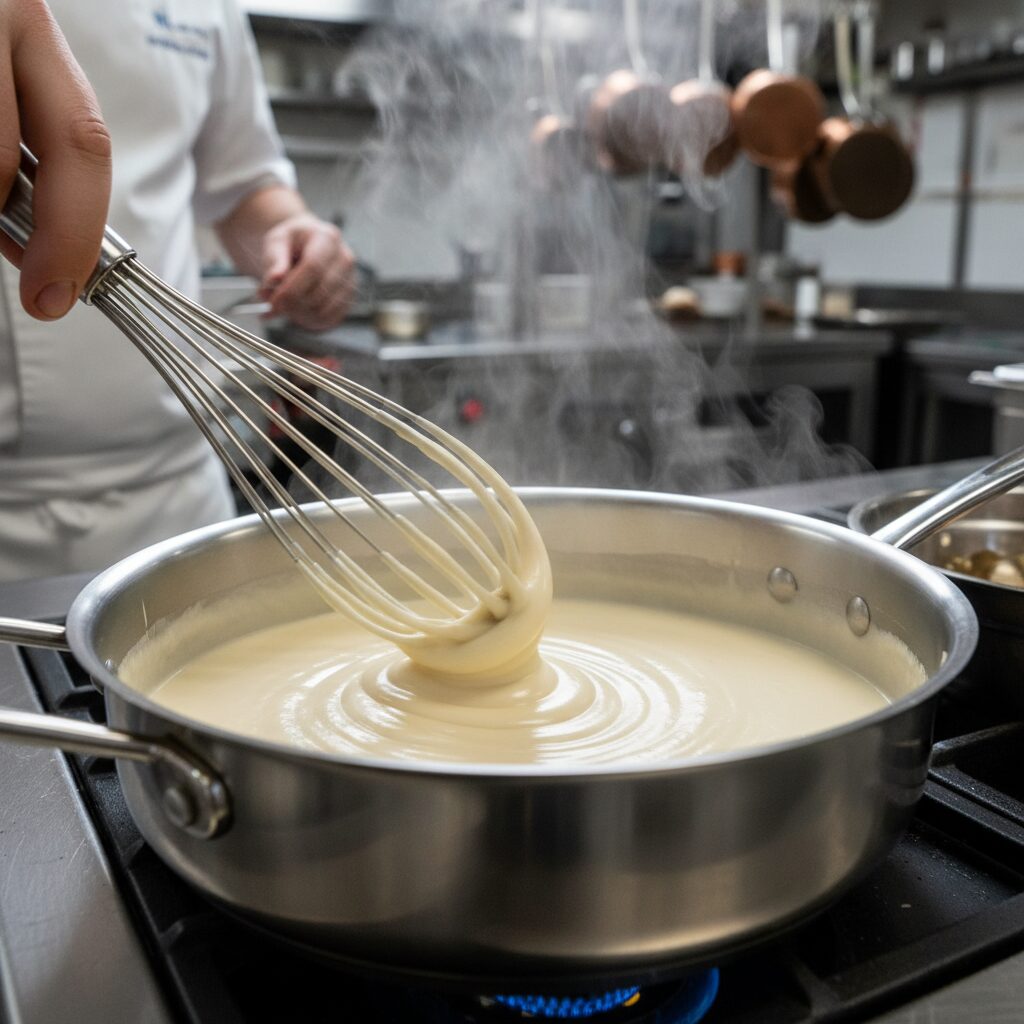
Think white sauce is just milk or cream left in your pan? Think again! Dive into this invisible, creamy world where French cuisine unveils its most mysterious flavor secrets. This perfect blend of smooth textures and hidden aromas conceals a veritable treasure trove of tastes. You’ll see, behind this seemingly innocent white veil, age-old tricks and extraordinary culinary techniques are at work, tantalizing your taste buds in unexpected ways. Prepare to discover that these sauces are much more than mere accompaniments: they are the key to a balance of flavors that makes all the difference.
On this journey into the heart of white sauces, you’ll be surprised to understand how a simple sauce base can be transformed into a gastronomic masterpiece thanks to subtle expertise. Between history, culinary science, and gastronomic whimsy, every drop holds a delicious story to be explored without restraint. In the end, you’ll never look at your béchamel, Mornay sauce, or velouté the same way again. And let’s not forget that white sauce is one of those French culinary mysteries that makes you think: why on earth put so much effort into something so seemingly unassuming?
Why are white sauces masters of smooth textures?
White sauces owe their reputation in French cuisine to their silky, mesmerizing texture. But what lies behind this legendary smoothness? Well, it’s a skillful blend of ingredients, mastery of heat, and the patience of a hermit that make all the difference.
To understand, we must go back to basics: béchamel, the undisputed star of white sauces, is based on a roux—a combination of butter and flour cooked together—to which milk is slowly added, avoiding any lumps. This simple yet incredibly delicate step requires a precise balance between fat and flour to guarantee perfect binding and ideal fluidity.
But the technique doesn’t stop there. Slow cooking allows the mixture to thicken without burning, and this is where the secret to its flavor comes in: the gradual heating creates a chemical interaction between proteins and starches, slowly releasing thousands of nuances of flavor and a texture that envelops the tongue like a caress. It’s a kind of scientific magic, where enzymes and molecules awaken to offer you a unique sensory experience.
Ces articles devraient vous plaire

How the taste of certain vegetables shocks our unfamiliar taste buds
Think eating vegetables should be as simple as biting into a juicy apple? Think again! Some vegetables seem straight out of a culinary horror movie, literally making our taste buds jump—those little sentinels on our…
Discover why white sauces hold mysterious flavor secrets that transcend classic tastes and awaken your taste buds.
What flavor secrets are hidden in the ingredients of white sauces?
If you think white sauce is just milk, butter, and a little flour going around in circles, you’re missing the most intriguing part: the ingredients hold flavor secrets that only the initiated can grasp. These sauces are like magic formulas where each element plays a precise role in balancing the flavors.
First, the choice of milk or cream is fundamental. Some chefs prefer whole milk, sometimes even smoked, which brings an unexpected depth. Others dare to use creams made from raw milk for richer textures and enhanced smoothness. The secret lies in the quality of the raw materials: the slightest mediocre ingredient destroys the aromatic subtleties.
Furthermore, the roux is not just a simple thickener. The cooking time for the butter-flour mixture can be adjusted to produce a variety of flavors, from a sweet amber hue to a hint of toasted hazelnut. This aromatic complexity, often subtle, creates hidden aromas that elevate the main dish, offering a truly immersive and aesthetic experience.
Furthermore, the use of spices and herbs is a masterful touch. There are no unexpected bursts of paprika or cumin, but rather freshly grated nutmeg, a touch of white pepper, or perhaps a hint of tarragon or chervil, depending on the recipe. These delicate touches create hidden layers of flavor that the palate unconsciously detects, revealing the mastery behind the technique. Finally, the stock, whether from poultry, veal, or even vegetables, is the true heart of the most sophisticated white sauces. These concentrated stocks impart a powerful umami, a characteristic often invisible to the eye but very present on the palate. It is the contrast between this deep base and the milky sweetness that creates a fascinating balance of flavors, both comforting and surprising.
Ces articles devraient vous plaire
Why were we all afraid of bitter tastes when we were children?
Do you remember when, as a child, you’d grimace whenever someone offered you a spoonful of that mysterious green and bitter thing whose exact ingredient no one would reveal? Yes, that infamous bitter taste that…
To spice things up a bit, feel free to take a look at this article
which explains how spiciness acts like a conductor of the mouth.
Even with a pure white sauce, the delicate management of flavors is an art that awakens the senses.
How do white sauces tell a story of French cuisine?
Ces articles devraient vous plaire

How street food reveals deliciously strange oddities
Imagine yourself wandering through a bustling Asian market or a colorful Latin American street corner, drawn by the enticing aromas of food that tickle your nostrils, but also by those bizarre dishes that raise an…
French cuisine isn’t just baguettes and cheese; it’s also a complex symphony of sauces and subtle balances, of which white sauces are one of the unsung heroes. They tell a story that is cultural, technical, and even social, rooted in culinary expertise passed down through generations.
Initially, béchamel sauce, though seemingly simple, symbolizes the patient work of cooks who sought to tame flour and milk to create a product approaching culinary perfection. This technical mastery illustrates French refinement, where every detail counts. One could almost say that each white sauce is a kind of culinary testament, reflecting an era, a region, or a legendary chef.
Regional and historical variations abound. For example, Nantua sauce, adorned with crayfish butter, evokes the shores of the Lyon region, while Mornay sauce, enriched with cheeses, reveals a love for the land and the country’s dairy bounty. Each adaptation is a story of terroir and a celebration of local products, proof that behind the apparent simplicity lies a true dialogue with nature and culture.
Over the centuries, white sauces have become a foundation for culinary innovations, from royal tables to Parisian bistros, and even into modern cuisine and its contemporary techniques. Chefs like Auguste Escoffier, who organized French gastronomy, elevated these recipes by blending rigor and imagination.
Ces articles devraient vous plaire
Why do we like to snack on things that make a strange crunching sound?
You know that guilty little moment when you grab a bag of chips, a piece of carrot, or maybe even that mysterious biscuit that makes a strange crunch? No, it’s not some exotic reflex reserved…
Their history also reveals a culture of sharing around the table, where the sauce becomes the link, the flavorful glue that unites meats, fish, or vegetables into a delicious and harmonious whole. It transforms an ordinary dish into a memorable experience, a blend of creamy sweetness and smooth textures. In short, white sauces are a declaration of love for French cuisine and its well-kept secrets.
What role do culinary techniques play in the magic of white sauces?
The enduring magic of white sauces lies not only in the ingredients, but above all in the refined expertise we call culinary techniques. The science behind hot and cold, the perfect rhythm of the whisk, and the careful attention to cooking times are what make these mysterious preparations so captivating.
To begin, mastering the temperature is a critical step. As soon as the milk comes into contact with the roux, the mixture can curdle in the blink of an eye if the temperature is too high. It’s a delicate dance where too fast equals disaster and too slow can mean loss of texture. Expert chefs work with ninja-like precision to achieve the perfect, even thickness that coats the roux without running. The right whisking motion is also a key technique. It’s not about frantically stirring to avoid panic, but about creating a fluid and constant movement that encourages the molecules to bind harmoniously. This gesture, as simple as it seems, is at the heart of the mysterious flavors contained in these white sauces. It acts like a delicate massage of the sauce, promoting the perfect integration of its components. The technique doesn’t stop there. Some cooks innovate by using tricks like heating in a bain-marie to control the cooking temperature or by incorporating the liquids very slowly to prevent separation. These methods ensure a flawless sauce base and results that are always worthy of the finest restaurants.
Finally, the art of white sauces also lies in the balance of flavors. It’s not enough to have a good texture; you must bring the whole thing to life with subtle and precise touches, from salt and white pepper to nutmeg. Each seasoning is carefully refined to create a harmonious flavor profile that surprises and delights.
In short, every gesture is a secret revealed, every technique a masterstroke in the grand culinary spectacle that is the preparation of white sauces. By remaining attentive and curious, you’ll quickly understand why this simple white curtain hides much more than just an ordinary accompaniment. How can you explore and experiment with the mysterious flavors of white sauces at home?
- Want to play alchemist in your kitchen? White sauces offer an incredibly rich playground for cooking enthusiasts who dream of unveiling their own flavor secrets and smooth textures. Here are a few tips to help you have fun experimenting with these sauces at home, without ending up with a mess of runny cream or an explosive lump.
- First, play around with the ingredients. Try replacing regular milk with less common varieties: oat, almond, or even lightly smoked milk to add an unexpected note. You can also twist your roux with different flavored butters (hello, truffle butter!).
- Next, master the essential cooking techniques. Take your time pouring the liquid in little by little, whisking constantly; this prevents lumps and develops a balance of flavors. Use a low heat; patience is an essential virtue in the art of white sauces.
| For the more adventurous, add subtle spices or herbs: a pinch of freshly grated nutmeg, a hint of lemon thyme, or even a touch of tarragon. These hidden aromas add extra depth to your creation. | Don’t hesitate to play with textures by incorporating grated cheese for a Mornay sauce, or a few drops of chicken stock to liven things up. Experimentation sometimes means making mistakes before you shine! Here’s a quick reminder of some tips to keep in mind to avoid a dramatic crash in your quest for the perfect white sauce: | 🔥 Always heat gently to prevent curdling |
|---|---|---|
| 🥄 Whisk slowly but steadily for a perfect blend | 🧈 Don’t skimp on the quality of the butter and milk | 🕰️ Wait between each addition of liquid |
| 🌿 Add freshly grated or chopped spices | Finally, what if the sauce turns sour? Don’t panic, there are ways to save it: add a little more hot liquid, strain it through a chinois, or even filter it to regain a smooth texture. White sauce is a bit like a temperamental old friend, but once you’ve mastered it, it becomes indispensable in your culinary repertoire. Culinary Technique 🧑🍳 | Impact on White Sauce 🍽️ |
| Practical Tip 💡 | Slow cooking over low heat | Smooth and even texture |
| Patience, avoid burning by stirring regularly | Gradual addition of liquid | Prevents lumps, homogeneous mixture |
| Pour slowly while whisking continuously | Regular whisking | Perfect integration of the roux and liquid |
Smooth movement, neither too fast nor hesitant Precise seasoningBalance of flavors Taste frequently, adjust salt and nutmegUse of a bain-marie (double boiler)
Temperature control, avoids mishaps
Ideal for delicate or thick sauces
There you go, you’re now ready to think outside the box with your white sauces and unveil their flavorful secrets in your own kitchen! Don’t forget that curiosity and experimentation are key to taming this discreet star of French cuisine.
And to deepen your understanding of how certain flavors explode in the mouth, check out this article about the spiciness of chili peppers that makes our senses sing.
Why is white sauce often the base for many recipes?
Because it offers a creamy texture and subtle flavor that can be easily modified with different spices and ingredients, it serves as a blank canvas for countless culinary creations.
What should you do if a white sauce becomes lumpy?