
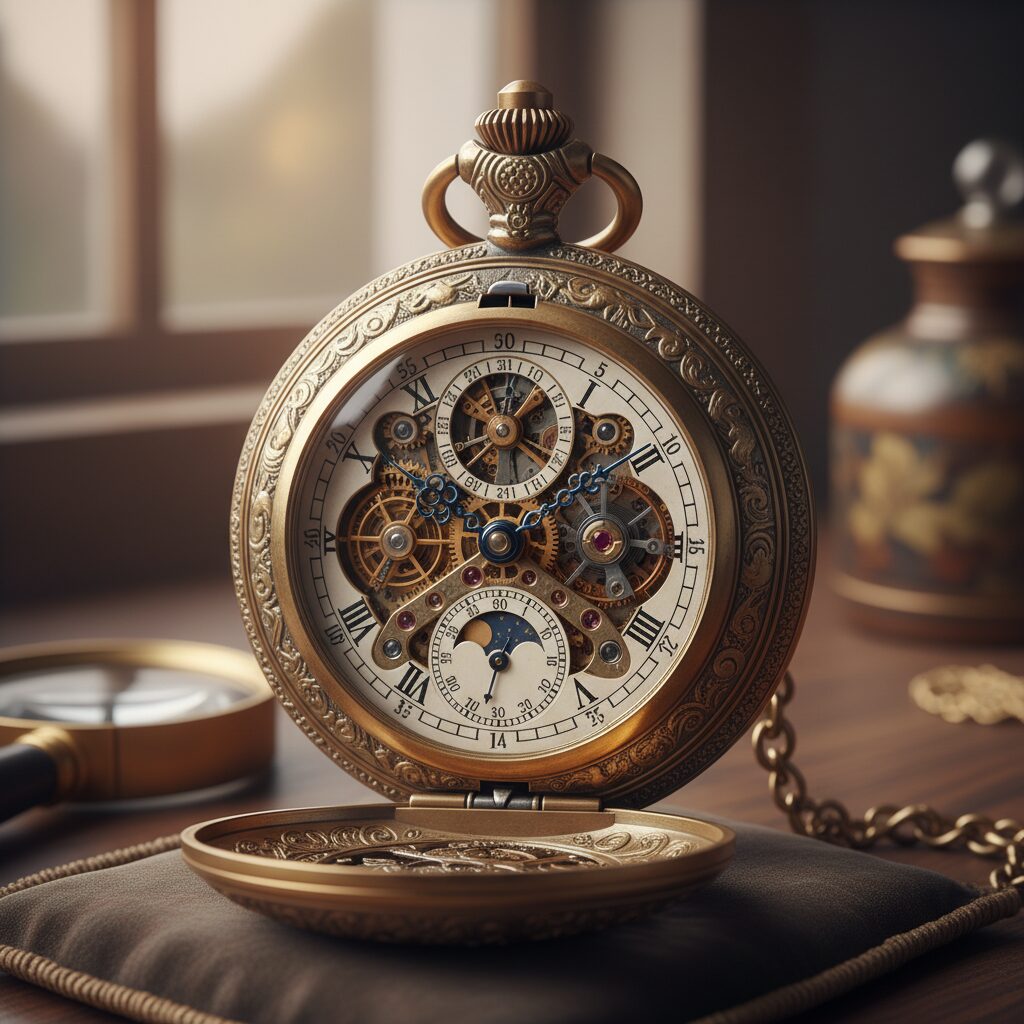
Ah, the pocket watch! This little engineering marvel, tucked away in a waistcoat or jacket pocket, is much more than simply telling the time like a smartphone overflowing with useless apps. No, this mechanical gem is the guardian of a hidden time, harboring legendary secrets and a fascinating horological symbolism that far transcends its utilitarian function. Between the mysteries of its secret mechanism and the history of a family heirloom, the pocket watch reveals itself to be a truly enigmatic object, brimming with historical intrigue that deserves closer examination, rather than being forgotten at the bottom of a dusty drawer. This jewel of ancient craftsmanship is not just beautiful to behold; it tells the story of an era when the precise measurement of time was not only a scientific feat, but also a social one. Here’s something to liven up your next trendy party: no need to show off flashy apps, your obsession with the pocket watch will be enough to captivate everyone, even those most resistant to mechanics. Let’s delve into its mysteries together, because discovering these watches means understanding a little better how humankind has tamed seconds with style and audacity. Why does the pocket watch conceal a mysterious time beneath its case?You’re probably wondering why these little marvels of the past don’t simply display the time in a basic way. Well, know that the pocket watch embodies a subtle balance between engineering and mechanical poetry. Beneath its case, the true protagonist is a secret mechanism of impressive complexity that has shaped the way we perceive time for centuries. The heart of this mystery lies in the mechanical movement, built around a mainspring that stores energy with the precision of a scientific laboratory. The balance wheel, this methodical oscillator that regulates the passage of seconds, manages this energy. Without any electronic components, the timepiece plays a mechanical score that rivals a symphony. From the escapement to the anchor wheel, each part fits together with a precision that would put a LEGO set to shame. Pocket watches were not mere gadgets; they were precious relics of an era when time had not yet become digital and instantaneous. It is this mysterious pastime that has driven watchmakers to imagine ever more refined devices, sometimes with sophisticated complications such as minute repeaters or moon phases. These elements add to the charm and rarity of these timepieces. And don’t be surprised if this hidden time within their mechanics has inspired urban legends and myths: they are not simply watches, but time machines, literally engraved with the history that has marked the lives of their owners. Their silent and precise operation has often been perceived as an enigma, almost magical. Discover the little-known role of the pocket watch and delve into its legendary secrets that have fascinated people for centuries.How does family heritage amplify the mystery surrounding pocket watches?
The pocket watch is much more than a fashion accessory or a technical tool: it is often a preciousfamily heirloom. Passed down from generation to generation, each pocket watch carries with it a host of stories, secrets, and sometimes even historical intrigues. Each piece carries a memory, a fragment of family history, making it incredibly precious.
In many families, this enigmatic object remains a powerful symbol, a tangible testament to the bonds and values passed down through time. Some models are even engraved with initials, important dates, or bear cryptic inscriptions that pique curiosity and lend an air of treasure hunting to their discovery. When one delves into their legendary secrets, one often discovers that a pocket watch has passed through unexpected hands: from a nobleman who lived through revolutions to a scientist who invented an ingenious process, it is, in a way, a key to personal and collective time. For example, some mechanisms were adapted for specific, discreet, and sometimes even clandestine uses, transforming these watches into veritable technological spies before their time.
The passion for collecting them isn’t limited to beauty; it’s the allure of mystery and the past, the desire to understand and preserve this ancient craft, that explains the enthusiasm. Moreover, if you want to gauge the cultural impact of the pocket watch, simply look at how its image has permeated literature, film, and even steampunk, a genre that celebrates the fusion of retro and futuristic elements.
Ultimately, the role of the modern collector is twofold. They are both a guardian of heritage and an explorer of buried mysteries, a kind of archaeologist of the ephemeral, breathing new life into these small mechanical worlds. Buying or restoring a pocket watch is therefore an act of communion with history—an elegant way to defy the ephemeral. What horological symbolism lies behind this enigmatic object?
Beyond its vintage appeal, the pocket watch is an inexhaustible source of symbols and allegories. Why? Because it embodies the concepts of time, memory, power, and precision. It is no coincidence that it has long been associated with social class and rigorous elegance. Simply wearing a pocket watch once signaled a taste for excellence, membership in a class where time was not a utilitarian commodity, but a treasure to be handled with care. One can even discern a certain horological symbolism linked to the mastery of time, a luxury reserved for men who wish to assert their authority through punctuality and patience. The case decorations are equally significant. Pocket watches often feature engraved motifs evoking nature, mythological figures, or delicately crafted gold chains that suggest mastery of precious metals. Each detail is a coded message, a wink to those who know how to read between the lines.

Ces articles devraient vous plaire

Amazing little habits around the wallet
Have you ever noticed how your wallet seems to have a life of its own, with its strange little habits that influence your finances without you even realizing it? From always keeping a light-colored coin…
In fact, the pocket watch can be compared to a mechanical labyrinth where time is simultaneously guarded and set free, a paradox that fascinates and attracts all those who seek to understand how humankind has managed to tame the serpent that is time. What technical mysteries have shaped the secret mechanism of pocket watches?
Entering the heart of a pocket watch is like stepping into a workshop of high industrial magic. Each gear, each spring appears tiny but plays a colossal role in the dance of time. This
secret mechanism It is the sacred union of physics, chemistry, and art.Watchmakers of past centuries faced a monumental challenge: mastering friction, balancing the force of the mainspring, and maintaining millimeter precision despite shocks or wear. To achieve this, they introduced innovations such as synthetic rubies to reduce friction and the Breguet balance spring, which stabilizes the balance wheel’s frequency.
Such a concentration of expertise produces an impressive result: some pocket watches lose only a few seconds a day, a remarkable feat compared to contemporary standards. This reminds us that, despite the omnipresence of digital technology, mechanics remains a champion of precision and ingenuity. Here is a list of the key elements of a pocket watch mechanism:
⚙️
Ces articles devraient vous plaire

Funny and educational: do chairs have a history?
We sit on them every day without giving it a second thought, and yet, a chair isn’t just a piece of wood with a backrest. It’s an object steeped in history, culture, design… and even…
The mainspring: provides the initial energy by unwinding.
🔩 The gear train: transmits and modulates this energy to the hands. ⏳ The escapement : converts continuous motion into regular pulses.
🎯 The balance wheel : regulates the frequency of the beats through its oscillation.
🔮 The jewels : reduce wear and friction, extending the watch’s lifespan.
Ces articles devraient vous plaire

Everyday objects: the joyful history of the tissue box
We see tissue boxes everywhere: at the office, on the living room table, sometimes even on the bedside table when a nasty cold strikes unexpectedly. This simple object, so commonplace that we rarely pay it…
A table to help you understand the importance of each component in a pocket watch:
Component Function Importance in the mechanism
Reference emoji
Mainspring
Source of mechanical energy
- Very high ⚙️ Gear train
- Transmission of force High 🔩
- Escapement Regulation of movement Very high
- ⏳ Balance wheel Stabilization of the rhythm
- Essential 🎯 Jewel
Reduction of friction
| Medium | 🔮 | https://www.youtube.com/watch?v=O1SXGr0EZps | How does the pocket watch resonate with historical intrigue in modern culture? |
|---|---|---|---|
| If you thought the pocket watch was just a dusty relic, think again: this enigmatic object is now at the heart of many stories, films, and even video games. Its | horological symbolism | and its | secret mechanism |
| fuel a rich imagination full of mysteries and plot twists, giving life to | fascinating historical intrigues. | In film, it is worn by phlegmatic detectives, intrepid spies, or time-traveling gentlemen. Whether in steampunk novels or suspense series, the watch embodies the idea of suspended time, of knowledge hidden within an object as commonplace as a timepiece. It is also a symbol of elegance and craftsmanship, a stark contrast to the digital age. | |
| This fascination is not solely fictional. Passionate scientists still explore the | legendary secrets | contained within these timepieces, while watchmakers perpetuate the | |
| ancient craftsmanship | with an almost religious respect for ancestral techniques. | As proof, the pocket watch is experiencing a renaissance in retro fashion, but also as a sophisticated geek accessory, capable of adding a touch of flair to any wardrobe. This blend of past and present rekindles the magic of time and its power to inspire dreams. It’s a truly mysterious pastime that challenges our digital watches, reminding us that there’s nothing quite like a beautiful mechanical movement to captivate a curious gaze. | |
| https://www.youtube.com/watch?v=gZkfauaEkyM | What is the historical origin of the pocket watch? | The pocket watch appeared in 16th-century Europe and became widespread in the 17th century. It replaced large clocks, being more compact, a result of advancements in portable watchmaking. |
Ces articles devraient vous plaire
Ordinary object or unsung hero? The incredible story of the lighter
Think the lighter, that little gadget we pull out of our pockets to light a cigarette, a campfire, or even sometimes conduct less-than-safe pyrokinetic experiments, is just a simple, everyday object? Think again! Behind this…
Why were pocket watches replaced by wristwatches?
Wristwatches appeared at the beginning of the 20th century, proving more practical for the military during World War I, and surpassing the pocket watch in popularity. What is a hand-wound mechanism? It’s a system where the wearer must regularly wind the mainspring by hand to provide the energy needed to power the watch. Can a pocket watch be used as a collector’s item? Absolutely! Antique pocket watches are highly prized by collectors for their history, their mechanical finesse, and their connection to family heirlooms.
How do you maintain an antique pocket watch?
It’s advisable to have the mechanism regularly serviced by a specialist watchmaker to ensure its proper functioning and preserve its delicate components.