

While the Indonesian jungle is already an incredible playground for any budding adventurer, it boasts an unexpected reptilian star: the spectacled snake. This mysterious creature, often seen displaying its famous ornamental “headband,” does more than just terrify lost tourists. It’s an animal that deserves our attention, as much for its beauty as for its place in the local ecosystem. Between its survival techniques worthy of a thriller, its essential role in the region’s exotic fauna, and the jungle’s fragile biodiversity, this spectacled snake has more than one secret to reveal. Embark on a captivating exploration of this fascinating reptile, a journey through myth, science, and tropical ecology that will give you a whole new perspective on the Indonesian jungle!
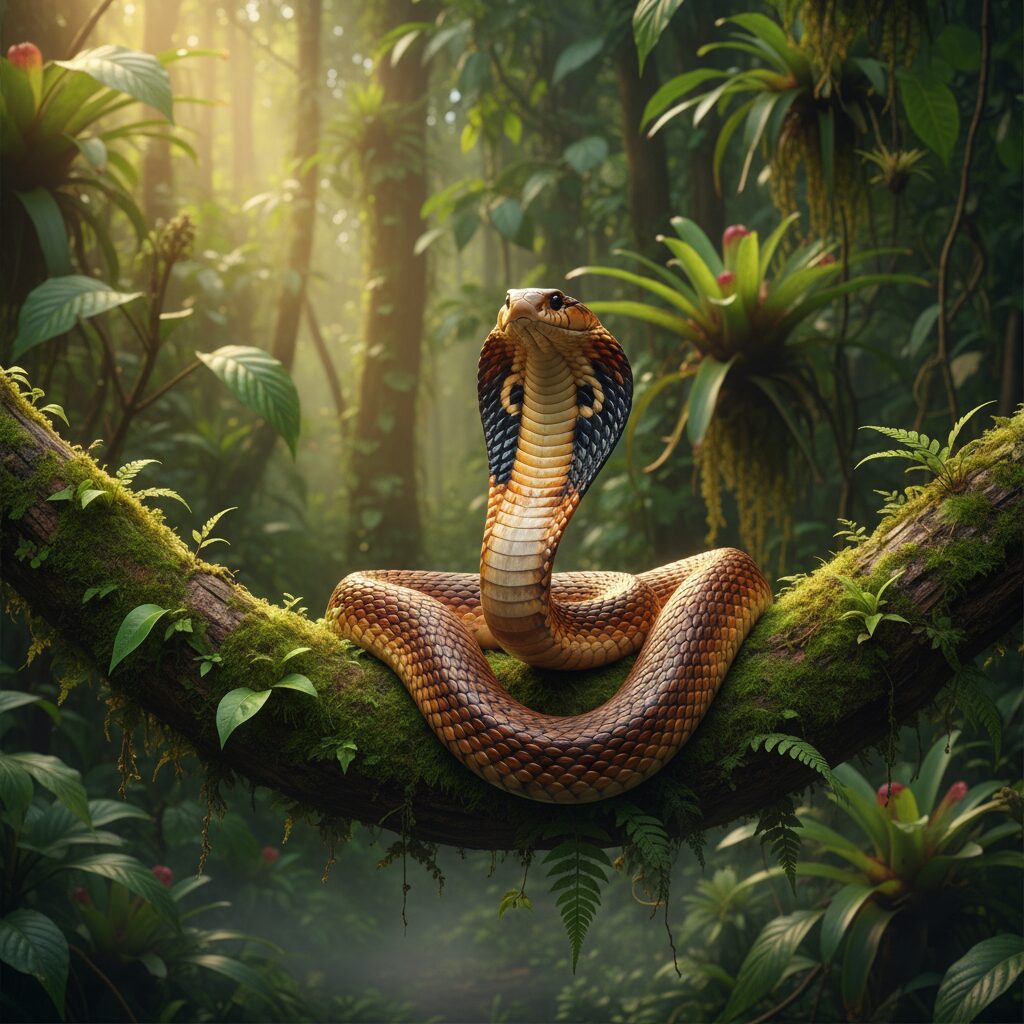
Why is the spectacled snake an unsung star of Indonesia’s exotic fauna? Beneath the canopy of the Indonesian jungle lies a master of performance: the spectacled snake. Not exactly known for its glittery displays, but rather for its unique ability to display a pattern on its head vaguely resembling a pair of glasses 👓 – at least, that’s what naturalists colloquially call its “headpiece.” This distinctive mark isn’t there for style, but for intimidation. When threatened, the snake unfurls its neck like a cobra, displaying this frightening mask to make any potential predator think twice.
But beyond its reputation as a scarecrow, this snake plays a crucial role in the jungle ecosystem. Both prey and predator, it helps regulate populations of small mammals, birds, and amphibians, preventing the jungle from becoming a giant rodent restaurant. Furthermore, its presence is an excellent indicator of local biodiversity, making it a sentinel—if that word weren’t so serious for a reptile! The quality of its natural habitat reflects, in part, the ecological health of the jungle.
From a scientific perspective, the secrets of the spectacled snake have fascinated biologists for decades. This reptile, although belonging to the cobra family, possesses a fairly potent venom, but one that is far from devastating to humans, allowing it to subdue its prey without making it a star of hospital emergency rooms. Yet, surprisingly, its venom is a subject of study in medicine, particularly in the search for compounds to treat certain diseases, proof that this wild creature also plays a role in modern medical research. Finally, it is a creature particularly active at dusk and at night, which adds a touch of mystery to its already secretive life. In short, the spectacled snake, far more than just a reptile, is an iconic figure of the Indonesian jungle, straddling the line between scientific curiosity and local legend.
Discover the mysteries of the spectacled snake, a fascinating creature of the Indonesian jungle, and delve into its secret and captivating world.
Ces articles devraient vous plaire
Did you know that some butterflies can survive extreme temperatures?
Did you think butterflies were just colorful, fluttering ornaments for sunny days, incapable of braving the slightest chill? Think again! Some of these delicate lepidoptera are showing real grit when faced with plummeting temperatures. Between…
When you picture the equatorial jungle, you might imagine a play of light and shadow, a nearly impenetrable forest full of nasty surprises. The spectacled snake has adapted to this environment like a pro. Its primary advantage: its ability to blend into its surroundings. Its light-colored body with the famous “spectacled” pattern might seem obvious at first glance, but it primarily serves as camouflage. This mix of colors and contrasts allows the snake to minimize its size in the eyes of a predator or competitor.
To better understand this art of camouflage, think of the famous mystery of rubber bands and their unusual tricks: just as a rubber band can adapt and change shape, the spectacled snake adapts its posture, its movements, and even the intensity of its visual threat to survive. A true reptilian chameleon, but with fewer vinyl colors!
But the jungle isn’t just about concealment: it’s also a hunting ground. The spectacled snake snatches prey with formidable efficiency. It possesses specialized fangs that inject a neurotoxic venom which quickly immobilizes its victims, small rodents and amphibians. A perfect method for avoiding chasing after its meals or getting bitten in the heat of battle.
As for locomotion, this snake is no slouch either. Its musculature and flexibility allow it to slither among roots, moss, and vines undetected, while remaining ready to strike. This stealth also gives it a considerable advantage in keeping its distance from larger predators, including monitor lizards and certain birds of prey in the region. Nothing beats being undetectable for keeping its skin intact.
This is largely due to the fact that the spectacled snake is a nocturnal creature, preferring to move when everyone else is asleep, which considerably reduces the risk of an unwanted encounter. Its vigilant discretion is a bit like you at a party, avoiding boring conversations to prevent any unnecessary contact. Intimidation tactics: spectacles or Batman?
The spectacled snake’s most spectacular technique is the famous hood it unfurls when it feels threatened. This shape resembles a small, illuminated “Beware, I am dangerous” sign, as effective as Batman’s mask at intimidating villains! By inflating its skin and displaying these natural spectacles, it can make itself appear larger, more aggressive, and above all… more ready for a fight than it actually is.
This stratagem even fools those who aren’t impressed by traditional animal threats: imagine yourself facing this spectacle in the middle of the jungle, the snake staring at you with its “spectacled gaze,” ready to deploy its full arsenal of defenses. This optical illusion is a true evolutionary masterpiece, far surpassing our own office intimidation tactics.
How does the spectacled snake influence the biodiversity and ecology of its natural habitat?
Ces articles devraient vous plaire
Discover why geckos can walk on ceilings without falling
Whether at home or deep in the tropical jungle, the gecko is a true little acrobat, defying gravity with astonishing skill. This lizard, capable of walking on walls, climbing smooth surfaces, and even strolling upside…
The spectacled snake isn’t just a star attraction in the Indonesian jungle; it’s also a vital pillar of the local ecosystem. As an opportunistic predator, it plays a key role in controlling populations of small animals that could otherwise become invasive. It’s a kind of natural wildlife regulator that prevents, for example, rodents from becoming uncontrollable hordes.
This has a direct impact on crop protection and limiting the spread of diseases transmitted by these small mammals. This role as a “silent guardian” also benefits humans and all other jungle species, ensuring a precious balance in this complex and fragile environment.
But the magic doesn’t stop there! By sometimes serving as prey for larger predators, such as certain birds of prey, the spectacled snake maintains a strong and dynamic food chain. It becomes an essential link in biodiversity, contributing to both the survival and evolution of the species around it.
| To better understand the importance of this creature, a simple comparison of the spectacled snake’s key roles in its environment is helpful: | 🦎Ecological Role | 🌿Impact on Biodiversity |
|---|---|---|
| 🛡️Consequences for the Ecosystem | Predator of rodents and small animals | Control of potential pest populations |
| Protection of local crops and disease prevention | Prey for birds of prey and other large predators | Maintaining the food chain |
| Balance between species and increased diversity | Indicator of natural habitat quality | Sensitivity to environmental changes |
Early warning for conservation
This ecological importance fully justifies efforts to protect the spectacled snake. Without it, the Indonesian jungle would lose a major piece of its puzzle. It’s no wonder that conservation initiatives are underway to safeguard its habitat and the associated local flora and fauna. Speaking of conservation, modern efforts often combine field monitoring and sophisticated technologies, much like jungle spies who also use tricks like magnets and their natural knowledge of attraction.
Ces articles devraient vous plaire

explore the fascinating phenomenon of bioluminescent waves on the beaches
Imagine this natural spectacle where the sea transforms into a living painting, illuminated with a vibrant blue each time the waves caress the shore. The beaches, usually welcoming with their peaceful appearance, metamorphose at night…
To better understand how to coexist with these fascinating species, the goal is as much about protecting this reptile as it is about preserving all tropical biodiversity.
What myths and legends surround the spectacled snake in local culture?
Like many intriguing animal species, the spectacled snake is at the heart of stories that oscillate between mystery, fear, and fascination. Among the indigenous peoples of Indonesia, it is not uncommon to hear tales where this creature is seen as a guardian, a protective spirit, or a supernatural force linked to the jungle itself.
It is said, for example, that crossing paths with a spectacled snake during a nighttime expedition is a sign that the forest is testing you, or even blessing you (depending on your attitude, of course). This snake is believed to be able to communicate in a mysterious way with certain shamans, serving as an intermediary between the natural and spiritual worlds.
Ces articles devraient vous plaire
Discover the phenomenon of synchronized firefly migration in Southeast Asia
Among the shimmering mysteries that nature offers us, the synchronized migration of fireflies in Southeast Asia stands out as a spectacle that is both poetic and scientific. Every year, as night falls on the rivers…
The shape of the spectacles on its head has inspired numerous interpretations. Some believe it represents wisdom, because clearly seeing one’s enemy is the first step to survival. Others see in it an allusion to a deeper, almost prophetic vision, one that only the snake possesses. It’s a bit like the reptilian version of a bespectacled liar, but with more charisma.
In contemporary popular culture, its role has also infiltrated captivating documentaries and accounts of exploration through the Indonesian jungle. This snake has managed to go from being an obscure reptile to a true star, even if its fans remain discreet, like a secret club of exotic wildlife enthusiasts. How can you explore the Indonesian jungle without making a bespectacled enemy?
- If the Indonesian jungle tempts you for an unforgettable adventure, it’s best to learn how to coexist peacefully with these spectacled snakes. First, remember that this reptile isn’t interested in your flashy t-shirt or your picnic sandwich: it prefers to avoid humans as much as possible. But if you get too close, prepare for a less than friendly encounter.
- Here are a few golden rules to keep in mind for a stress-free, biodiversity-focused exploration:
- 🦶 Move slowly and avoid making too much noise; snakes prefer discretion.
- ☀️ Opt for early morning or late afternoon to observe wildlife; this is when they are most active.
🕵️♂️ Never touch a snake, even if it seems asleep; it might hold a grudge for life.
📵 Avoid running; it triggers their immediate defensive reflex.
🔦 If you approach at night, use a lamp or torch to see better and avoid surprises.
With these simple actions, you’ll become an explorer respected by the jungle, and especially by your local spectacled snake. The interaction between humans and reptiles can then become a fascinating dance of mutual respect and silent observation.
Because, let’s be honest, the Indonesian jungle is already an incredible playground for adventure; there’s no need to add a large venomous snake to the mix without serious preparation!
Is the spectacled snake dangerous to humans?
Although it possesses a powerful neurotoxic venom for its prey, the spectacled snake generally does not attack humans. It prefers to flee and uses its venom primarily for hunting, not for defense, except in cases of extreme threat.
How to recognize a spectacled snake in the jungle?
Its spectacle-like pattern on its head, visible when it extends its neck, is its main visual clue. Aside from this, its overall color can vary, but it helps it blend perfectly into the tropical environment.