
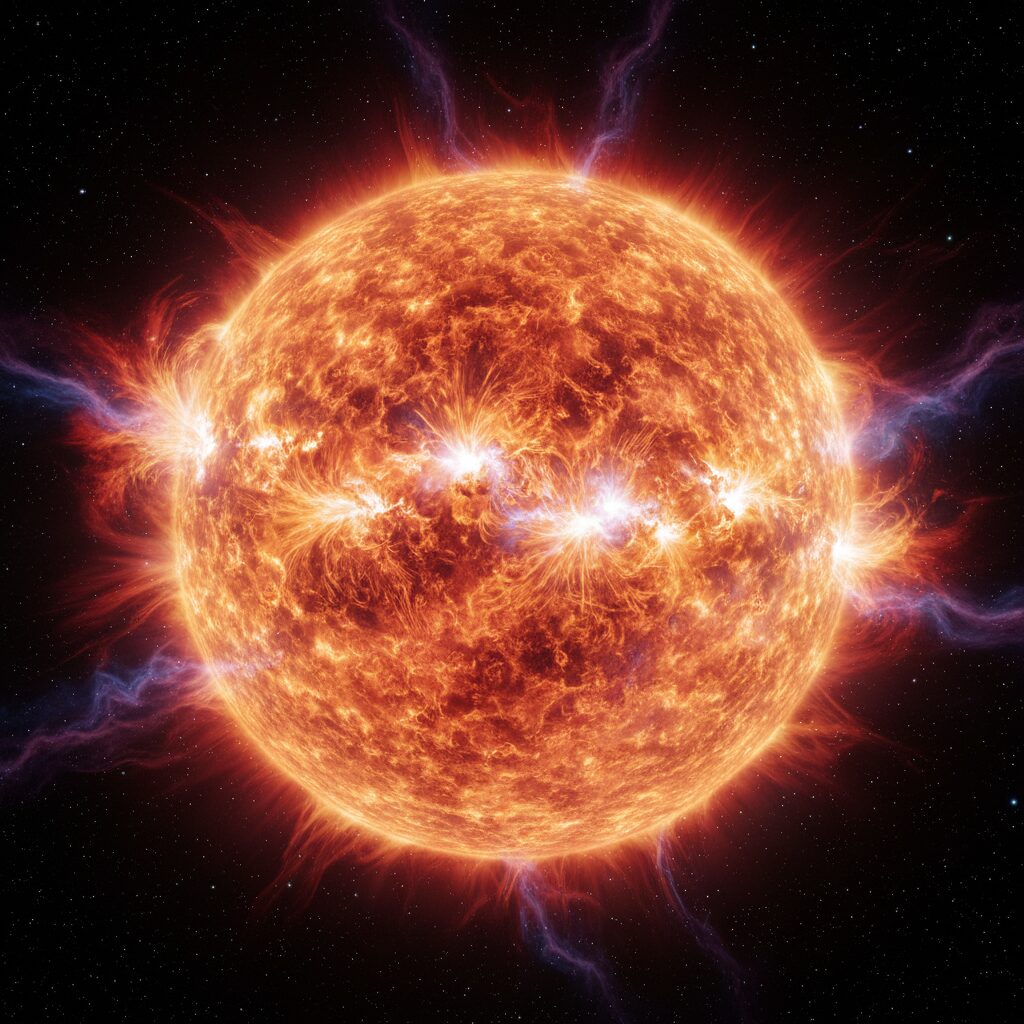
Stars, those majestic celestial fireballs, have never ceased to amaze humankind for millennia. Yet, behind their seemingly eternal brilliance lies a fascinating scientific secret, worthy of the greatest science fiction novels – but without the aliens (sorry, fans). How on earth do these celestial bodies manage to emit such intense and long-lasting light, sometimes for billions of years? Far from being a simple cosmic firework display, their brilliance relies on a subtle mechanism that combines thermonuclear reactions with invisible forces like gravity. Through this slightly offbeat article, somewhere between quantum physics and astrophysics, let’s decipher this luminous enigma, perfect for impressing at parties and wowing everyone with anecdotes as useless as they are dazzling!
Because yes, when we watch a star twinkle in the night sky, behind this spectacle lies a true story of balance and stellar energy, where hydrogen plays the leading role as a cosmic actor, transformed into helium by the magic (or rather, the science) of nuclear fusion. No time to fall asleep, there’s plenty to learn and laugh about without succumbing to scientific boredom.
How does nuclear fusion keep stars shining?
Let’s start with nuclear fusion: this phenomenon is the key to understanding why stars stay lit for so long. Imagine a huge ball of gas, primarily hydrogen, compressed by gravity to the point where the temperature rises to several million degrees at the star’s core. It’s not a hot water bottle; it’s more like hell on steroids!
Under these extreme conditions, hydrogen nuclei no longer simply coexist peacefully; they fuse to form helium. In fusing, they lose a tiny percentage of mass—tiny, but enormous in terms of energy: this is the Einstein effect in action (E=mc²), releasing a phenomenal amount of energy into space. This energy is what makes stars shine; it’s their atomic battery, their infinite generator!
- But be warned, this fusion doesn’t happen haphazardly or anywhere in the star. It requires incredible temperature and pressure, caused by the force of gravity that crushes the ball of gas in on itself. This race to the millionth of a millimeter, producing thermonuclear reactions, is what keeps stars alive for billions of years; otherwise, it would be a cosmic firework display that would extinguish itself in the blink of an eye. To give you an idea: the Sun, our old local star, has been consuming its hydrogen very efficiently for about 4.6 billion years, and it’s predicted to continue radiating like this for a little over 5 billion years. The secret? It only converts a tiny fraction of its hydrogen at a time, making the reserve practically inexhaustible on a human timescale.🔥 A star is primarily composed of
- hydrogen and helium
- . ⏳ The lifespan of a star depends on its mass: the larger the star, the shorter its lifespan because of faster fusion.
- 🌌 Nuclear fusion transforms hydrogen into helium, releasing a gigantic amount ofstellar
energy.
Ces articles devraient vous plaire
How does gravity stop the rain from falling endlessly?
Imagine rain as an army of tiny water droplets launched into a dizzying ballet orchestrated by nature. They evaporate from the oceans, condense into clouds, and then, whoosh, tumble to the ground. But wait a…
⚖️ Gravity
maintains this balance, called hydrostatic
equilibrium, between inward pressure and outward energy.
Incredible, isn’t it? This delicate interplay between nuclear fusion and gravity is precisely why stars don’t suddenly burn out but shine for so long, in a stable and sustained way.
Discover the astrophysical phenomena that allow stars to shine for billions of years and the mechanisms behind their exceptional lifespan.
| Why do the most massive stars have such incredibly long lifespans? Still tend to confuse mass and efficiency? Let’s debunk some stellar stereotypes. Is a star’s mass the key factor that determines its brightness? Yes. Its lifespan? Absolutely, but in a completely counterintuitive way! The most massive stars are veritable gluttons: they burn their fuel (hydrogen) at a frenetic pace, which makes them shine with an impressive but ephemeral cosmic fireworks display. Meanwhile, smaller stars, like red dwarfs, can shine quietly but steadily… for tens or even hundreds of billions of years, no less! | In practical terms, a star’s power depends not only on its volume but also on the pressure and temperature at its core, which increase exponentially with mass. A star 10 times more massive than the Sun could therefore shine millions of times brighter, but it will expel its hydrogen reserves in record time. A kind of cosmic sprinter, burning the candle at both ends. | These behemoths often end in a breathtaking spectacle: a supernova, a gigantic explosion that illuminates the entire galaxy and disperses heavy chemical elements into space, sowing the seeds for the birth of new stars. A true cosmic Netflix series with an explosive finale. | |
|---|---|---|---|
| Star type ⭐ | Mass relative to the Sun ⚖️ | Approximate lifespan ⏳ | |
| End mode 🪦 | Red Dwarfs | 0.1 to 0.5 | 50 to 100 billion years |
| Gradual cooling, slow end | Sun (G-type stars) | 1 | 10 billion years |
Red giant, then white dwarf
Ces articles devraient vous plaire
Why do apples turn brown once they are cut?
Admit it, it’s frustrating: you take a beautiful, fresh apple, carefully slice it, and suddenly it’s browning faster than expected—and on your apple, no less. No need for sunscreen; this browning is automatic, inevitable, and…
10 to 50+
A few million years
Supernova, neutron star, or black hole
In short: the bigger it is, the faster it heats up, but the faster it burns out. It’s a cosmic law that doesn’t forgive impatience!
- https://www.youtube.com/watch?v=fou_v4TL9MIWhy do stars twinkle (well, not really)?
- Okay, here we’re debunking a myth – stars don’t actually twinkle. This twinkling is just a super annoying thing caused by our Earth’s atmosphere acting as a spoilsport. Starlight, once it embarks on its interstellar journey, arrives perfectly stable at the edge of our atmosphere. But then, in the heart of the gaseous chaos of the troposphere, it is distorted, making the star’s image dance like a reflection in a puddle stirred by the wind.
Ces articles devraient vous plaire
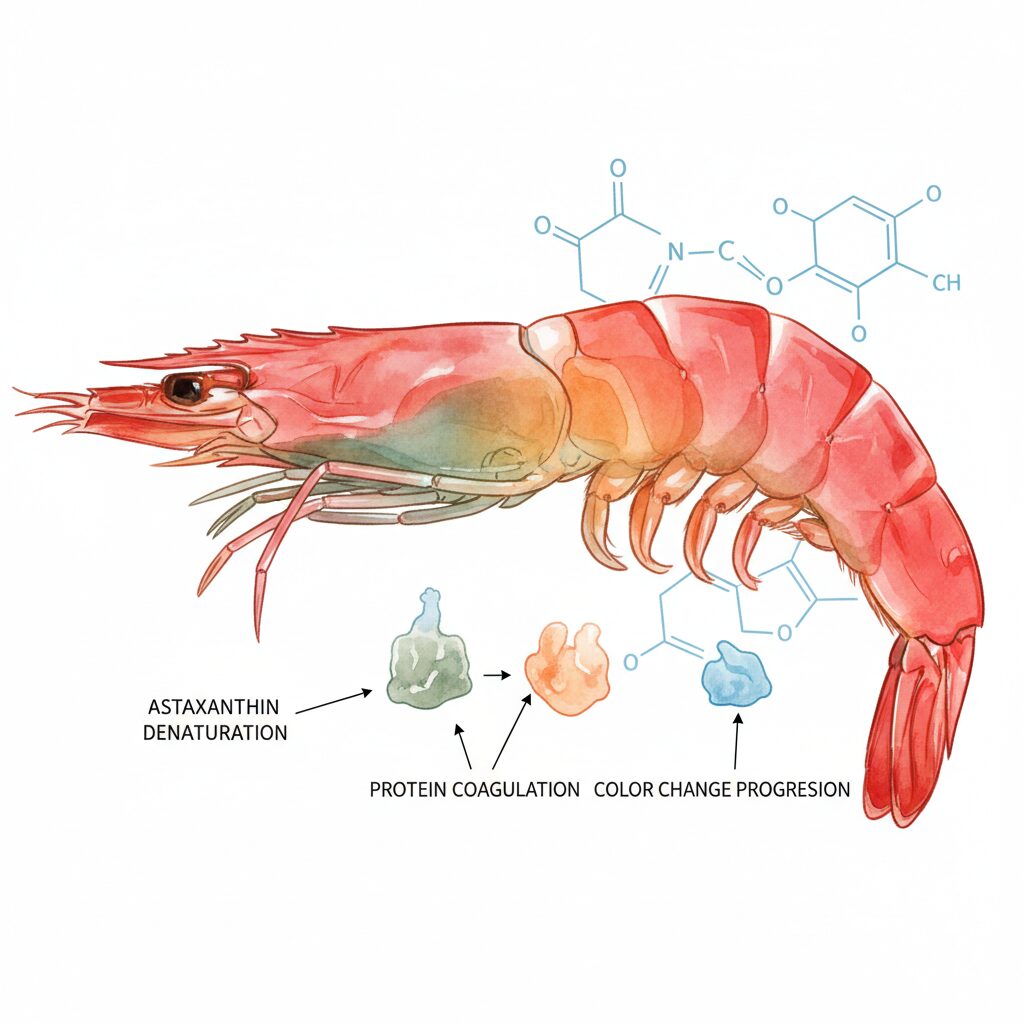
Why do shrimp change color when cooked?
Shrimp and shellfish in general have this magical ability to transform from a dreary gray to a vibrant pink as soon as they encounter a little heat. It’s the kind of thing that fascinates everyone,…
But this twinkling phenomenon is, in a way, useful, because it allows our human eyes to appreciate the fragility of the night sky. The next time you look at the sky, think of these invisible fluctuations, a luminous ballet perfectly orchestrated by atmospheric turbulence.
🌬️ Twinkling is caused by atmospheric turbulence, not by the star itself. 👁️🗨️ This phenomenon distorts the path of light, creating a “flickering” effect.
🚀 Outside the atmosphere, stars shine steadily. https://www.youtube.com/watch?v=CDy6kEEClK0 How does gravity maintain the balance and brightness of stars?
For a star to shine brightly for a long time without going haywire, it must find a delicate balance between two opposing forces. On one hand, gravity pulls everything inward, trying to crush this ball of gas into a compact mass (we’re not talking about a new pâté recipe). On the other hand, the enormous pressure generated by thermonuclear reactions pushes matter outward. This is what we call hydrostatic equilibrium, this perfect cosmic boxing match where every blow forces a response. If nuclear fusion slows down, gravity takes over, compressing the core even more, which heats everything up again to restart fusion. And if, on the contrary, gravity weakens, the pressure causes the star to expand, lowering the central temperature and slowing down fusion.
Ces articles devraient vous plaire

How does flour transform dough into a delicious cake?
Ah, flour! That little white cloud that finds its way into almost every kitchen and works wonders. But how is it that this simple powder transforms, under the influence of baking and its exceptional partners…
This self-regulating mechanism is what stabilizes a star’s brightness for billions of years; without it, it would either explode or collapse without mercy. Like a sophisticated cosmic thermostat, gravity and nuclear fusion are in constant dialogue to maintain the star’s life. This struggle for balance explains why celestial bodies as massive as some supermassive black holes are not stars—because they do not produce thermal energy through nuclear fusion. Their gravity is limitless, there is no outward pressure, so the party’s over in eternal light mode.
What do stars teach us about our place in the universe? By scrutinizing these cool or hot giants and studying their evolution of lifespan. We are beginning to grasp profound truths not only about the Universe but about our very origin. Every star at the end of its life disperses its heavy elements into space, elements produced by thermonuclear reactions, elements from which our own bodies are made. Yes, you can thank those millions of stellar storms for being here.Understanding how stars manage to shine for so long encourages us to respect this virtuous cycle, where energy transformation reigns supreme, and where natural laws like gravity orchestrate a fascinating balance.
- 🌟 The life of stars is a continuously renewed cycle of energy and matter.
- 💫 Their brightness informs us about fundamental physical forces. 🌍 They remind us of our cosmic connection to the universe and even to the
living world on Earth.
How does nuclear fusion produce energy in a star?
Nuclear fusion in a star involves combining light nuclei, such as hydrogen, to form heavier nuclei, such as helium. This transformation releases a large amount of energy in the form of light and heat, allowing the star to shine.
Why do massive stars have shorter lifespans?
Massive stars burn their nuclear fuel much faster than smaller stars, causing them to burn out and die much more quickly, often exploding as supernovae.
What is hydrostatic equilibrium in a star?
It is the balance between gravity, which attracts matter towards the center of the star, and the energy pressure due to nuclear fusion, which pushes matter outwards. This balance maintains the star’s stability and brightness.
Do stars actually twinkle?